
The Chinese automotive industry continues to accelerate forward. Over the next decade, the sector is likely to undergo changes far more profound than those witnessed in the past century.
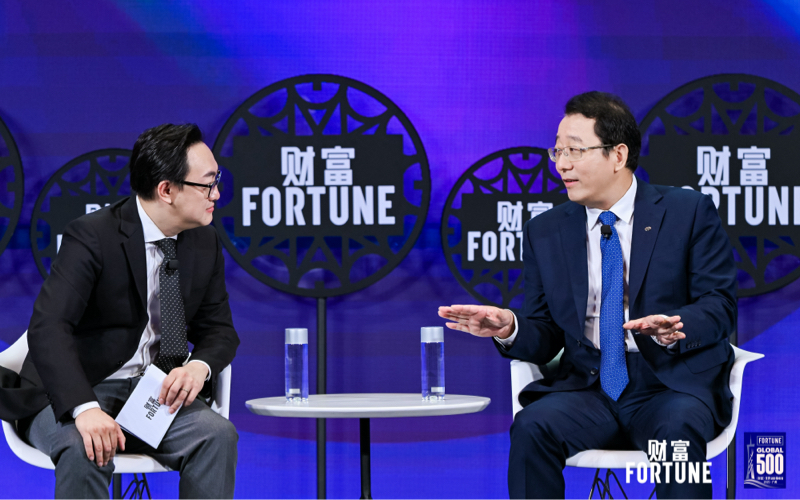
On September 25, at the 2025 Fortune Global 500 Forum, Feng Xingya, chairman of Guangzhou Automobile Group Co., Ltd. (GAC Group), shared his thoughts on the current state of the industry and his vision for its future development.
Feng stated that the automotive industry is currently in a period of four overlapping phases: a phase of industrial transformation, rapid technological iteration, internal management model restructuring, and reshaping of the competitive landscape.
Currently, domestic automotive brands are locked in intense competition, with several brands having already exited the market over the past two years. Discussions about which automakers will ultimately survive are rampant.
Feng, however, is considerably more optimistic. He believes that in 10 years, at least three, or even three to five, of the world’s top 10 automakers will be Chinese companies. “It’s not a question of whether three to five can survive but that three to five will be among the global top ten,” he said.
This optimism stems from the Chinese automotive industry’s successful bet on green and smart technologies. He analyzed, “The future development model of the industry will inevitably move toward new energy, low carbon, and greenization, and China is at the forefront in this aspect.” He added, “Simultaneously, automobiles will definitely develop toward intelligence. It would be an exaggeration to say China has an absolute lead in this regard, but it is currently at an advanced level globally. Furthermore, Chinese consumers have the highest demand and enthusiasm for intelligent features in the world.”
“As long as the trend remains unchanged, I believe many Chinese companies will become globalized enterprises in the next 10 years,” said Feng.
In the era of traditional internal combustion engine vehicles, companies could not simply purchase engines from third parties. However, in the new energy era, companies can source batteries externally. This change in power source has significantly lowered the barrier to entry, with competitors flooding in from all directions.
Feng stated that the capabilities required of automakers today are different from before, including user insight and product definition capabilities, vehicle integration capabilities, intelligent capabilities, and marketing capabilities. “The technical threshold has indeed been lowered, but there are still conditions for entering the industry. Companies need to possess one or several of these new capabilities. Without a distinct advantage, car manufacturing is still far from easy,” he remarked.
Facing the challenges posed by technology companies crossing over into the automotive sector, Feng, as a leader of a traditional automaker, stated that when building a company’s core moat, it must possess both a “spear and a shield.” The offensive “spear” is technological innovation, addressing shortcomings in intelligence through cooperation as quickly as possible. The defensive “shield” is the quality and safety assurance, an area where traditional automakers excel.
He noted that while intelligent features indeed satisfy consumers’ pursuit of novelty, a significant potential risk is the neglect of safety issues, which can backfire on companies. “A car is like a tiger—driving is like riding on its back. Quality and safety are extremely important,” Feng emphasized.
Feng pointed out that as the automotive industry has developed, the consumer base has become highly segmented. There are those who prioritize practical functional value and those who seek emotional value. However, automakers focusing excessively on providing emotional value might harbor hidden risks.
“We often say that when approaching a traffic light, one should slow down, look twice, and then proceed. This doesn’t require high acceleration performance. In the era of internal combustion engines, a luxury car accelerating from 0 to 100 km/h in eight seconds was considered very advanced. Now, new energy models easily achieve 0 to 100 km/h in five seconds. This can easily lead to accidents,” he said.
Note: This content was created by Guangzhou Automobile Group Co., Ltd.