
As AI takes on a larger role in gaming and content creation, GIGABYTE is designing it to feel more human, adaptable, and intuitive.
AI is becoming more deeply integrated into gaming and creative workflows, growing faster and smarter with each iteration. But that progress brings new questions about the role this software should take. When AI begins to anticipate too much or intervene too often, it can disrupt focus and shift agency away from the person at the keyboard.
For gamers and creators, that matters. Rather than software that takes over, they’re looking for something closer to a partner—AI that understands context, responds to intent, and knows when to step aside. At its best, this kind of technology supports one of the most human needs in digital work and play: a sense of companionship.
It’s the idea center of GIGABYTE’s approach to AI innovation. “AI should feel present but never intrusive, capable of assisting perception, execution, and optimization while remaining subordinate to human judgment,” says GIGABYTE Group CEO Eddie Lin. “This model reflects how gamers and creators actually work today, valuing autonomy, control, and trust over automated decision-making.” Meanwhile, GIGABYTE cements this trust via local AI, ensuring privacy, data security, and zero-latency performance that keeps pace with human thought.
User empowerment woven in
GIGABYTE’s emphasis on user empowerment isn’t something tacked on late in the development process. Instead, it’s built into the company’s AI strategy from the outset when core assumptions are made about how a system should behave and who ultimately remains in control. “It was a company-wide decision,” says Lin, “to treat AI participation as a mutual choice between the user and the system rather than a default behavior users have to work around.”
This distinction is key in gaming and creative environments, where timing, attention, and momentum are vital. An AI system that intervenes mid-match to adjust performance—or that interrupts a creator mid-edit with suggestions—can quickly disrupt focus. Even well-intentioned optimization, such as reallocating compute resources or altering visual output, can undermine flow when it occurs unprompted.
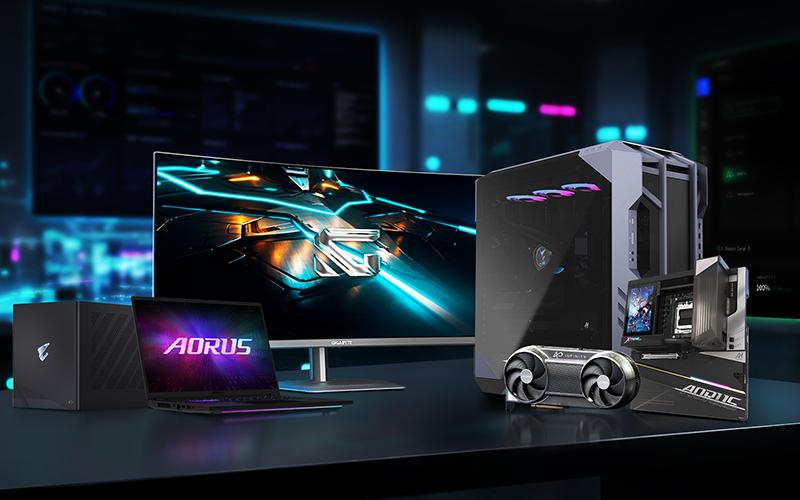
GIGABYTE’s vision transcends individual hardware; it is a holistic AI ecosystem that unifies AI gaming laptops, motherboards, graphics cards, OLED monitors, and the AI TOP System through seamless software-hardware integration under a human-centered philosophy. “By embedding restraint into the system architecture, AI behavior remains intentional, predictable, and easy to disengage,” says Lin. “This approach transforms AI from an always-on tool into a trusted partner that respects user choice and operates only within clearly defined boundaries.”
“By embedding restraint into the system architecture, AI behavior remains intentional, predictable, and easy to disengage,” says Lin.
Parameters that keep users in charge
These boundaries, designed to limit the risk of AI intrusion, take two central forms: first, the system requires users to engage AI explicitly when help is needed, and second, the system performs differently depending on the task at hand, in ways that are consistent and easy to anticipate.
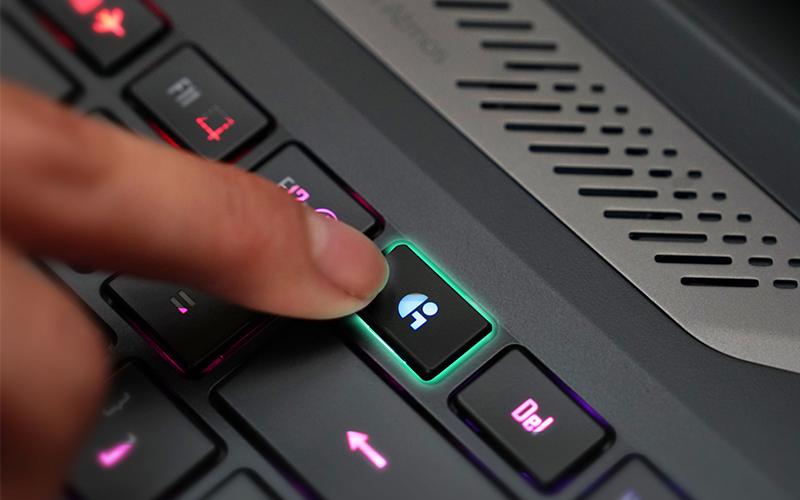
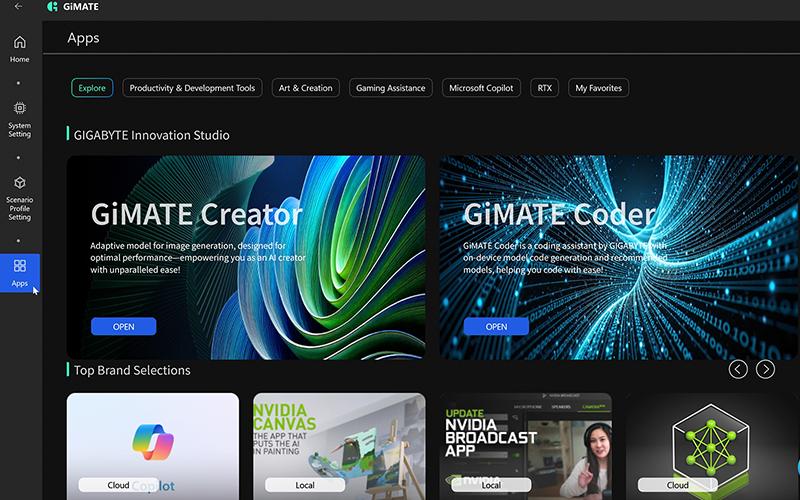
GiMATE, GIGABYTE’s exclusive AI agent on gaming laptops, is a prime example of the former. GiMATE turns everyday controls—performance, cooling, privacy, and productivity—into a faster, more intuitive layer you can access at a glance or with a voice prompt. The goal is to make GiMATE work like a personal agent, adapting to users’ work, play, and creation daily.
In a fluid workday, users move between high-stakes meetings and focused tasks where GiMATE assists as a responsive partner. AI Audio and AI Voice optimize acoustic clarity for professional calls and filter background noise based on the environment, while AI Privacy safeguards sensitive data by detecting unauthorized viewing to trigger timely alerts. By responding only to the user’s immediate context, GiMATE enhances productivity without the friction of constant intervention.
The same logic applies on the creative side. With GiMATE Creator and GiMATE Coder, a developer can ask for help generating or refactoring code, or a creator can invoke on-device image generation or editing support, without the system attempting to anticipate needs or interrupt an active workflow.
Where GiMATE illustrates AI as something that can be switched on and off, X3D Turbo Mode—a performance setting that lets users deliberately opt into AI-guided system tuning—shows how boundaries work at the level of modes.
Available on AORUS X870E X3D Series, the feature places the system into a precision-tuned performance state when enabled, allowing AI to optimize within clearly understood parameters. A player preparing for a competitive session, for example, can activate this mode to prioritize gaming performance and latency throughout that session. Once it’s turned off, the system returns to its baseline behavior, with no residual tuning or background intervention.
Reducing friction with an accessible, layered approach
What ultimately ties these AI constraints together is a preference for reducing friction rather than maximizing automation. GIGABYTE’s AI is designed to feel approachable on the surface, with deeper capability available only if and when users choose to engage with it. “The goal,” says Lin, “is to provide transparency while avoiding a one-size-fits-all model that treats every user and every task the same.”
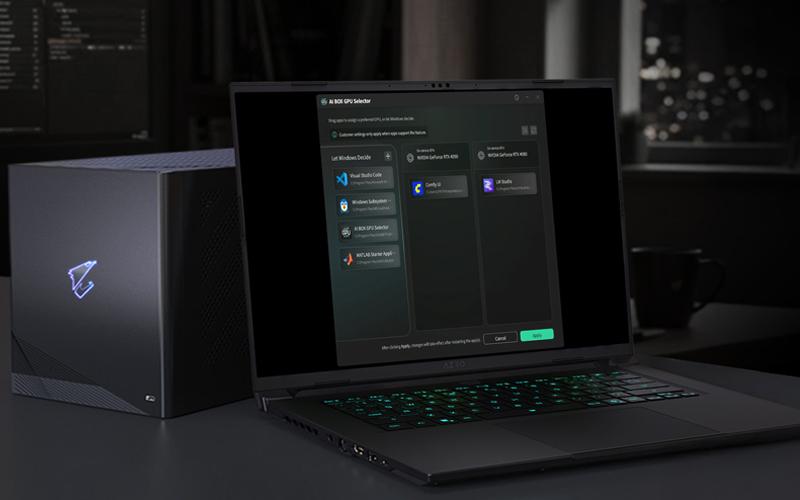
That layered approach is visible in products such as the AORUS RTX 50 Series AI BOX, an external graphics card that transforms ultrabook laptops into versatile hybrid systems for gaming, 3D rendering, and AI computing. Users can manually assign workloads to specific GPUs, allowing AI to help execute those choices, but it doesn’t set priorities on its own. Rather, it acts as a partner that preserves flexibility and performance without hiding what’s happening beneath the surface.
A similar philosophy applies to GIGABYTE’s OLED gaming monitors, in which AI Picture mode is offered through clearly defined visual modes to enhance contrast or clarity depending on what’s on screen, but it never alters game mechanics or creative output. Users select the experience they want, and the display responds predictably, without adding complexity or second-guessing their intent.
Shifting the balance
As AI capabilities deepen and real-world adoption accelerates, GIGABYTE is doubling down on its deliberate, partnership-focused strategy.
“With AI growing in sophistication, the balance should shift toward smarter guidance, not stronger control. Our method ensures AI solutions will continue on the path of companionship, adapting to users while preserving freedom, performance, and trust.”
Discover more GIGABYTE AI innovations.