
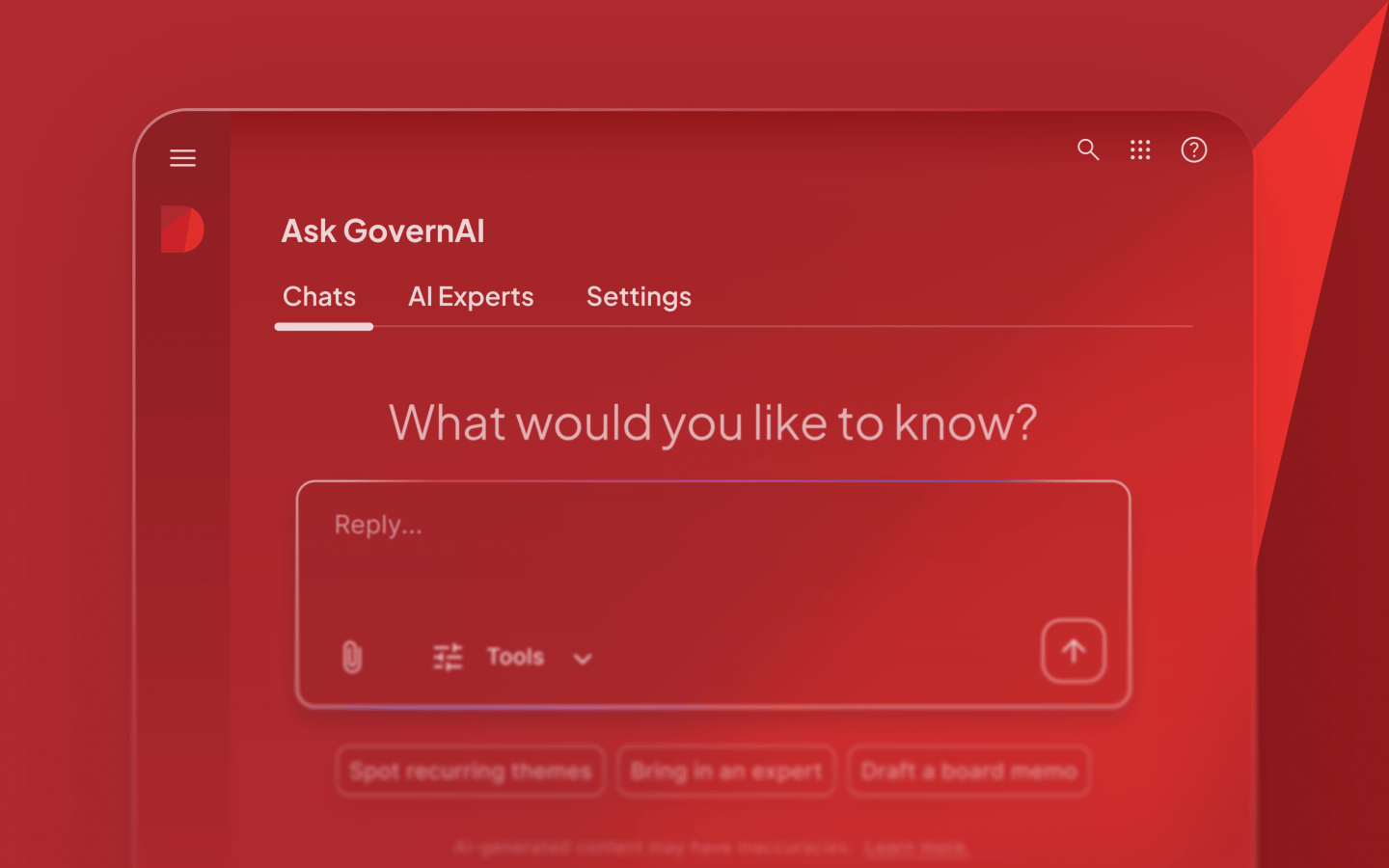
Harnessing new technology is not about handing decision-making over to machines. Diligent says it’s about helping directors prepare more effectively—with context.
Corporate directors have never been expected to know everything, but they are expected to ask the right questions.
That responsibility is becoming harder. Board agendas now routinely span cybersecurity, AI, geopolitical risk, regulatory shifts, and capital allocation, requiring directors to challenge management across issues that often fall well outside their own expertise. What was once addressed through quarterly discussions is now, in many organizations, subject to monthly check-ins and updates. These wide-ranging and increasingly frequent conversations can shape everything from corporate strategy to risk management and shareholder value.
As those expectations grow, directors are increasingly turning to AI. Not to make decisions for them, but to prepare for high-stakes meetings. Rather than replacing judgment, AI is helping boards build expertise, pressure-test assumptions, roleplay, uncover historical context, and arrive at meetings better equipped to challenge and engage management. In doing so, the technology is reshaping how directors prepare for board meetings and how governance itself is practiced.
“With governance, using AI for efficiency is not the point,” says Brian Stafford, president and CEO, Diligent. “It’s about effectiveness—bringing the right context and AI powered insights together so directors can provide the right oversight in an even faster moving world.”
How directors are putting AI to work
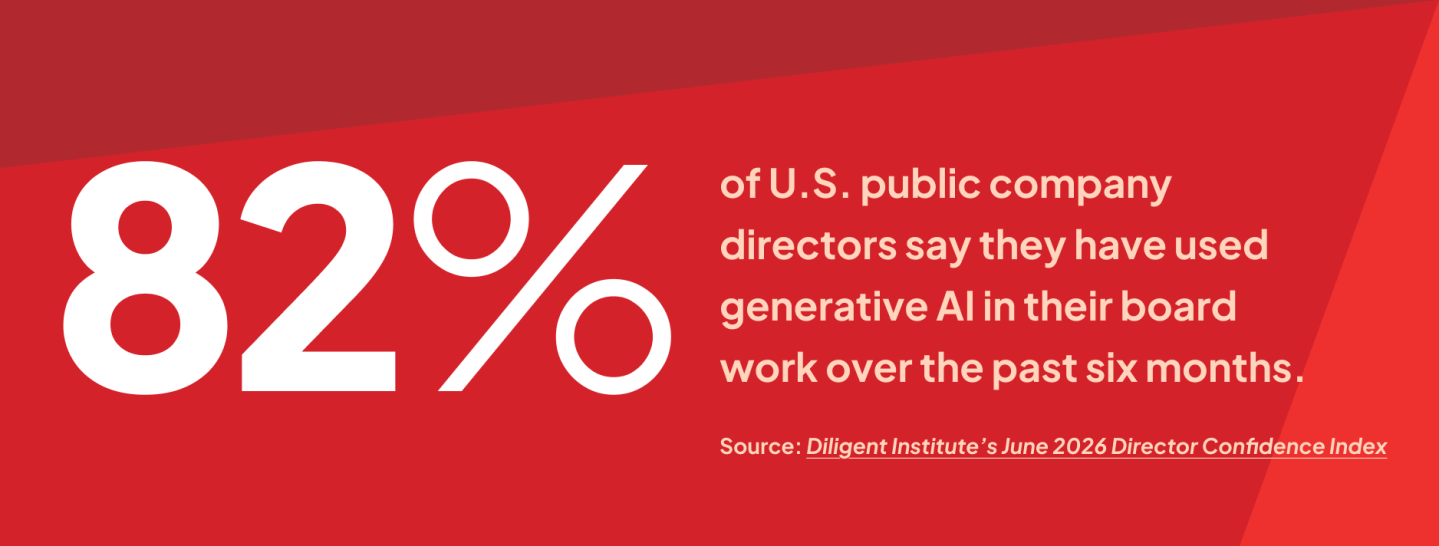
According to Diligent Institute’s recent Director Confidence Index, 82% of U.S. public company directors say they have used generative AI in their board work over the past six months, up from 66% in September 2025. Despite this, only 6% say their organization has a formal policy specific to board use of AI.
Furthermore, nearly one-half of respondents say they use AI to learn about unfamiliar topics and prepare for board or committee discussions. Others are using it to benchmark peers, competitors, and market trends, summarize board books and meeting materials, and draft questions for management before meetings.
For Dottie Schindlinger, executive director of the Diligent Institute, those findings suggest directors aren’t looking for AI to make decisions for them. Rather than replacing directors’ judgment, AI is becoming a research and preparation tool that helps boards engage more thoughtfully with complex issues before they enter the boardroom.
“Board directors want to be enhanced,” says Schindlinger. “They want to have more nuanced, more sophisticated, smarter questions. They want to be able to see around the corner.”
“Board directors want to be enhanced,” says Schindlinger.
Schindlinger believes those changing behaviors could ultimately reshape governance itself.
“Corporate governance hasn’t changed significantly in decades,” says Schindlinger. “We’re likely to see governance begin to evolve into something more continuous and fluid because there are technology tools in place that can surface information differently.”
Designing AI for how boards work
Diligent built agentic capabilities to enable and accelerate these emerging workflows.
Unlike general-purpose AI assistants, Diligent’s AI capabilities are purpose-built for board governance, in which directors oversee sensitive corporate information, operate under fiduciary duties, and navigate unique legal and confidentiality requirements. It combines instant recall of relevant board materials, expert perspective on boardroom topics, knowledge of the public record and market developments, and agentic intelligence—all in a single experience.
Much of that preparation begins with understanding unfamiliar subjects. A director reviewing a chief technology officer’s report, for example, can use the “ask” feature to explain technical concepts, identify issues that warrant closer attention, and suggest questions to raise with management. A compensation committee member can use it to compare proposals against peer practice and anticipate lines of shareholder scrutiny, rather than just relying on consultants. By using curated AI domain experts—including a risk and compliance specialist, board chair, cyber consultant, and more to come—a board discussing a major transaction can pressure-test the deal through different expert lenses and address potential responses before those questions arise publicly.
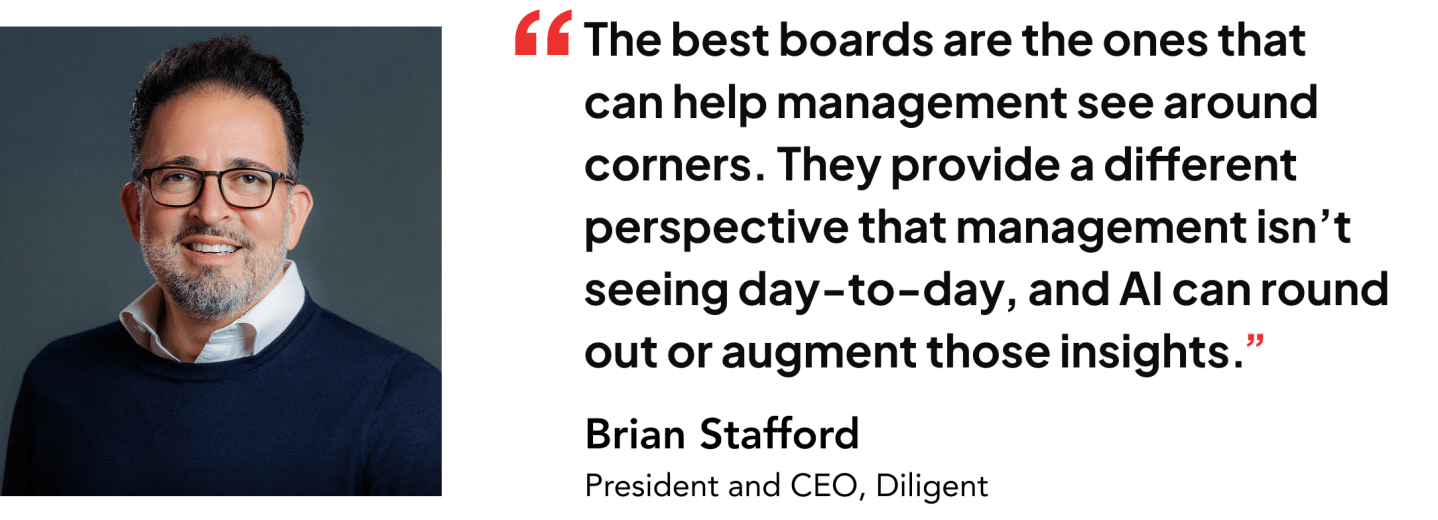
“The best boards are the ones that can help management see around corners,” says Stafford. “They provide a different perspective that management isn’t seeing day-to-day, and AI can round out or augment those insights.”
Integrating AI into existing board work
As of Oct. 2026, the agentic board assistant previously only available to early adopters is now integrated into Diligent Boards—the company’s market-leading board management software trusted by more than 80% of the Fortune 500 and 85% of the FTSE 100, according to the company. Stafford says this integration will allow the tool to retrieve precise, cited information from across board materials and institutional knowledge in real time, with no manual upload required.
“Directors can ask questions of their own materials and get cited answers grounded in governance history, expert insight, and market context. And they can do all of that inside the same secure governance environment they already know and trust,” says Stafford. “By bringing that intelligence directly into the boardroom workflow, we’re making governance-grade AI part of the tools directors already use, rather than another system they have to manage.”
Directors can use the feature alongside the existing suite of AI capabilities in Diligent Boards, including an AI-powered board book builder, board summarization tool, meeting minute creation tool, industry news tracker, and risk scanner.
Connecting past decisions to future discussions
Because board oversight unfolds over months or years, Diligent’s AI can analyze troves of board materials to identify when an issue was previously discussed, trace how it evolved, and provide historical context. That kind of institutional knowledge can be especially useful when directors serve on multiple boards, when committee work spans long time horizons, or when a new issue turns out to have roots in an older discussion.
Security and control are central to any discussion about AI in the boardroom. Directors routinely deal with highly sensitive materials, from acquisition plans to executive performance and legal risk, so any tool introduced into that environment must work within strict information boundaries.
Stafford says Diligent’s AI is built with those constraints in mind. The system is designed to work within the sharing and permission settings a company already has in place inside Diligent Boards, including who can access specific board books, committee materials, minutes, resolutions, and other governance documents, so responses are limited to the materials a director is authorized to see. It also includes administrative controls around retention and deletion, allowing organizations to decide whether prompts are kept or removed after meetings.
“Strong guardrails shouldn’t come at the expense of innovation,” says Schindlinger. “Instead, they should enable organizations to move faster with greater confidence.”
For Stafford, AI’s biggest opportunity lies in expanding the range of expertise it can bring into the boardroom. As directors grapple with increasingly complex risks, AI is giving them another tool to prepare, probe, and govern more effectively. “It’s not about trying to do the jobs of the board members,” says Stafford. “AI works to make the role and input from of the board member richer, more current, and adds important nuance.”