
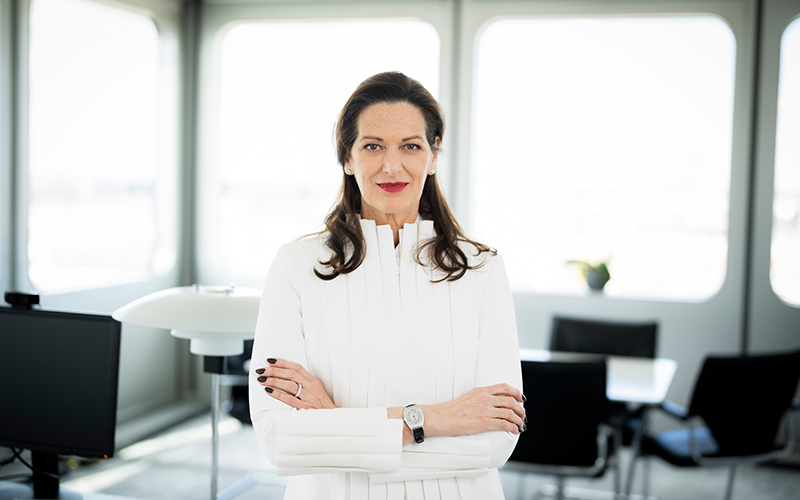
The company’s working model helps deliver better patient outcomes more efficiently, says Christine Roth, Bayer’s executive vice president of global product strategy and commercialization.
Traditional global pharmaceutical companies are built for control: layered governance, functional silos, and annual budget cycles designed to manage risk at scale. Yet in today’s environment—where science evolves quickly, regulatory pathways shift, and patient expectations are rising—those same structures can start to work against us. Decisions take longer than they should. Ownership becomes harder to pin down. Resources stay locked in place even when priorities clearly move.
Many leaders will recognize the feeling: Talented teams are doing the right things, but progress is still slower—and heavier—than expected.
The challenge is no longer about incremental improvement. It’s about rethinking how work actually gets done—how to preserve scientific rigor and compliance while enabling the speed, focus, and accountability more often associated with smaller biotech environments. This is the problem Bayer set out to solve with its Dynamic Shared Ownership (DSO) model.
DSO is not a reorganization; it is a different way of operating. It replaces fixed budgets and functional silos with empowered product- and customer-centric teams that can access shared resources as needs evolve. Instead of optimizing within functions, teams are accountable for outcomes. Talent and capital move to where they create the most value—when they are needed, not months later.
It is also important to be clear about what DSO is not. It is not a traditional matrix. Matrix organizations were designed to improve collaboration across functions, but many leaders have experienced the reality: dual reporting lines, competing priorities, and time spent aligning rather than acting.
DSO acknowledges that complex work still requires multiple disciplines—but it changes how that collaboration happens. At Bayer, this is described as a “network of entrepreneurial teams”: small, empowered groups aligned to a product or customer, connected by shared outcomes rather than layered reporting lines. The work still cuts across functions, but the experience is simpler. Decisions feel closer. Accountability is clearer. Progress is faster.
The impact is already visible. Bayer has removed unnecessary management layers and redeployed capital to higher-value projects. But the more meaningful shift is how work feels inside the organization. There is a clearer connection between decisions and outcomes—between what teams do and the difference it makes for patients.
Bayer has removed unnecessary management layers and redeployed capital to higher-value projects.
This model turns the traditional management pyramid on its head. Decision-making moves closer to the people who understand the science, the market, and the patient context best. Instead of navigating multiple layers of approval, teams operate with real autonomy within clear guardrails. Over time, the organization starts to feel less like a hierarchy and more like a connected network:
- Customer-centric: Solutions shaped by real-world health care settings
- Agile: The ability to respond as regulatory and market conditions evolve
- Accountable: A shared mindset of ownership—where individuals ask, “How does this move the product forward?”
In practice, these shifts show up in moments that matter. Most decisions are now made without senior leadership intervention, enabling faster regulatory filings and contributing to multiple U.S. FDA approvals in 2025. More importantly, patients are gaining access to new treatments sooner.
One oncology program illustrates the difference. Initially focused on one patient population, early data pointed to a more promising subgroup. In a traditional or matrix environment, that pivot might have taken months of alignment across functions. Under DSO, a small team made the call quickly and moved directly to Phase III, shortening development timelines by nearly two years. For the team involved, it was a moment where the system worked the way they always felt it should.
The same pattern is visible in commercialization. Teams supporting a women’s health therapy adjusted their approach in real time, rather than waiting for the next planning cycle. In cardiovascular medicine, decentralized market entry strategies contributed to nearly 80% growth in one year. In each case, the difference was not a single decision, but the ability to make many decisions—quickly, clearly, and with ownership.
At the core of DSO is a redefinition of leadership. We’ve roughly halved the number of layers. And we’ve reoriented the focus of the company—from administering to doing—by cutting management by two-thirds. Rather than primarily directing work, leaders operate as VACC leaders: visionaries, architects, catalysts, and coaches. Many now support broader groups, spending less time on oversight and more time enabling others to succeed.
This shift is reinforced by a new rhythm of work. Annual planning cycles have been replaced with rolling 90-day horizons, making it possible to reallocate resources quickly as new information emerges. Teams test, learn, and adapt continuously—moving funding and effort in weeks rather than years.
For leaders across pharmaceutical and biotech organizations, the distinction is practical. Matrix structures try to manage complexity by adding coordination. DSO addresses it by simplifying ownership. It preserves the benefits of cross-functional expertise while reducing the ambiguity that often slows teams down.
Two years into the transformation, one of the most noticeable changes at Bayer is cultural. People are stepping forward more readily, taking ownership, and bringing forward ideas that might previously have stalled. There is a different kind of energy—one that comes from feeling trusted and accountable at the same time.
The result is an organization that feels different to work in: faster, more connected, and more focused on what ultimately matters—delivering better outcomes for patients.
For many leaders, the question this raises is a simple one: If the barriers experienced every day are structural, not individual, what would change if those structures were redesigned?
Note: This content was created by Bayer.