• Home
  • Latest
  • Fortune 500
  • Finance
  • Tech
  • Leadership
  • Lifestyle
  • Rankings
  • Multimedia
CommentaryRobotics

Beyond the humanoid hype: Why specialized robots will dominate the next decade

By
Romain Moulin
Romain Moulin
Down Arrow Button Icon
By
Romain Moulin
Romain Moulin
Down Arrow Button Icon
May 6, 2025, 7:46 AM ET

Romain Moulin is CEO and cofounder of Exotec.

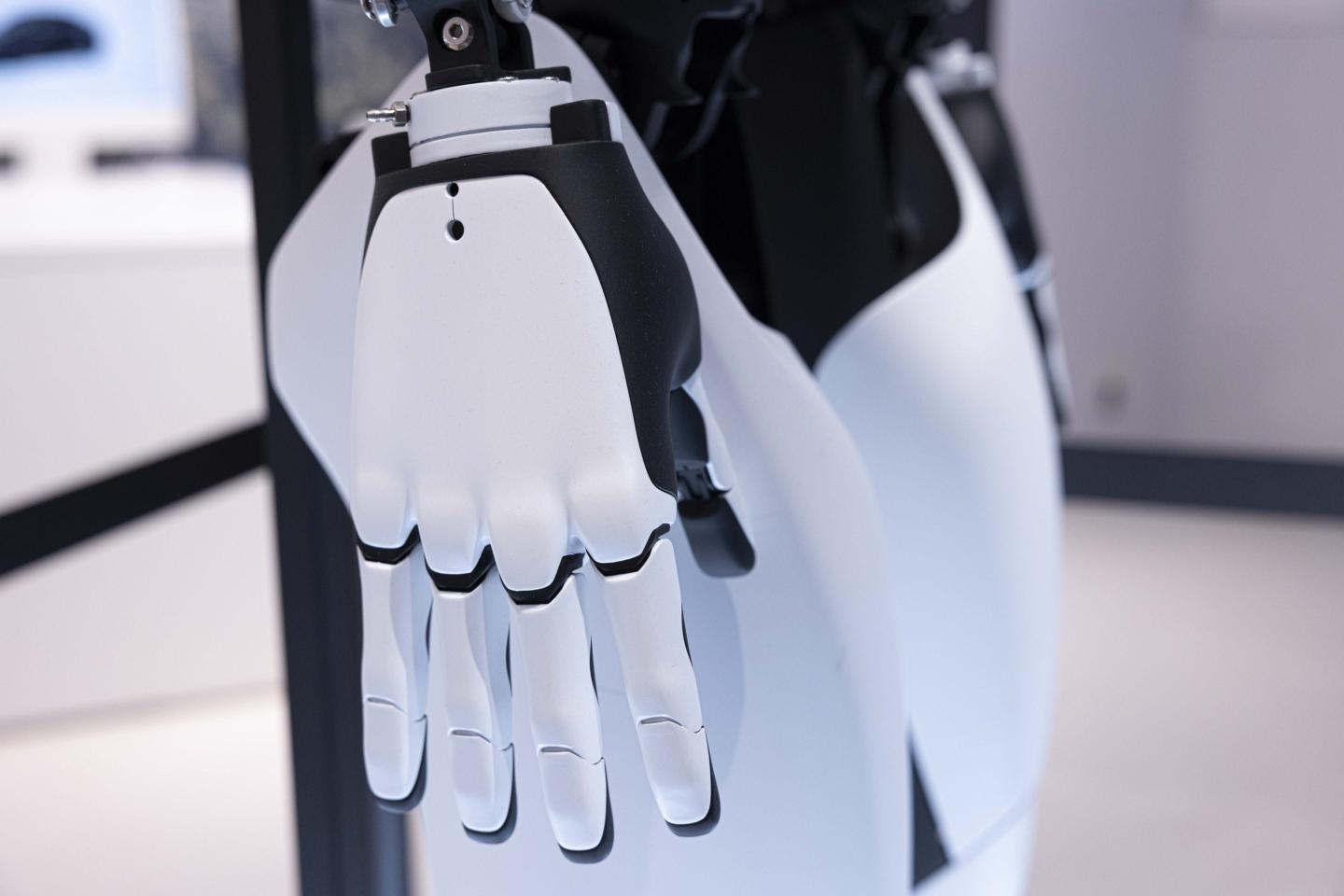
The hand of a Tesla Optimus humanoid robot displayed at a pop-up store in Tokyo last month.
The hand of a Tesla Optimus humanoid robot displayed at a pop-up store in Tokyo last month.Stanislav Kogiku/SOPA Images/LightRocket via Getty Images

Humanoid robots are catnip for the imagination. They dazzle at tech shows, mimicking our moves with eerie precision. I’m deeply impressed by the innovations powering robots that walk, talk, and gesture like us. They represent significant technological breakthroughs that herald exciting applications ahead.

But here’s the truth: They’re the wrong tool for most industrial applications today, especially in some of the biggest markets, and in particular the $11 trillion supply chain.

Several humanoid robot companies have recently rolled out offerings across everything from manufacturing to elder care. Venture capital firms are investing heavily in humanoid robots, yet actual adoption in the field is slow to nonexistent.

I’m the founder and CEO of a multibillion-dollar company that was built by rejecting this one-sized-robot-fits-all-approach, choosing instead to build, orchestrate, and scale robots that are the best at what they do. That’s because I believe the next decade of robotics will be defined by specialized, purpose-built machines rather than ones that look like us. Machine systems provide better economics and operational efficiency than generalized humanoids, despite the latter’s impressive technological advances.

You can’t fight economic natural selection

Consider a simple thought experiment: Would you rather have a humanoid robot or a dishwasher wash your dishes? This is the crux of the issue: complexity versus price. The dishwasher is faster, more efficient, and vastly more cost-effective because it’s designed specifically for one task.

In a real-life machine, each additional joint, sensor, and actuator has a price. A typical humanoid robot today is quite costly, with prices ranging between $50,000 and $250,000 each. Even with massive effect of scale, it will be a while before they reach the same cost efficiency as a $1,000 dishwasher. Repeat this for all sorts of problems to be solved: Will you harvest your field with an army of humanoids? Will you drive your driverless car with a humanoid in the front seat?

When Morgan Stanley estimated that Amazon’s warehouse robotics alone are projected to yield $10 billion in annual savings by 2030, they weren’t talking about humanoids. They were referring to specialized machines that excel at discrete tasks: moving inventory, sorting packages, and optimizing space.

Today’s most successful automation solutions don’t try to replicate humans; they reimagine processes from first principles.

Contrast this with a humanoid robot such as Tesla’s Optimus, which might be tasked with fetching items in a warehouse. Consider what happens if Tesla reaches the holy grail of humanoid robotics: being as fast, as autonomous, as agile, and less expensive than a human operator. Then what would one do to further improve performance? Use the specialized robots to speed up the humanoid robots?

The lesson is clear: Automation excels not by imitating humans but by reengineering processes to maximize performance at the lowest cost.

When might humanoid robots make sense?

In unstructured environments where tasks vary wildly and space is designed for human bodies, jack-of-all-trades humanoids have merit if costs drop dramatically and capabilities improve exponentially—all of which are quite possible and even likely in the years ahead. Advances in specialized robots often find their way into humanoids as motors and sensors are deployed in ever larger numbers.

For instance, advancements in vision-based picking, as seen in systems like Boston Dynamics’ Stretch, enable robots to handle complex warehouse tasks with precision, adapting to varied objects in real time. These capabilities are now informing humanoid designs, enhancing their ability to navigate and manipulate environments.

For humanoids, applications inside the home may make sense, as well as any place where legs are more valuable than speedy wheels—like tight environments where terrain is unpredictable. Several humanoid robot companies have announced in-home trials before the end of 2025, hinting at this potential.

Similarly, medical wearables are seeing progress. Robotic exosuits from companies like Ekso Bionics integrate humanoid-inspired actuation and sensor technology to aid mobility for patients, pushing the boundaries of human-robot interaction. These use cases drive economies of scale for components, propelling the broader robotics ecosystem forward.

But supply chain operations are the opposite of this scenario, and the constraints aren’t forgiving. They’re highly structured environments where tasks are predictable and repetitive. The economics of purpose-built systems will always win in these scenarios, which is why Amazon, after acquiring Kiva Systems (now Amazon Robotics) for $775 million in 2012, doubled down on specialized robotics rather than pursuing the humanoid path.

Return on robotics: the new ROI

I am optimistic that humanoids’ dramatic price drop and performance upgrade will happen over the next decade and will add incredible dimensions to human life—and finally help me to stop folding laundry.

Until then, businesses serving customers and investors must drill into their return-on-robotics investment. In warehouse automation, it comes down to critical operational performance: speed, volume, and precision of inventory retrieval, all weighed against the cost of the robot and ongoing operational costs. That demands robots honed for the job—and meeting today’s high bar for performance. Today, most purpose-built robotics companies promise payback in five years or so—an impressive start for a nascent industry that will only improve.

Moreover, the market continues to grow rapidly. As McKinsey notes, some experts foresee robot shipments growing by 50% per year, with warehouse automation growing north of 10%. Businesses simply can’t wait for robots; they need them now and in the near future to overcome the global labor crunch and stay ahead of rigorous customer expectations.

Humanoids inspire awe. Yet I believe the next 10 years will be ruled by purpose-built robots solving hard problems with lean solutions that maximize productivity from every inch of operations and pay for themselves many times over.

For now, don’t bet on robots that mimic your walk—invest in ones that run your business better.

The opinions expressed in Fortune.com commentary pieces are solely the views of their authors and do not necessarily reflect the opinions and beliefs of Fortune.

Read more:

  • Meet the growing army of Amazon robots working alongside humans to reduce workplace injuries
  • Gecko Robotics CEO: How I bucked Silicon Valley’s monopoly on frontier tech
  • Some manufacturing jobs will return to America only if AI robots do them—and that’s a good thing
  • Elon Musk claims Tesla is the top robot company but worries that Nos. 2 through 10 will be Chinese
Join us at the Fortune Workplace Innovation Summit May 19–20, 2026, in Atlanta. The next era of workplace innovation is here—and the old playbook is being rewritten. At this exclusive, high-energy event, the world’s most innovative leaders will convene to explore how AI, humanity, and strategy converge to redefine, again, the future of work. Register now.
About the Author
By Romain Moulin
See full bioRight Arrow Button Icon

Latest in Commentary

Finance
Lorem ipsum dolor sit amet, consectetur adipiscing elit, sed do eiusmod tempor incididunt ut labore et dolore magna aliqua. Ut enim ad minim veniam
By Fortune Editors
October 20, 2025
Finance
Lorem ipsum dolor sit amet, consectetur adipiscing elit, sed do eiusmod tempor incididunt ut labore et dolore magna aliqua. Ut enim ad minim veniam
By Fortune Editors
October 20, 2025
Finance
Lorem ipsum dolor sit amet, consectetur adipiscing elit, sed do eiusmod tempor incididunt ut labore et dolore magna aliqua. Ut enim ad minim veniam
By Fortune Editors
October 20, 2025
Finance
Lorem ipsum dolor sit amet, consectetur adipiscing elit, sed do eiusmod tempor incididunt ut labore et dolore magna aliqua. Ut enim ad minim veniam
By Fortune Editors
October 20, 2025
Finance
Lorem ipsum dolor sit amet, consectetur adipiscing elit, sed do eiusmod tempor incididunt ut labore et dolore magna aliqua. Ut enim ad minim veniam
By Fortune Editors
October 20, 2025
Finance
Lorem ipsum dolor sit amet, consectetur adipiscing elit, sed do eiusmod tempor incididunt ut labore et dolore magna aliqua. Ut enim ad minim veniam
By Fortune Editors
October 20, 2025

Most Popular

Finance
Lorem ipsum dolor sit amet, consectetur adipiscing elit, sed do eiusmod tempor incididunt ut labore et dolore magna aliqua. Ut enim ad minim veniam
By Fortune Editors
October 20, 2025
Finance
Lorem ipsum dolor sit amet, consectetur adipiscing elit, sed do eiusmod tempor incididunt ut labore et dolore magna aliqua. Ut enim ad minim veniam
By Fortune Editors
October 20, 2025
Finance
Lorem ipsum dolor sit amet, consectetur adipiscing elit, sed do eiusmod tempor incididunt ut labore et dolore magna aliqua. Ut enim ad minim veniam
By Fortune Editors
October 20, 2025
Finance
Lorem ipsum dolor sit amet, consectetur adipiscing elit, sed do eiusmod tempor incididunt ut labore et dolore magna aliqua. Ut enim ad minim veniam
By Fortune Editors
October 20, 2025
Finance
Lorem ipsum dolor sit amet, consectetur adipiscing elit, sed do eiusmod tempor incididunt ut labore et dolore magna aliqua. Ut enim ad minim veniam
By Fortune Editors
October 20, 2025
Finance
Lorem ipsum dolor sit amet, consectetur adipiscing elit, sed do eiusmod tempor incididunt ut labore et dolore magna aliqua. Ut enim ad minim veniam
By Fortune Editors
October 20, 2025
Fortune Secondary Logo
Rankings
  • 100 Best Companies
  • Fortune 500
  • Global 500
  • Fortune 500 Europe
  • Most Powerful Women
  • World's Most Admired Companies
  • See All Rankings
  • Lists Calendar
Sections
  • Finance
  • Fortune Crypto
  • Features
  • Leadership
  • Health
  • Commentary
  • Success
  • Retail
  • Mpw
  • Tech
  • Lifestyle
  • CEO Initiative
  • Asia
  • Politics
  • Conferences
  • Europe
  • Newsletters
  • Personal Finance
  • Environment
  • Magazine
  • Education
Customer Support
  • Frequently Asked Questions
  • Customer Service Portal
  • Privacy Policy
  • Terms Of Use
  • Single Issues For Purchase
  • International Print
Commercial Services
  • Advertising
  • Fortune Brand Studio
  • Fortune Analytics
  • Fortune Conferences
  • Business Development
  • Group Subscriptions
About Us
  • About Us
  • Press Center
  • Work At Fortune
  • Terms And Conditions
  • Site Map
  • About Us
  • Press Center
  • Work At Fortune
  • Terms And Conditions
  • Site Map
  • Facebook icon
  • Twitter icon
  • LinkedIn icon
  • Instagram icon
  • Pinterest icon

Latest in Commentary

hollywood
CommentaryMarketing
I spent 20 years learning to navigate an industry. Then I built a campaign for the man who’s dismantling it
By Matti YahavApril 29, 2026
8 hours ago
aging
HealthLongevity
We’re the CEOs of Peloton and the Hospital for Special Surgery. Living longer isn’t enough, we need to live better, too
By Bryan T. Kelly and Peter SternApril 29, 2026
9 hours ago
gen z
Commentarydisruption
AI won’t kill your job — it will kill the path to your first one
By Jeffrey Sonnenfeld, Stephen Henriques, Johan Griesel, Andrew Alam-Nist and Peter YuApril 29, 2026
9 hours ago
greer
CommentaryTariffs
No, tariffs are not strengthening the economy
By Alex DuranteApril 29, 2026
10 hours ago
AI is changing who gets to be an expert. Are your colleagues ready to become ‘directors of intelligence’?
AIProductivity
AI is changing who gets to be an expert. Are your colleagues ready to become ‘directors of intelligence’?
By Bruce BroussardApril 29, 2026
12 hours ago
gen z
CommentaryEducation
Gen Z has the wrong idea about college. Your career doesn’t start after you graduate 
By Ashley BigdaApril 29, 2026
12 hours ago

Most Popular

Apple cofounder Ronald Wayne—whose stake would be worth up to $400 billion had he not sold it in 1976—says that at 91, he has no regrets
Success
Apple cofounder Ronald Wayne—whose stake would be worth up to $400 billion had he not sold it in 1976—says that at 91, he has no regrets
By Preston ForeApril 27, 2026
2 days ago
‘The cost of compute is far beyond the costs of the employees’: Nvidia executive says right now AI is more expensive than paying human workers
AI
‘The cost of compute is far beyond the costs of the employees’: Nvidia executive says right now AI is more expensive than paying human workers
By Sasha RogelbergApril 28, 2026
2 days ago
‘Take the money and run’: Johns Hopkins economist Steve Hanke on why the UAE quit OPEC
Energy
‘Take the money and run’: Johns Hopkins economist Steve Hanke on why the UAE quit OPEC
By Shawn TullyApril 29, 2026
14 hours ago
Current price of gold as of April 28, 2026
Personal Finance
Current price of gold as of April 28, 2026
By Danny BakstApril 28, 2026
1 day ago
The U.S. military may have already used up half of its most expensive missiles, and it could take up to 4 years to rebuild its stockpiles
Politics
The U.S. military may have already used up half of its most expensive missiles, and it could take up to 4 years to rebuild its stockpiles
By Sasha RogelbergApril 24, 2026
5 days ago
More than two-thirds of U.S. schools say they’re unable to afford the cost of student free lunch—and MAHA’s dietary guidelines may make it worse
Economy
More than two-thirds of U.S. schools say they’re unable to afford the cost of student free lunch—and MAHA’s dietary guidelines may make it worse
By Sasha RogelbergApril 29, 2026
12 hours ago

© 2026 Fortune Media IP Limited. All Rights Reserved. Use of this site constitutes acceptance of our Terms of Use and Privacy Policy | CA Notice at Collection and Privacy Notice | Do Not Sell/Share My Personal Information
FORTUNE is a trademark of Fortune Media IP Limited, registered in the U.S. and other countries. FORTUNE may receive compensation for some links to products and services on this website. Offers may be subject to change without notice.