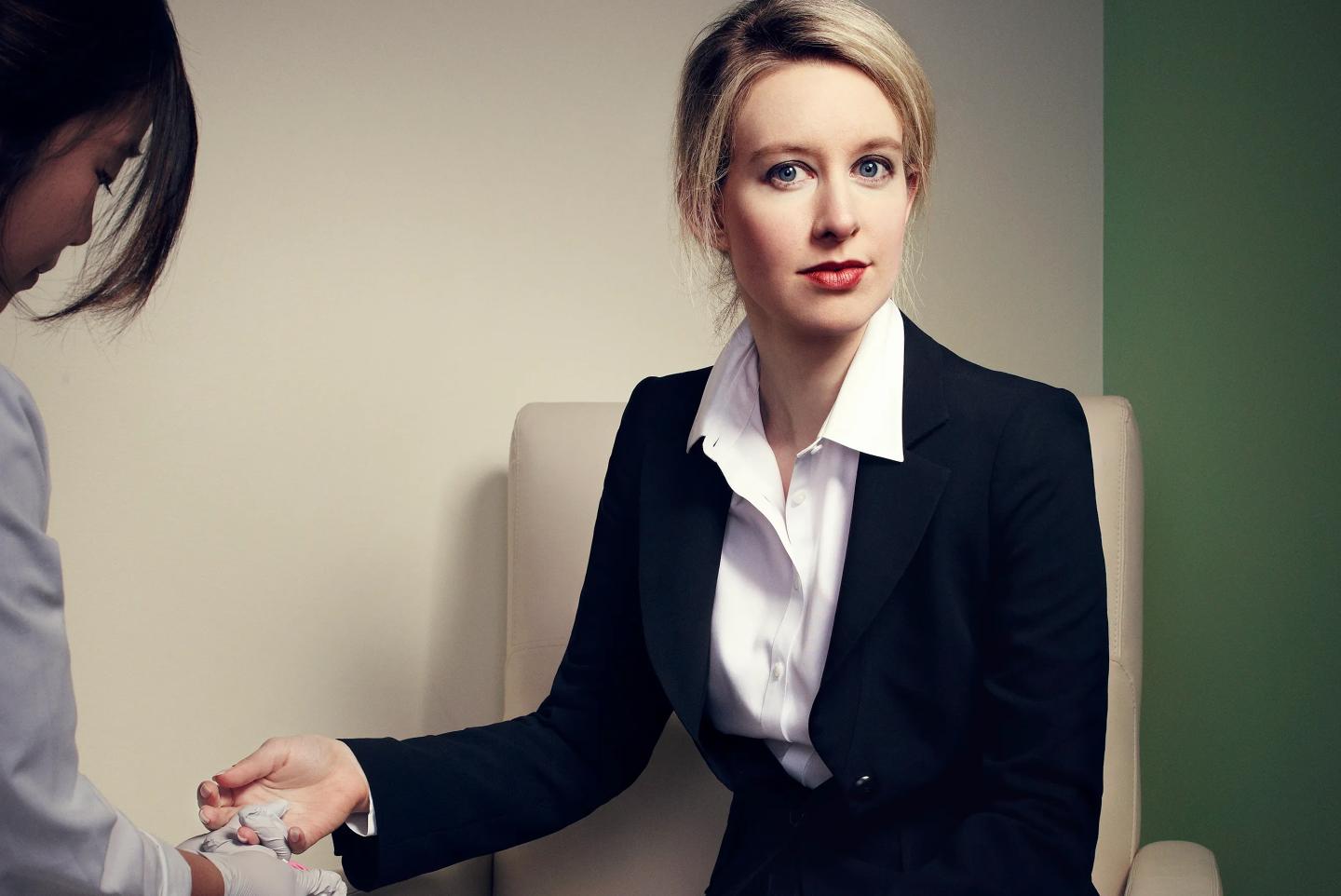
The portrait of Elizabeth Holmes staring wide-eyed from the cover of Fortune‘s June 2014 issue is stark and striking: the young founder in her signature black turtleneck and dark red lipstick, with a headline promising a CEO “out for blood.” Roger Parloff’s feature on Theranos’s founder laid out what the buzzy health tech startup said its device could do. It could run more than 200 tests from a few drops of blood taken by a finger prick instead of a needle, Parloff reported. The tests were fast, and they cost far less than those of established labs.
Holmes’s admirers were as dazzling as the claims. Her Stanford professor Channing Robertson told Parloff, “I realized that I could have just as well been looking into the eyes of a Steve Jobs or a Bill Gates.” Henry Kissinger, then on the Theranos board, testified to her integrity: “There is no performance associated with her. I have seen no sign that financial gain is of any interest to her. She’s like a monk.”
If it all sounded too good to be true, then—as you undoubtedly know by now—it was. In January 2022, a jury convicted Holmes on four counts of defrauding investors. She was sentenced to 11 years in prison, which she began in May 2023.
Holmes and Theranos are back in the news because of Nathan Fielder and Lance Oppenheim’s documentary You Can See Everything, which follows Holmes and her family through her last weeks of freedom. It has been a smashing success, recently crossing the $100 million mark in global box office receipts, and it is widely talked about as an Oscar contender.
The Fortune cover makes an appearance in the film, serving as a shorthand for how far Holmes had climbed in the business world at her peak. And indeed, Parloff’s profile anoints Holmes as a new business titan: “Though Theranos is largely unknown even in Silicon Valley, that is about to change,” he wrote. He also broke news about the company’s size, its funding, and its roughly $9 billion valuation.
After John Carreyrou of the Wall Street Journal broke the story of Holmes’s deception, Parloff owned up to his mistake in trusting Holmes. In his extended correction, titled “How Theranos Misled Me,” he says it plainly: “I blew it,” he writes, detailing the “great, flapping red flag” that he missed; the instances where Holmes’s answers were evasive and confusing; and her citing of “trade secrets” to explain their opaqueness. “I regret the error,” he wrote.
In Fielder’s nearly three-hour-long film, that frustrating evasion is evident. In one conversation, Holmes goes back and forth with Fielder over the word “can” in describing what her machine could do at some future point, vs. what she had claimed it was actually doing.
Parloff’s Fortune cover helped make Holmes a star. His correction is part of the record too, and it is a model of how to answer for an error in the “first draft of history” that journalism offers: promptly, in full, and in the open. Then you keep reporting.