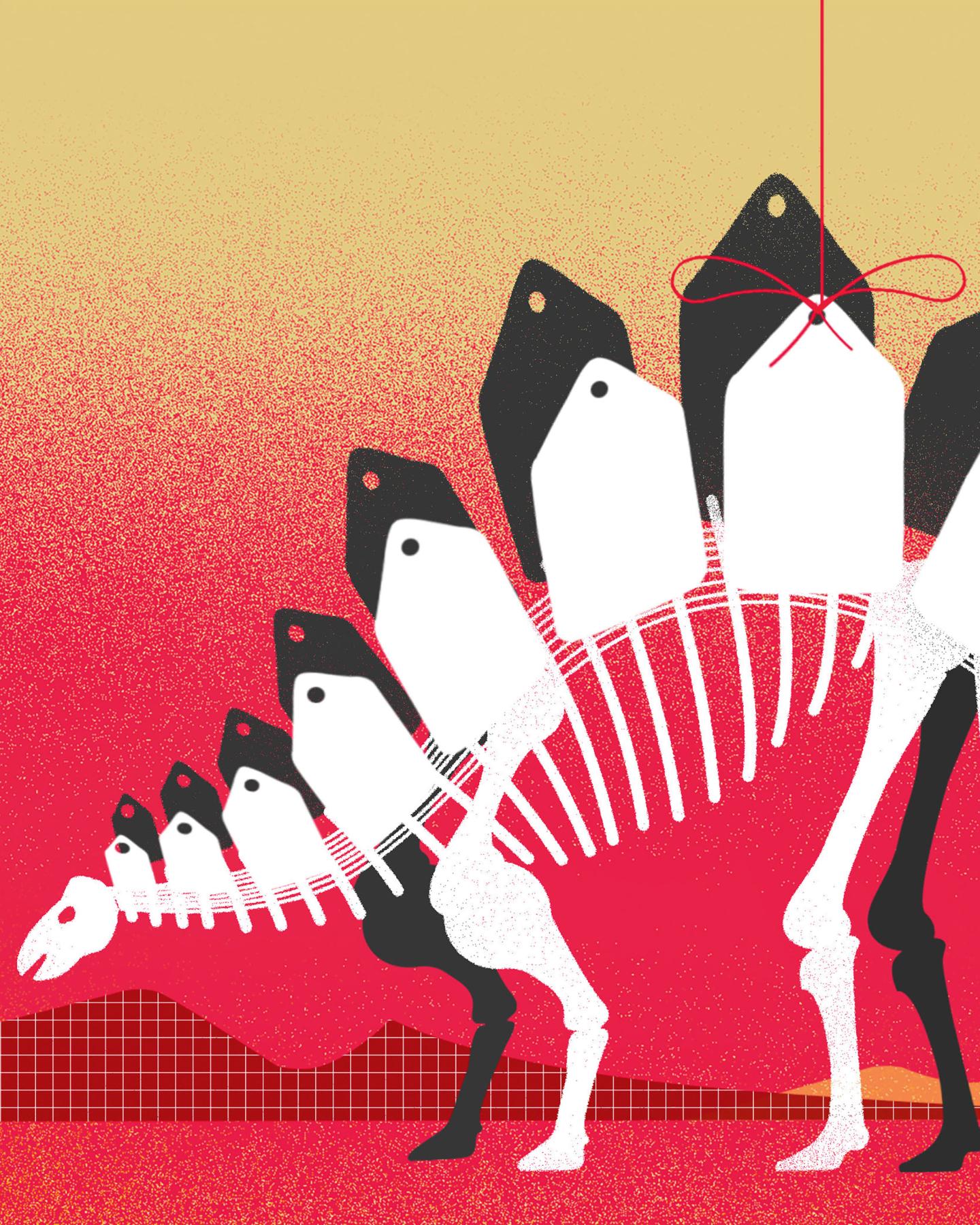

When an unknown buyer purchased a Tyrannosaurus rex specimen named Gus for $50.1 million at Sotheby’s in July, making it the most expensive fossil ever sold at auction, the investment world was atwitter at this hot new “alternative asset class” that was emerging right as the AI race minted billionaires. Was a bone boom underway?
The buzz was valid. Gus, a 38-foot-long, 67-million-year-old dinosaur discovered in South Dakota, sold for almost twice its estimate after a 10-minute, seven-bidder war reminiscent of the clashes that once broke out over, say, a prized Rothko. At about 38 feet long, about 12.5 feet tall with a skull length of 54 inches, it was one of the largest T. rex fossils ever found, according to Sotheby’s.
It shattered the 2024 record set by billionaire Ken Griffin’s purchase of Apex, a Stegosaurus, for $44.6 million. In October, a Nanotyrannus named Jodi sold for $47.3 million.
A handful of mega dinosaur sales have made headlines in recent years—and that’s the problem. Even in a collectibles market defined by scarcity, dinosaur bones that command such
vast sums are few and far between. Gus and Apex were remarkably intact. (Gus had a 61% bone count.)
Adding to the scarcity, excavation of fossils must be authorized, and unlike the market for Pollocks and Matisses, there are few standards for proving authenticity and provenance, says Christie’s guide to dinosaur-bone collecting. Those factors make dino bones more one-off trophies than a true asset class; there are too few sales of prized fossils to conclude that ordinary fossils appreciate consistently or can be resold easily.
A 2025 study of fossil sales at 115 auction houses from 2010 through 2022 found that
the 2020 sale of Stan, a T. rex, for $32 million, made up 35.5% of revenue for the entire
period. Still, those prices are much higher than those skeletons at the very high end were commanding only four years ago.
Many buyers are lending their bones to museums, taking them off the market
indefinitely. Griffin lent Apex to New York’s American Museum of Natural History. Stan is at Abu Dhabi’s Natural History Museum.
Research and public interest won out before the latest mega-fossil even hit the auction block. A Dubreuillosaurus valesdunensis fossil that’s considered a holotype—one used as comparison by researchers hunting for other fossils of the same species—was set for auction in Paris in mid-November. But French authorities stepped in to reach an agreement that will see the skeleton displayed at the Gallery of Palaeontology and Comparative Anatomy at the Jardin des Plantes in Paris, which is set to open this summer.
The precious few skeletons that make it to market are likely to fetch fortunes. For those who lose out—AI billionaires included—there’s always a museum ticket.
A version of this article appears in the December 2026/January 2027 issue of Fortune.