

Black and Latino workers are about 20% more likely than White workers to need to move into an entirely new occupation by 2035 as AI and automation reshape work, according to projections in a new report from the McKinsey Institute for Economic Mobility released Nov. 20.
AI and automation could take over about the same share of work across racial groups, McKinsey projects. What differs is whether that work disappears. McKinsey estimates that automation could reduce an average of 21% of current U.S. work hours by 2035. Of the hours it takes over, 40% of those worked by Black workers and 41% of those worked by Latino workers would be displaced, compared with 37% for White workers and 36% for Asian workers, meaning employers would need fewer people, rather than an augmented environment in which the technology supports a person doing the job.
The report ties the gap to the kinds of jobs people hold. Automation is most likely to replace tasks that are standardized, easy to check and low-stakes when wrong. McKinsey’s example is answering a routine billing question, as opposed to adjusting a patient’s medication dose. Tasks like the billing question make up a larger share of the hours Black and Latino workers put in. Physical work, which is increasingly exposed to robotics, accounts for 35% of Black workers’ hours and 39% of Latino workers’ hours, compared with 26% for White workers.
“Our research indicates that while AI and automation are expected to affect a similar share of work hours across racial groups, the consequences may differ significantly,” Duwain Pinder, a partner at McKinsey & Company, said to Fortune in a statement.
“While displacement doesn’t vary significantly between cognitive and physical work, the central question is not only how much work AI and automation technologies can perform, but whose work it replaces and through which types of activities.”
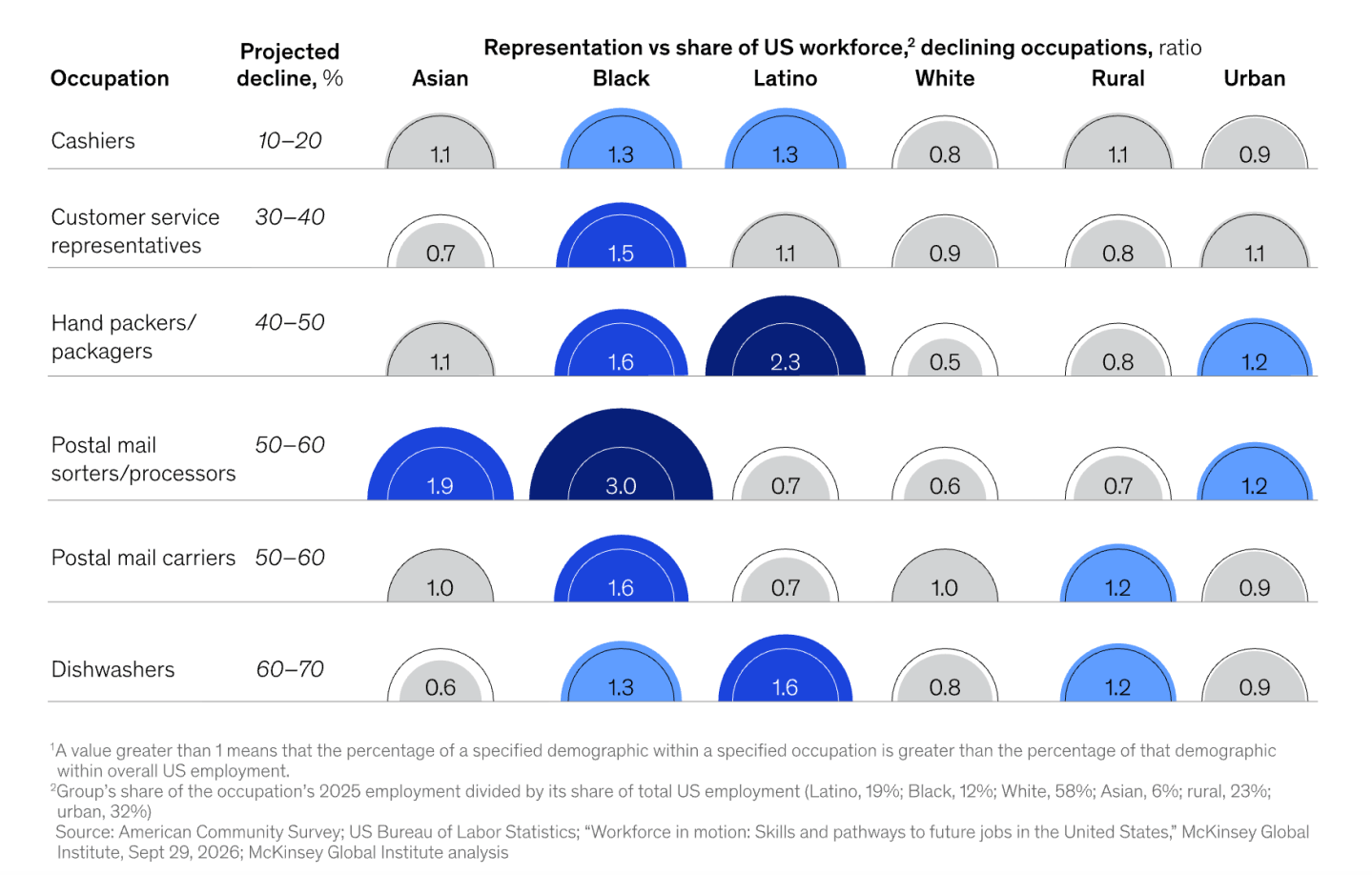
The effects are projected to concentrate in specific jobs: Black workers hold more than their share of the workforce in each of the six occupations with the steepest projected declines in labor demand. Latino workers hold 43% of hand packer and packager jobs, 2.3 times their share of the workforce.
The differences carry into projected job growth. Based on today’s jobs, McKinsey projects total work hours for Latino workers will grow 1.4% between 2025 and 2035 and 2.1% for Black workers. For White workers, it projects 3.4%, and for Asian workers, 5.8%.
The report builds on the McKinsey Global Institute’s “Workforce in motion” study, which found that automation could cut demand for about 36 million U.S. jobs by 2035 while growth elsewhere adds about 41 million. About 11 million workers may need to move into entirely different occupations. Lower-wage workers are 7.6 times as likely as higher-wage workers to be among them.
Only about 14% of workers who may need to switch have a direct path into a growing job, meaning minimal retraining and no pay cut. Among workers earning less than $38,000 a year, about 10% do, compared with almost 40% of workers in the top wage bracket.
Private AI investment reached nearly $345 billion globally in 2025, according to Stanford’s AI Index, which the report cites. McKinsey finds White workers are 30% to 50% more likely than Black and Latino workers to work in the areas where it expects that capital, and the jobs and wealth that come with it, to concentrate over the next two decades, including AI software, semiconductors, robotics and biotech.
The report also points to strain on new workers more broadly. It cites Stanford’s tracking of young workers, which found that employment for 22- to 25-year-olds in some highly AI-exposed jobs is 19% lower than it would be had it kept pace with less-exposed jobs.
McKinsey flags risks that could make the gaps worse. About one in six U.S. households has no internet connection, and Black adults are roughly 80% to 90% more likely than White adults to lack broadband. A Stanford study of 4 million job applications cited in the report found that 26% of Black applicants applied to jobs where an AI hiring tool discriminated against their group.
The report also argues AI could help at key points in people’s lives. It cites an AI model built on data from Medicaid-enrolled women that flagged pregnancy risks a median of 55 days before standard clinical signs. Simulations projected up to a 31.8% drop in adverse outcomes. On schools, it notes the evidence is mixed and points to New York City’s one-year ban on student-facing AI for pre-K through eighth grade.
This is not the first time McKinsey has warned that AI could deepen racial gaps. In 2023, it estimated that generative AI could widen the wealth gap between Black and White households by $43 billion a year by 2045.
The new report calls on employers to train frontline workers in AI and hire on skills rather than degrees. It asks investors to require bias testing of AI tools broken out by race, income and geography. It also urges states to use federal broadband funds to reach communities that are still offline.