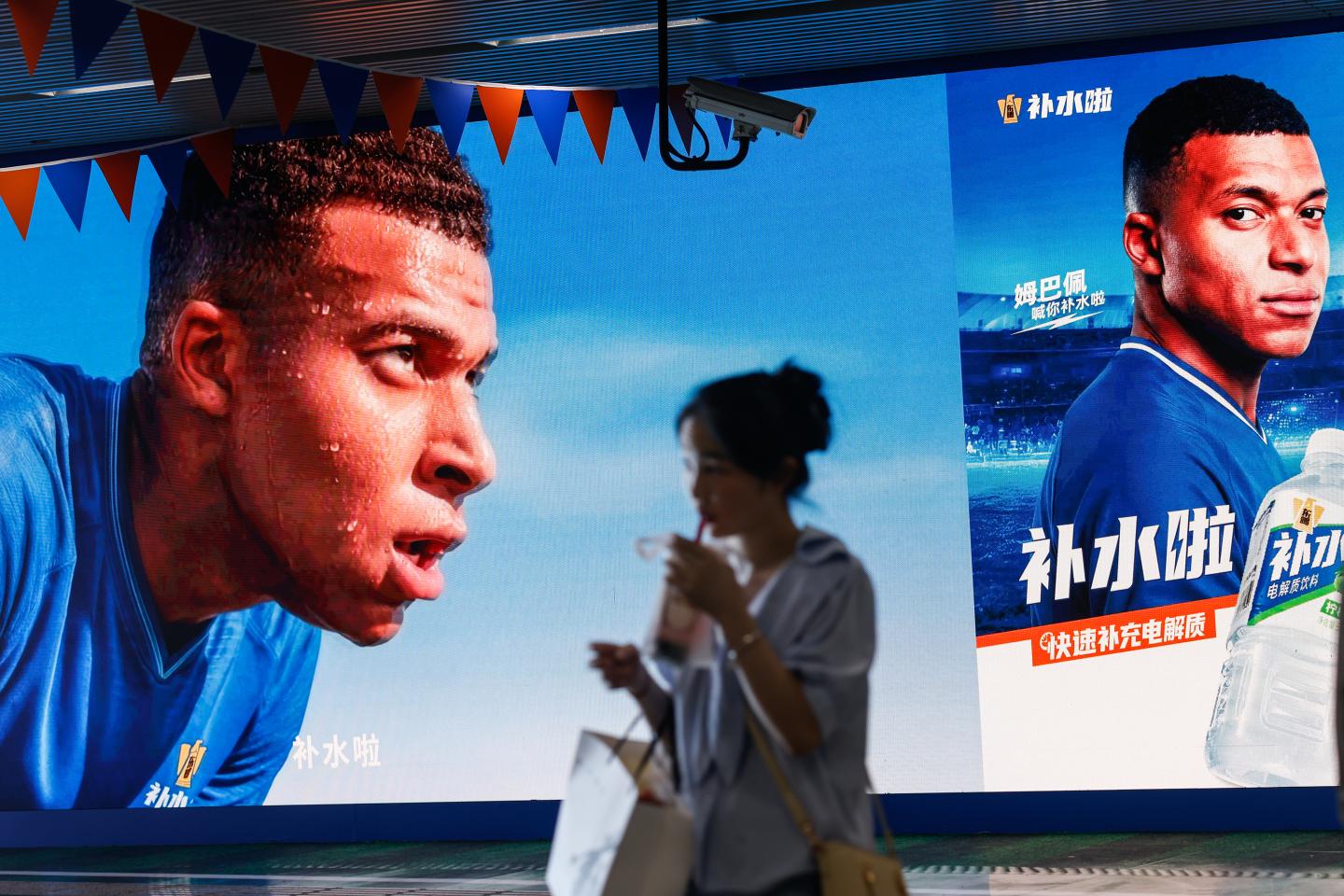
A meme superimposing Kylian Mbappé—the Real Madrid striker and 2018 World Cup hero—onto Mao Zedong’s body went largely unnoticed until a Chinese football forum picked it up in late October. The episode has made the French superstar the latest victim of China’s economic coercion. Mbappé, his club, and La Liga all kowtowed—but without a collective effort to stand up to China’s economic bullying, individuals, firms, and governments will keep getting targeted.
In a clip from the French talk show The Bridge, Mbappé said the funniest meme of himself showed “some guy—I think he’s a Chinese dictator.” Beijing’s red card came swiftly. Within a day, three Chinese sponsors had dropped him, and his name and likeness were pulled from social media posts from Dior, Hublot, On, and Adidas ads and stores across China. China’s state broadcaster took La Liga matches—Spain’s top league, where Real Madrid and FC Barcelona play—off the air, and Mbappé’s accounts on Xiaohongshu (also known as RedNote) and Weibo were restricted. China’s foreign ministry called the backlash natural.
La Liga, which earns an estimated $100 million a year in Chinese media rights, apologized through its president, Javier Tebas, to Chinese fans. Mbappé quickly apologized for his “ill-judged” comment, and Real Madrid—which counts millions of Chinese fans and reportedly sells about 15% of its jerseys there—issued a statement apologizing to the Chinese people for any “discomfort” the football star’s words had caused.
Apologizing so fast may look like an own goal, but it was the only move available to Mbappé, Real Madrid, and La Liga. As long as governments won’t stand up to China, no company or individual will—and certainly no athlete, no matter how famous. Why would they? None of them can take on a nation-state, least of all China.
The answer is not braver individuals or companies. It is a collective economic deterrence pledge, where coercion against one country’s companies or people would be answered by all.
This diplomatic row is far from unprecedented. A single tweet about the Hong Kong protests by Houston Rockets general manager Daryl Morey in October 2019 unleashed a massive coercion campaign by Beijing: all 11 of the NBA’s official Chinese partners suspended ties, and Chinese state media canceled broadcasts, costing the league hundreds of millions of dollars.
The stakes for sports clubs are obvious. Since 2005, more than 60 basketball players have signed deals with Chinese brands that together are worth hundreds of millions of dollars. Europe’s biggest soccer clubs fly to China regularly, and they sell a lot of jerseys while they are there. Formula One still races in Shanghai, and the NFL is bringing flag football into Chinese schools.
Hollywood is no different. MGM digitally turned the Chinese invaders of its “Red Dawn” remake into North Koreans. The Taiwanese and Japanese flags vanished from Tom Cruise’s jacket in the first trailer for “Top Gun: Maverick.” John Cena apologized in Mandarin in 2021 for calling Taiwan a country while promoting a film. When was the last time you saw a movie where China was the bad guy?
China’s sanctions give athletes, filmmakers, and the companies behind them a reason to avoid saying or doing anything that invites a similar response. That lets Beijing shape what states, companies, and individuals do—not just in sports and movies, but on human rights, Taiwan, and UN votes.
Public backlash to celebrity comments isn’t new, of course—nor should celebrities avoid apologizing if there’s genuine regret. But what makes the Chinese backlash different is the role of Beijing in signaling its displeasure—and in guiding Chinese companies to act.
We have tracked 605 cases of Chinese economic coercion since the 1990s—582 of them against companies and individuals for perceived slights to CCP legitimacy, territorial disputes, Tiananmen commemorations, and arms sales. Almost none were about trade. the targets were overwhelmingly based in rich democracies, with the G7 economies, Australia and South Korea accounting for 81% of cases. And in almost every case, the target did what Mbappé did: they acquiesced, apologized almost immediately, and stayed silent.
The real lesson is that it should not fall to athletes, or to any company or individual, to stand up to China. That is the job of governments. As of this writing, only one French politician has said Mbappé had nothing to apologize for. France does not have to like the joke to defend the principle: Beijing should not be able to decide what a French citizen can say on French television.
Governments can do what individuals and companies can’t, because China depends on the countries it bullies more than it admits. Two groups of countries hold that leverage. The first is the victims of China’s economic coercion: our research found that the 18 countries Beijing has punished export more than $43 billion of goods to China on which China is highly dependent—including inputs to its solar panels, batteries, construction, and plastics. The second is the countries across the Americas, Asia, and Europe hollowed out by Chinese overcapacity, which absorb more than $286 billion of China’s surplus goods yet supply many of the inputs its factories cannot do without: Brazil’s ferro-niobium for high-strength steel and superalloys in jet engines, and Indonesia’s ferro-nickel for stainless steel and EV batteries.
What’s needed is a collective economic deterrence pledge—a NATO-type Article 5 for trade, in which coercion against one is answered by all. This would raise the price of China’s bullying. It could start with the G7, Australia, and South Korea before widening to the economies bearing the brunt of China’s overcapacity. Europe can lead by extending its Anti-Coercion Instrument, the European Union’s “trade bazooka,” which allows Brussels to hit back with tariffs and restrictions on trade, investment, and public contracts when a foreign government uses economic pressure on a member state. But it covers only coercion aimed at governments. The EU should propose extending it to European companies and individuals to protect the next Mbappé—or European firm—from Beijing.
The French show that aired the clip has deleted it. The lesson it teaches has not. Any collective action pact will be tested at least once before China believes it. Until governments sign one, the next Mbappé will be on his own—and he will have no choice but to apologize too.
The opinions expressed in Fortune.com commentary pieces are solely the views of their authors and do not necessarily reflect the opinions and beliefs of Fortune.