
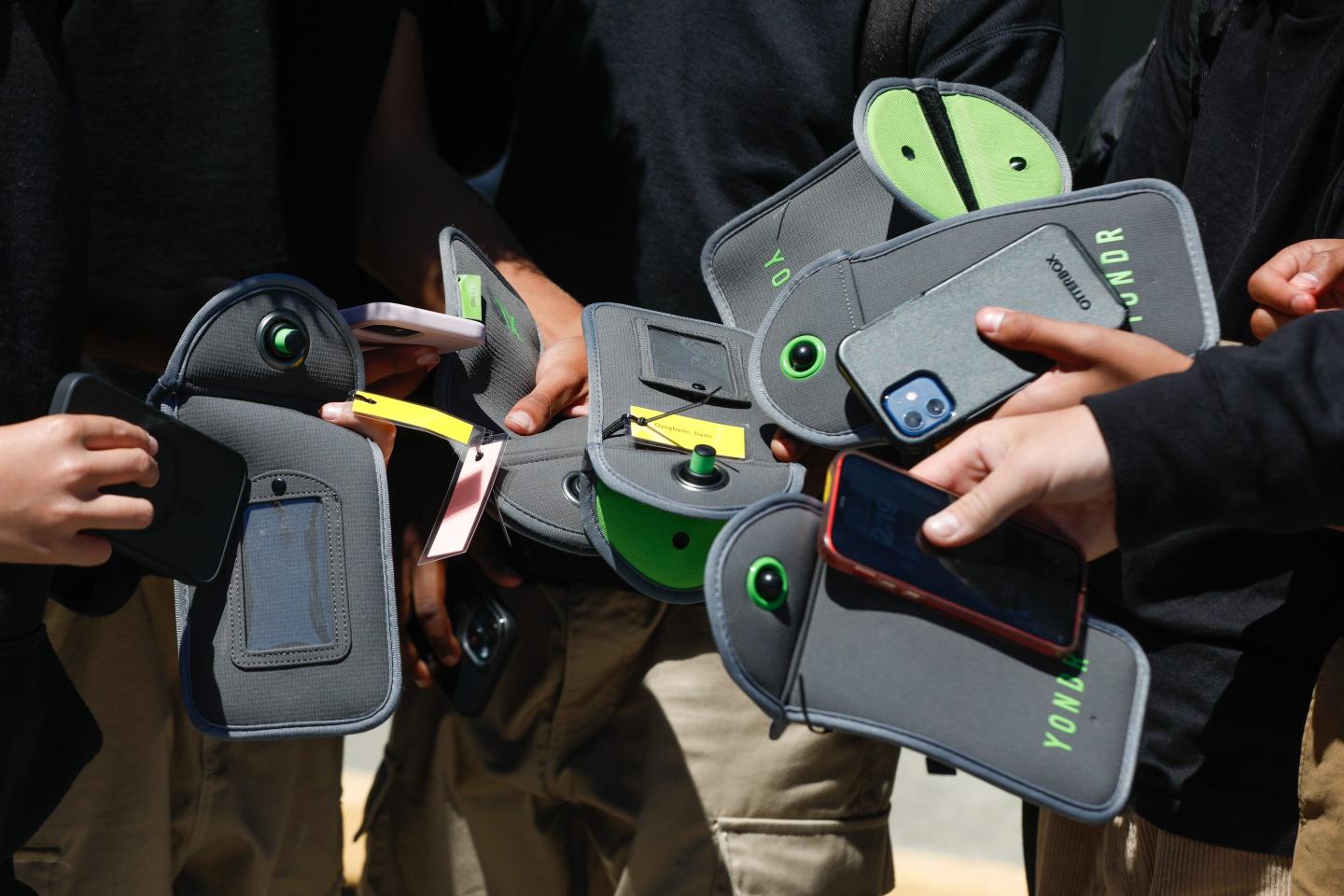
Making students lock their phones in pouches for the school day adds one to two weeks of learning a year, according to a national study released Tuesday.
The study, from Harvard’s Center for Education Policy Research, with researchers at Dartmouth and the testing nonprofit NWEA, found that schools that required students to store their phones in pouches experienced an annual boost in achievement growth of 0.01 standard deviations—equivalent to 1–2 weeks of additional learning per year (or restoring two minutes per hour of class time). The team followed 3.3 million students at 4,600 schools across 49 states and Washington, D.C., from the 2021–22 through 2025–26 school years.
The gains are small, but they last. Achievement gains begin in the first year of the ban and appear to continue three years later, and the effect held across elementary, middle and high schools, and across rich and poor ones.
The result breaks with the last big study of school phone bans, which found in May that they did close to nothing for test scores. The argument has money riding on it: New York and 16 other states put bell-to-bell bans in place last school year, and Kane puts the cost of a pouch at about $25 a student.
That matters because of how far students have fallen. Tom Kane, an economist and education professor who serves as the director of Harvard’s Center for Education Policy Research, released an Education Scorecard which traced a “learning recession” back to 2013, years before the pandemic. Between 2013 and 2024, eighth-grade math and reading achievement fell by roughly one grade equivalent. The slide lines up with the spread of smartphones: in 2011, fewer than a quarter of teen students had access to smartphones. By 2018, 95% did.
“Strict cell phone bans seem to plug about half of that leak,” said Kane in a statement.
As for the other half, Kane told Fortune “the two main suspects are declining test-based accountability following the replacement of the No Child Left Behind Act and out-of-school social media use.” He added: “One of the big mysteries our study did not explain is the precipitous drop for the lowest achieving students. The abandonment of test-based accountability and out-of-school social media use could be most costly for them.”
Not everyone is sold
A National Bureau of Economic Research study found in May that strict bans had close to zero effect on test scores. That team did find statistically significant gains with Yondr pouches in high school math, but those gains were offset by ban-related learning losses in middle school.
Tom Dee, a Stanford professor and co-author of that study, told NPR he considers the early results on phone bans “largely disappointing.” Neither study has been published in a peer-reviewed journal. The two also measured different things: the NBER study pooled school-level mean test scores at several thousand Yondr-adopting schools, while the Harvard study used student-level scores at the 844 schools that use both Yondr pouches and tests administered by NWEA.
Kane said the Harvard study, which is not a randomized trial, compared achievement growth at “roughly 800 Yondr-adopting schools before and after adoption against the achievement growth of 3800 matched comparison schools over the same time period.” He added, “The fact that the two groups of schools seemed to [be] following similar trends in the years before adoption made us more confident.”
The Harvard team flags its own limits too. It found signs that state-mandated bans in 22 states raised reading and math scores last year, but researchers cautioned that these findings might be confounded by pre-existing trends in the states implementing bans.
“Given the difference in post-pandemic recovery in the states with and without bans, it will be hard for anyone—not just us—to discern the effect of the bans by comparing across states,” Kane said. A better test, he said, would compare schools that already had strict bans of their own with schools in the same state that adopted bans only after the state law passed.
Kane’s pitch to districts is about money. “$25 is a small price to pay for an additional 1-2 weeks of instruction per student,” he said.
Advocates say the study confirms what schools have already seen. “Anecdotal evidence has already demonstrated that schools making the transition have the ability to change their school culture and bring face-to-face interaction back to the classroom and common areas like the cafeteria,” Ashwin Verghese, communications director at the children’s advocacy nonprofit Fairplay, told Fortune. “Now, the Harvard study is backing that up with evidence of steady educational gains.”
Julie Scelfo, a mother and the founder and executive director of Mothers Against Media Addiction, said the gains matter more than they sound. “It’s easy to forget that education is sequential, meaning that basic building blocks must be established before a child can go on to higher orders of learning,” she told Fortune. “So a week or two may not sound like much, but it actually adds up to quite a lot across a child’s K-12 education.” The benefit isn’t only academic, she added, but “the ability to focus and develop other executive functioning skills that are critical to every area of a child’s life.”
Scelfo acknowledged the study “doesn’t say much about phone and social media use after school,” but said the rise of smartphones and social media among young people tracks with what pediatric groups have declared a national emergency in child and adolescent mental health. “Parents should do everything possible to delay access to these products until safeguards are in place,” she said. She pointed to state laws such as the Age-Appropriate Design Code and New York’s Stop Addictive Feeds Exploitation (SAFE) for Kids Act as models for other states.
New York already ran this experiment, but in reverse
New York City has banned, unbanned and rebanned phones in schools. The city’s ban dated to the late 1980s, but Bloomberg started strongly enforcing it in 2006. A small industry grew up around it: storage trucks outside schools charged students about $1 a day to hold their phones. One van owner in Far Rockaway told DNAinfo he netted around $160 to $170 per day.
In 2015, Mayor Bill de Blasio scrapped the ban, calling it “simply out of touch with the realities of modern day parenting,” according to CBS New York. He also called it unfair, because the ban was enforced mostly at schools with metal detectors in low-income neighborhoods.
A decade later, the city reversed course again. When Gov. Kathy Hochul signed the 2026 state budget into law on May 9, 2025, she made New York the largest state in the nation to restrict smartphones and other internet-enabled personal devices throughout the entire school day. New York was one of 17 states that adopted bell-to-bell bans for last school year.
The pouches at the center of the study weren’t built for classrooms. Graham Dugoni, a former professional soccer player, founded Yondr in 2014. He found early success with live performers, including comedian Dave Chappelle, who used the pouches to keep audiences from filming performances starting in 2015. A California high school was using them as early as 2019. More than 3,300 schools nationwide began using the pouches between the ‘19-‘20 and ‘25-‘26 school years.
What happens after the bell
The researchers say the bigger unknown is what students do with their phones outside school. They point to Meta’s $17 billion settlement with state attorneys general, which requires a block on app access between midnight and 6 a.m. and muted notifications during school hours (8 a.m. to 3 p.m.), excepting direct messages. The Harvard team wants states to encourage other platforms used by youth—YouTube, TikTok, Snapchat, etc.—to adopt similar restrictions so students don’t simply switch apps.
Verghese said other platforms “should absolutely adopt the same limits, but they can’t stop there.” Fairplay was disappointed that the settlement does not turn off by default “recommendation algorithms that connect kids to predators and send young people down dangerous rabbit holes,” he said, and he argued it was “too focused on offering parents tools rather than restricting harmful features.” He added: “Even if other companies adopted these restrictions, two hours per day on four or five different platforms adds up to far too much time.”
“What families really need is for Congress to pass comprehensive legislation that will force companies like Meta to stop designing for addiction and make their products safer by default,” Verghese said, calling on lawmakers to pass the Kids Online Safety Act in the coming weeks.
Teodora Pavkovic, director of wellbeing and parent advocacy at Qustodio and Aura Parents, which make parental-control apps, told Fortune that a school-day ban “only addresses a fraction of students’ digital lives, leaving the hours outside school largely untouched.” Aura Parents’ 2026 State of the Youth Report found that sleep is the single strongest predictor of a teen’s digital wellbeing. “Teens with low wellbeing spend three times more time on their devices overnight, pick up their phones seven times more often, and take twice as long to disengage after bedtime,” Pavkovic said.
Kids don’t fully make up for lost screen time after school, Pavkovic said, “but they do pack their social lives into those hours.” Among nearly 30,000 children ages 7 to 17 in Aura’s data, about a third use their devices during school hours. By 3 p.m., more than 60% do. “School phone bans are a helpful starting point, but they need to be paired with healthy boundaries at home, like keeping phones out of bedrooms at night,” she said.
Kane says he now wants to study students’ smartphone and social media use outside of school.