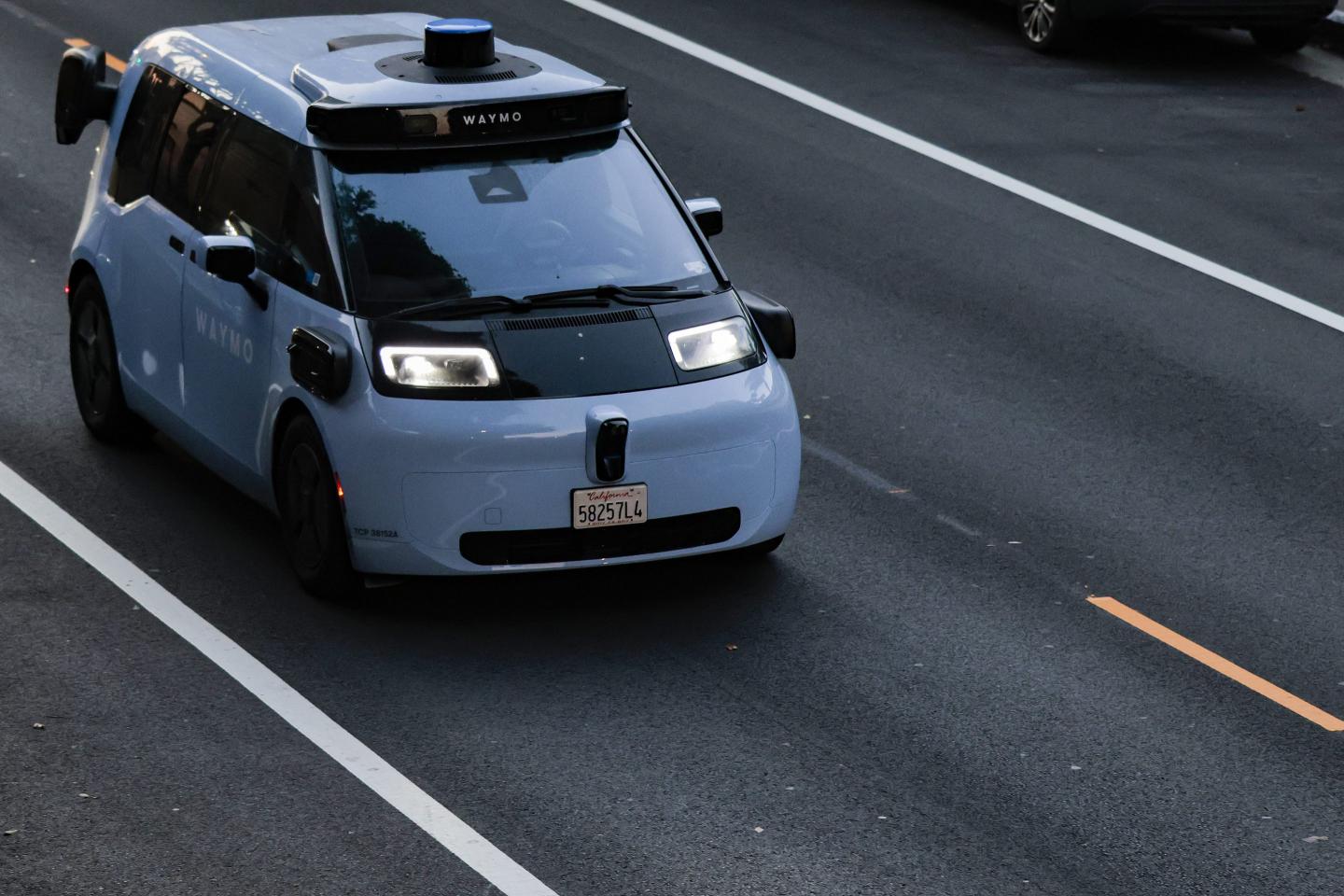
Waymo says its robotaxis are involved in far fewer serious crashes than human drivers. California regulators now say its cars are an “imminent hazard” on the freeway.
On Nov. 11, the California Department of Motor Vehicles barred Waymo from operating or testing its driverless cars on freeways after several vehicles entered an active construction closure and another incident in which a Waymo tried to get around California Highway Patrol cars running a traffic break. Waymo has since paused driverless freeway rides in all its markets, including Phoenix, Miami and Austin, though it is still testing on freeways with specialists behind the wheel.
“Right now we’re looking at this technology. You get in it, you expect it to work perfectly,” Bryan Reimer, a research scientist at MIT’s AgeLab who studies automated vehicles, told Fortune. “We shouldn’t.”
The DMV said three Waymo vehicles entered an active construction closure on U.S. Route 101 near Burlingame on Nov. 5. Then the agency cited the separate incident involving Highway Patrol vehicles in San Francisco, ultimately resulting in the agency declaring Waymo’s freeway operations an “imminent hazard to public safety,” in a statement.
It’s the second time this year Waymo’s freeway service has gone dark. Similar incidents in May prompted an earlier restriction and corrective actions, but the DMV said Waymo’s vehicles continued entering active construction zones despite those changes. Waymo paused freeway rides nationwide then, too, and brought them back gradually starting in late July.
“Safety is at the foundation of everything we do,” a Waymo spokesperson told Fortune, adding that the recent incidents did not result in any injuries or collisions.
California’s restrictions will remain in place until Waymo can show regulators that its vehicles can safely detect and respond to construction zones, emergency vehicles, and other roadway hazards. The company says it’s working with officials to get back on freeways, though winning public confidence may be a less straightforward process.
Waymo’s robotaxis are still operating on surface streets, where the company says it provides more than half a million rides each week. The company began offering passengers freeway trips in California in November 2025, after years of autonomous freeway driving.
Safer than humans, but is it enough?
Waymo, however, does have numbers to make its case. Across more than 270 million fully autonomous miles through June, the company says its cars have been involved in 82% fewer injury-causing crashes and 95% fewer crashes causing serious injuries or worse than statistically comparable human drivers. Waymo also says its vehicles have been involved in 93% fewer injury-causing crashes involving pedestrians.
But Reimer cautioned that those numbers don’t necessarily tell the whole story. Waymo’s software and vehicles are constantly changing, making it difficult to draw definitive conclusions about a technology that may look different today than it did when many of those miles were recorded.
Even if the numbers hold up, being safer than human drivers may not be enough to convince Americans to hop in the back of the baby-blue Waymo.
“Humans look at robots to be better than human, and I think the same is true for automated vehicles,” he said.
Reimer sees human drivers as a reasonable starting point for measuring safety, but as robotaxis expand, he believes they’ll need to clear a much higher bar.
“If you’re going to expand, it’s gotta be magnitudes safer,” he said.
The problem with expecting perfection
Reimer argues that part of the problem is how autonomous driving has been presented to the public. A Waymo might have an empty driver’s seat, but that doesn’t mean humans are entirely out of the picture. Remote support staff can step in to help when vehicles encounter problems.
“It is not autonomous driving,” Reimer said. “It is highly automated, but there is a lot of human components behind the scenes.”
He believes companies could earn more trust by being upfront about those limitations instead of treating the technology like a finished product. That would also help passengers calibrate their trust in what the cars can actually do.
“We’re much more accepting of technology when we have a better understanding of its limitations,” he said. “Under-promising and over-delivering always wins.”
One incident can change everything
The stakes are particularly high for an industry that has already seen how quickly a safety incident can derail a business. In 2023, a Cruise robotaxi dragged a pedestrian who had been struck by another vehicle, prompting California regulators to suspend the company’s driverless permits. More than a year later, General Motors announced it would stop funding Cruise’s robotaxi development, citing the cost of scaling the business and growing competition.
“We as humans are enamored by technology, and first impressions do matter,” Reimer said. “But at the end of the day, when we experience something that doesn’t feel right, it does erode trust.”
Reimer also believes Waymo will eventually face a serious incident of its own, given the sheer number of vehicles and miles involved. “It is a law of probabilities,” he said. “Something will happen at some point.”
That’s why he worries about companies presenting technology that’s still evolving as something consumers can already trust without hesitation.
“We are talking about a technology that can revolutionarily change how we live and move, but can also suffer from a complete collapse of consumer trust overnight,” Reimer said.
“Trust is the coveted commodity,” Reimer said. “And we are not looking at how to manage trust as effectively as we should.”