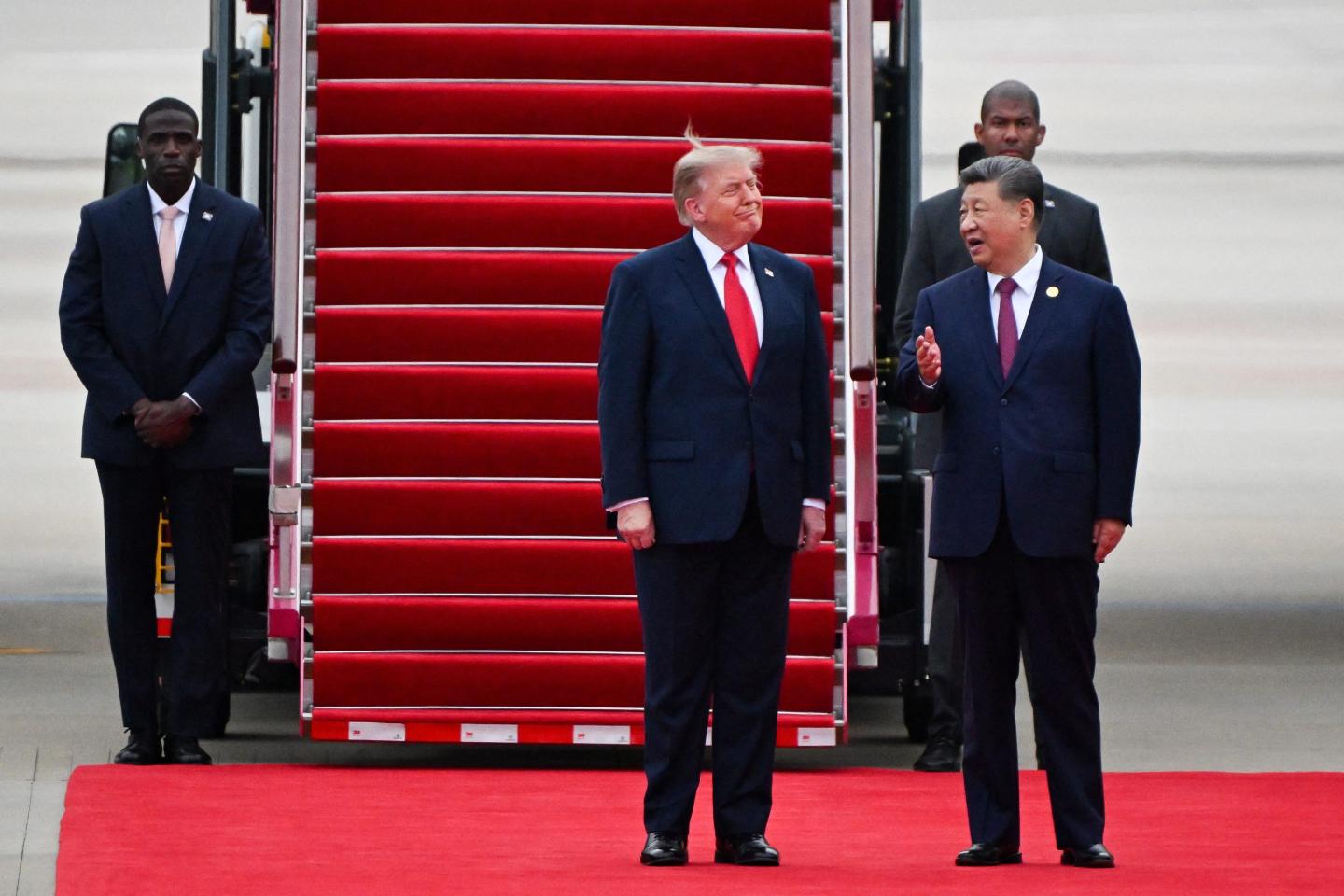
U.S. President Donald Trump is on a whirlwind tour of Asia this week. He arrived in Manila on Tuesday wrapping up meetings on the sidelines the annual summit of the Association of Southeast Asian Nations. He then traveled to Shenzhen, where he was welcomed by Chinese President Xi Jinping for this year’s Asia-Pacific Economic Cooperation (APEC) Forum.
Trump is scheduled to take part in three-way talks with Xi and Russian President Vladimir Putin while in Shenzhen. “They will exchange views in depth on safeguarding world peace and promoting strategic stability in major-power relations, which is of groundbreaking significance,” Chinese Foreign Ministry spokesperson Mao Ning said on Monday, according to Reuters.
Trump’s meetings with the two leaders at APEC could test whether the U.S., China and Russia can make progress on trade and help ease tensions in the Middle East.
The talks are likely to focus on immediate economic and security concerns. Looming over the Trump-Xi meeting is a trade truce negotiated at last year’s APEC Summit, where the U.S. and China agreed to pause an escalating battle of export controls and begin a regular series of talks on trade and investment. The truce expires on Jan. 10.
Yet Trump arrives in Shenzhen just days after Washington proposed expanding export controls on semiconductors, showing just how easily the U.S.-China relationship could tilt back into a trade war.
Why is trade the most important issue?
Trade is likely to be a central issue in Trump’s meeting with Xi. At last year’s APEC summit in South Korea, the two leaders agreed to a truce in their trade war. Trump agreed to lower tariffs in exchange for Beijing cracking down on fentanyl precursors, resuming soybean purchases and pausing rare-earth export controls. In September, Treasury Secretary Scott Bessent said that the U.S. and China had agreed to extend their trade war truce until Jan. 10.
“I think the number one issue has to do with what conditions would need to be met to extend the ceasefire beyond January,” Scott Kennedy, senior adviser in Chinese business and economics at the Center for Strategic and International Studies (CSIS), says.
Kennedy notes that leaders might negotiate right up to the January deadline, rather than reach an agreement in Shenzhen. Trump and Xi are also expected to meet next month at the G20 summit in Florida.
Tariffs may have dominated trade tensions last year, but Kennedy says the focus has shifted toward export controls—both U.S. restrictions on semiconductors and China’s limits on rare earth minerals.
The U.S. has blocked exports of advanced AI chips and chipmaking equipment to China since 2022, and has tightened those restrictions in the years since.
China retaliated with its own export controls in April 2025, imposing licensing requirements on exports of several rare-earth materials, which are key to industries like semiconductor and car manufacturing. The resulting supply disruptions threatened factory production in the U.S. and Europe.
Both sides agreed to suspend some export-control measures as part of last year’s trade truce.
Yet on Monday, just days before Trump’s scheduled meeting with Xi, the U.S. Commerce Department expanded its rules governing the use of advanced AI chips, requiring licenses for companies trying to export advanced chips to Singapore, Malaysia, Thailand, Indonesia, and Brazil. The rule also require licenses for data center operators that want to offer large amounts of computing power to Chinese clients.
“The rule is designed to ensure that existing restrictions on access to sensitive American technology cannot be circumvented through remote computing arrangements involving data centers in third countries,” the Commerce Department said in a statement on Nov. 16.
Beijing criticized the measures on Tuesday, with a spokesperson from the country’s commerce ministry expressing “strong dissatisfaction” with the new export controls. “If the U.S. persists, China will take countermeasures.”
Where does Iran fit in?
The U.S.’s war in Iran could also feature in discussions between Xi, Trump, and Putin. “The U.S. clearly wants to exit Iran,” Kennedy says. “It could benefit from Russian and Chinese help in achieving that goal.”
Kennedy said China and Russia’s close ties with Iran could help the U.S. secure Tehran’s commitment not to charge vessels tolls or fees to transit the Strait of Hormuz. He added that the two countries could help curb oil prices, which have risen amid Iranian attacks on commercial ships in the waterway, adding to cost-of-living pressures in the U.S. and around the globe.
Most voters in the Nov. 3 midterm elections said inflation was causing hardship for their families, and identified the affordability of gas, food, and utilities as major concerns, according to an NBC exit poll.
“Given the clear message that voters sent at the midterm elections, I suspect the main topic of discussion might be the Middle East, where both China and Russia have considerable leverage,” says Victor Shih, a China expert at UC San Diego’s School of Global Policy and Strategy.
Chinese ships, along with vessels from India, Qatar, and Iraq, are exempt from the restrictions Iran has imposed on shipping through the Strait of Hormuz, Al Jazeera reported this month.
Brainstorm Tech International will convene CEOs and founders, technologists and investors, thinkers and doers to tackle the challenge of turning technological promise into lasting business and societal value. December 2 in Macau. Apply here.