
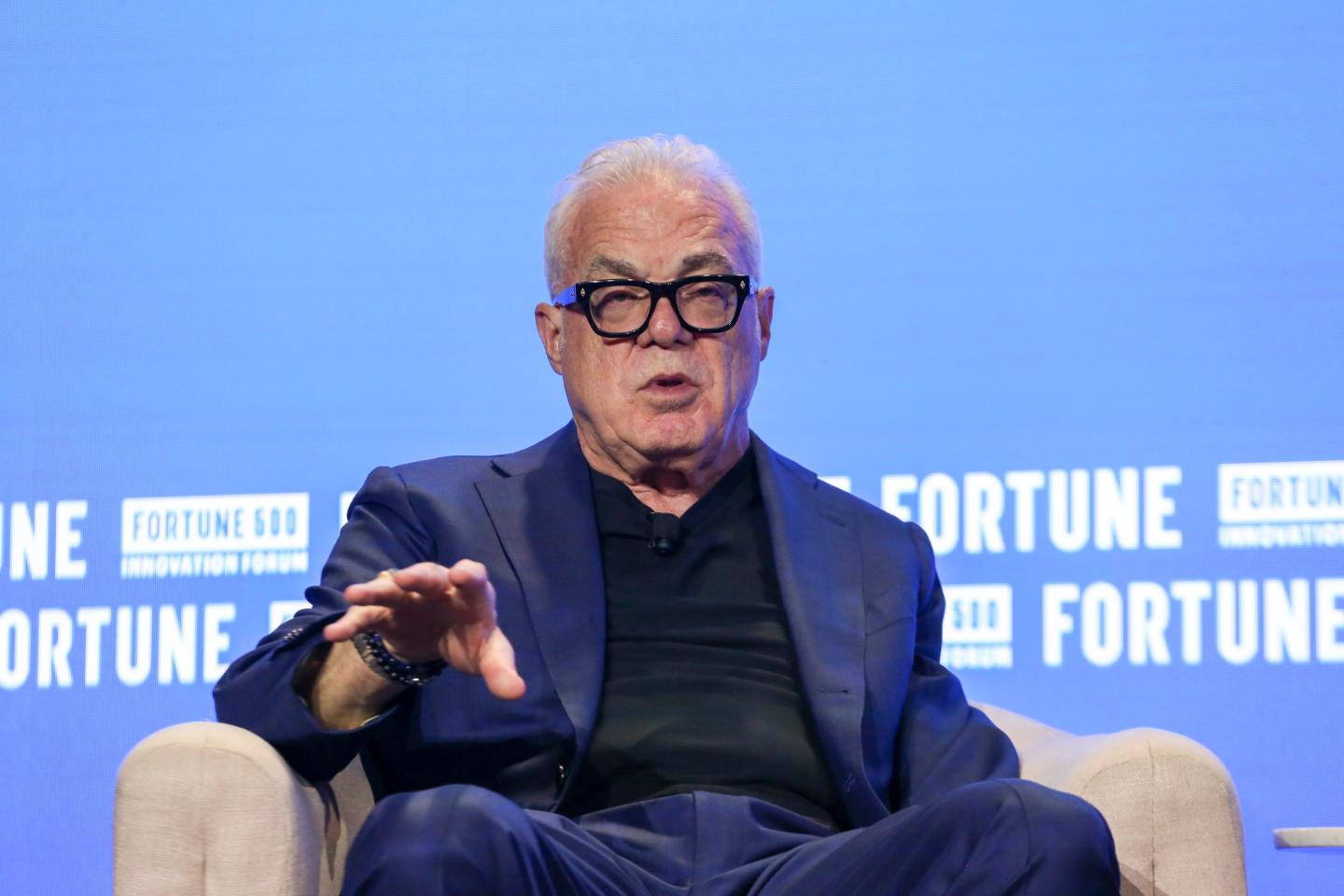
Mark Bertolini sold Aetna to CVS Health for almost $70 billion in 2018. On Monday, he told a room of Fortune 500 executives what he thinks CVS was really buying.
“The real intention” of the purchase, Bertolini said at the Fortune 500 Innovation Forum in Detroit, “was just to take the earning stream and revenue stream from [Aetna] to hide a bunch of other things that they never really fixed.” He tied that directly to the breakup CVS is going through now: “You’d never do that deal now.”
The comments land two weeks after CVS said it will split in two. CVS Health will keep Aetna and its Caremark pharmacy benefit manager and spin off its roughly 9,000 stores and MinuteClinic as a separate company, CVS Pharmacy, by the first half of 2028. CVS shares closed down 12.5% on Nov. 4, the day of the announcement, wiping out nearly $15 billion in market value.
For employers, insurers, and anyone with a pharmacy benefit, it’s the partial unwinding of the biggest bet on vertical integration in American health care.
CVS declined to comment on Bertolini’s remarks. “This is the right decision, at the right time,” CVS Health spokesperson David Whitrap said of the split in an email to Fortune, adding that the company is “getting ahead of the external market dynamics from a position of strength. Each of our businesses are thriving.” He confirmed that Aetna and Caremark will stay together and that the separation should be finished by mid-2028.
Where’s the queen?
Bertolini ran Aetna from 2011 through the sale and has been CEO of Oscar Health since April 2023. He had been asked by Fortune’s Kristin Stoller whether—after decades running one of the system’s biggest players—he worried he’d made it worse.
He started with what he called “an admission against self-interest.” Bertolini said he was part of the team that took Express Scripts public, back when “we thought the PBM [pharmacy benefit manager] was a great idea.”
“I thought it would never last, but it did,” he said, comparing it to a card hustle on a New York street corner: “Where’s the queen?”
The Aetna deal was supposed to be something else. Bertolini said the idea was “a new front door for health care,” with customers shopping for care at the front of CVS stores. In 2017 he pitched it as “10,000 new front doors to the health care system.” He said that vision “never got pulled through because it took a lot of intensity to do it,” and he was moved to the board. On CEO succession, he was blunt: “There can only be one CEO.”
CVS cut him from its board in February 2020 as it shrank from 16 directors to 13. Bertolini told the Wall Street Journal at the time he was being pushed out before the Aetna integration was finished. A CVS spokesperson said at the time “the board felt it was the right time for Mark to focus on his other endeavors.”
The stores, the front door in Bertolini’s pitch, are now the part CVS is cutting loose. Bertolini said the strategy stopped making sense after the pandemic and the shift to virtual care. CVS CEO David Joyner’s explanation is that the split is possible because things are going well.
“The businesses are running really well,” he told Reuters. “We’ve been afforded the opportunity to make different decisions than we, than I could have two years ago.”
Morningstar’s Julie Utterback noted “CVS has the most exposure to vertical integration in the industry.”
‘Eliminate employer-sponsored health insurance’
Asked what he’d remove from the system—even something his own company benefits from—Bertolini didn’t hesitate: “Eliminate employer-sponsored health insurance.”
His argument is about bargaining power. Doctors, hospitals, and insurers each competed for a bigger share and consolidated along the way, he said, so an employer with 20,000 or 30,000 workers that could get a good network deal 15 years ago can’t anymore. Bertolini said 74% of large employers are now considering defined contribution, where the employer gives workers a set amount of money instead of a plan. He wants that money in portable accounts, like HSAs or HRAs, that follow workers through job changes, gig work, and Medicaid or Medicare.
“Americans always pick the best solution last,” he said.
Employers are paying a lot for the current version. Family premiums for employer coverage passed $28,000 in 2026, with workers paying $7,471 of it, according to KFF’s annual survey.
Zach Reitano, CEO of the cash-pay telehealth company Ro, who shared the stage, gave the same answer: “Most frequently in the healthcare system, the patient is not the customer,” he said, adding that creates “suboptimal outcomes just based on incentives.”
Reitano borrowed the old line about democracy being the worst form of government except for all the rest: “In our mind, a patient is sort of the worst person to determine their healthcare except for everyone else,” he said.
Oscar’s own math
Bertolini is talking from a stronger position than he had a few years ago. Oscar, which mostly sells plans on the Affordable Care Act exchanges, reported third-quarter net income of $167.3 million, against a loss of $137.5 million a year earlier, on revenue of $5.14 billion, up 72%. Membership was about 2.69 million, according to its results.
Onstage, he said 67% of Oscar’s coding is now done by AI agents, that the company runs 40 large language models, and that it has taken $1.2 billion out of its operating costs over three years.
“We try everything else until we get the right one, which is the last one, and that’s the consumer,” he said.
CVS expects to finish the split in the first half of 2028. Aetna will stay with Caremark, and the front door will be on its own.
This story has been updated with comment from CVS Health.