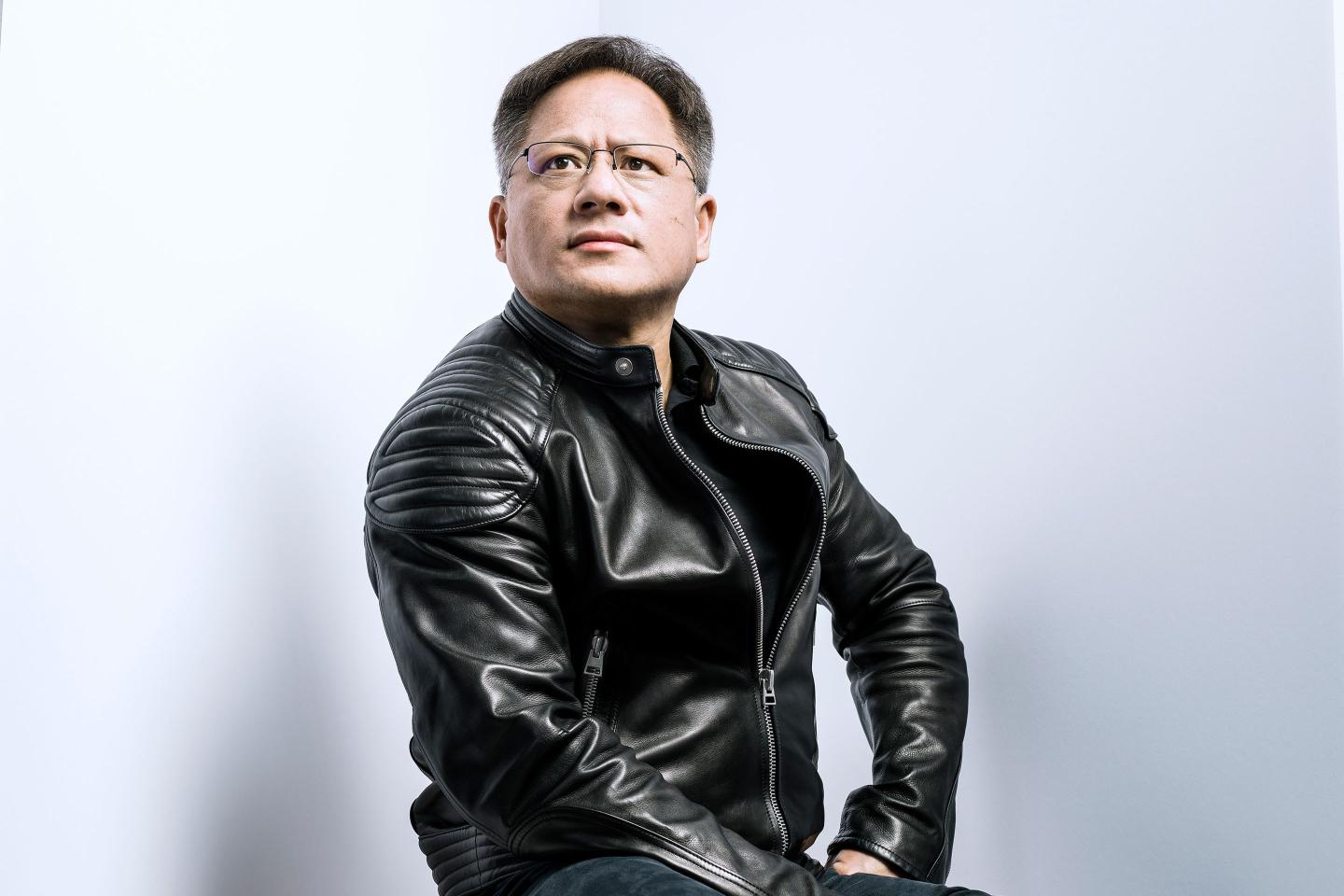
Before the multitrillion-dollar chipmaker Nvidia was the most valuable company in the world and a household name, it didn’t have a name at all. In 1993, after its cofounders Jensen Huang, Chris Malachowsky, and Curtis Priem dreamed up the idea for the company in the booth of a Denny’s, they couldn’t think of one, as Andrew Nusca recounted in Fortune’s 2017 Businessperson of the Year profile of Huang.
So the cofounders started with a placesaver, Huang explained: “[W]e named all of our files NV, as in ‘next version.’” They extended those two letters into the name Nvidia based on invidia, the Latin word for envy. “It stuck.”
Back in 2017, Nusca wrote, “If you haven’t heard of Nvidia, you can be forgiven.” These days, whether you know the name or not, you’ve probably used the company’s products because it’s ”the default supplier of the vital chips that are fueling the AI industry’s rapid growth,” as Beatrice Nolan and Jeremy Kahn write in a new Fortune feature. They caught up with Huang in October on the London leg of his “victory tour” through Europe where he was spreading his gospel of AI optimism.
Huang was already a “corporate celebrity,” they write, but this week, Huang’s name was splashed on front pages for reasons he would not have chosen. After reports that U.S. intelligence agencies believed he had been involved with a suspected Chinese intelligence asset, he admitted to staff that he had been “unfaithful” to his wife and apologized. A second alleged affair came out soon after, and on Thursday he resigned.
Huang has always been a larger-than-life character, famous for his designer leather jackets and eager to show Nusca, in 2017, the tattoo he got on his arm to fulfill a pledge he made for if the company’s stock price went to $100. But there was also real substance beneath the bombast, Nusca wrote, describing him as “a visionary who foresaw a blossoming market for a new kind of computing early enough to reposition his company years in advance.” Huang was already predicting “the ability for artificial intelligence to write artificial intelligence by itself.”
Jay Goldberg, an analyst at Seaport Research Partners, told Nolan and Kahn that it was Huang’s willingness to make big bets—even if some failed—that set his leadership of Nvidia apart. “If they lose that,” he said, “they’re going to become just another chip company.”
Plenty remains uncertain about the future of Nvidia and of the AI ecosystem it helped seed with investments. In Nolan and Kahn’s words, “the sector has yet to prove it can thrive without Nvidia—and Nvidia has yet to prove it can thrive without Huang.”
One question does have a clear answer, however: how to say the company’s name. As Nusca’s story explains, it’s not “NUH-vid-ee-uh.” It’s “en-VID-eeyah.”