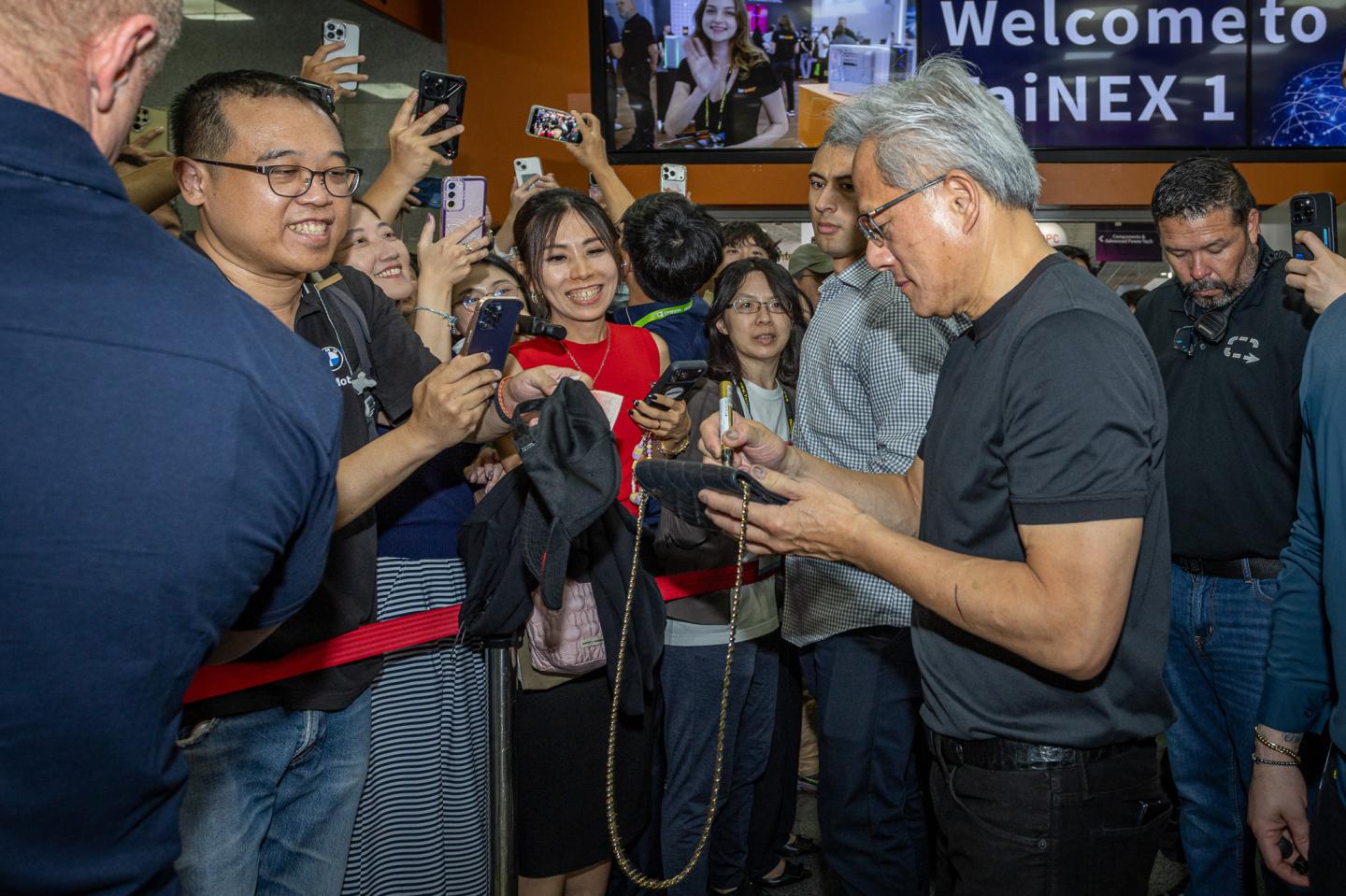
In Taiwan, Jensen Huang is more than a CEO. The Tainan-born Nvidia founder is a frequent visitor who dines with the island’s tech elite and draws fans wherever he goes.
On Thursday, Huang resigned from the top job at Nvidia after reports of two extramarital affairs, one with a woman U.S. intelligence officials reportedly believe is a Chinese intelligence asset.
Few places have more riding on Huang’s reputation than Taiwan, where TSMC, Foxconn and other suppliers form the backbone of Nvidia’s business and Huang is treated as a homegrown hero. Analysts there say Taiwanese are likely to forgive his personal failings. The allegations that Chinese intelligence may have exploited his relationships are another matter on an island that sees Beijing’s spying on its tech industry as a long-running national security threat.
Huang’s reputation is now in ruins in the U.S. following revelations that he had an extramarital affair with a woman whom U.S. intelligence officials believe to be a Chinese intelligence asset. Nvidia is also dogged by accusations that it facilitated Chinese access to its AI chips, which are subject to U.S. export controls.
Nvidia’s relationship with Megaspeed, a Singapore-based company, is now under scrutiny following a flurry of media reports about Jensen Huang’s relationship with Alice Huang, a former Megaspeed executive. Several media reports allege that Megaspeed helped Chinese companies get access to Nvidia AI processors, potentially in violation of U.S. export controls. (Beijing denies Alice Huang is a spy; Megaspeed has also denied allegations that it’s involved in chip smuggling).
On Oct. 29, The New York Times reported that U.S. intelligence officials believed Alice Huang to be feeding information to Beijing. On Nov. 8, Jensen Huang admitted that he’d had an extramarital affair, and Nvidia announced that it would conduct an independent investigation, adding that it had “no reason to believe that either national security or NVIDIA secrets were compromised.”
The Wall Street Journal reported Wednesday that Nvidia’s board was preparing to remove Huang as CEO after a second relationship with an employee was reported by the New York Times. By Thursday morning, Huang had resigned as CEO, and CFO Colette Kress was appointed interim CEO.
In Taiwan, analysts say the extramarital affairs will do little to dent Huang’s celebrity status, given how his business success has become a source of pride.
“Jensen can be said to be a rockstar of the high-tech industry,” Fang-Yu Chen, an associate professor in political science at Taiwan’s Soochow University, says. “People feel that his achievements are extraordinary and feel very proud that Taiwan ‘produced’ such a world-class entrepreneur.”
However, the intelligence allegations could pose a more serious threat to his standing.
“If Chinese intelligence operatives were able to exploit business relationships at the highest level of Nvidia, we need to ask whether similar vulnerabilities might exist elsewhere in that network,” Hung-Jen Wang, a political science professor at National Cheng Kung University, says.
“The allegations raise legitimate questions about supply-chain security that deserve closer examination,” he adds. “This is particularly important for Taiwan because Chinese intelligence activities targeting its technology sector are already a longstanding national security concern.”
On Wednesday, Taiwan revoked Alice Huang’s entry permit, preventing her from returning to the island.
Could Huang’s standing in Taiwan change?
Huang maintains close ties with Taiwan’s technology industry. During a 55-hour visit to Taiwan in January 2025, Nvidia’s CEO met with senior executives from some of the island’s leading technology companies. He also attended a lunch in Taipei with Foxconn chairman Liu Young-way, Acer chairman Jason Chen, Quanta Computer chairman Barry Lam, and 33 other high-profile guests.
In May, Nvidia announced plans to invest $150 billion a year in Taiwan, which Huang described as the “epicenter” of the AI revolution. Days later, Huang delivered a keynote address at Taiwan’s Computex, one of the world’s largest technology trade shows. He unveiled a new chip designed to bring AI capabilities directly to desktop computers and laptops.
Wang says that the Nvidia CEO’s relationship with Alice Huang may have only a limited effect on his reputation because Taiwanese people recognize his contributions to the technology industry. “If the controversy remains primarily a matter of personal misconduct, I suspect Huang will retain much of his popularity,” he says.
However, he adds that Jensen Huang’s standing in Taiwan could change depending on what “ongoing investigations establish.”
“But, the situation would become much more serious if investigators found that sensitive technologies, confidential business information, or restricted AI chips had been transferred to China through relationships connected to this case,” Wang adds. “It would be particularly damaging if evidence emerged that Taiwanese companies or individuals within Nvidia’s supply chain had been compromised.”
Wang points out that Huang has already faced criticism in Taiwan for Nvidia’s efforts to enter the mainland Chinese market. In October, Reuters reported that ByteDance, Alibaba, and Tencent placed over $35 billion worth of Nvidia chip orders.
“From their [Taiwanese] perspective, advanced AI chips are no longer simply commercial products,” Wang said, adding that advanced AI chips have become “strategically important technologies” with potential military and national security implications.
“If the investigation establishes that Chinese intelligence networks exploited those commercial relationships, his previous arguments about selling advanced chips to China would face much greater scrutiny in Taiwan.”
Nvidia will next report earnings—with Kress at the helm—on Nov. 17.