
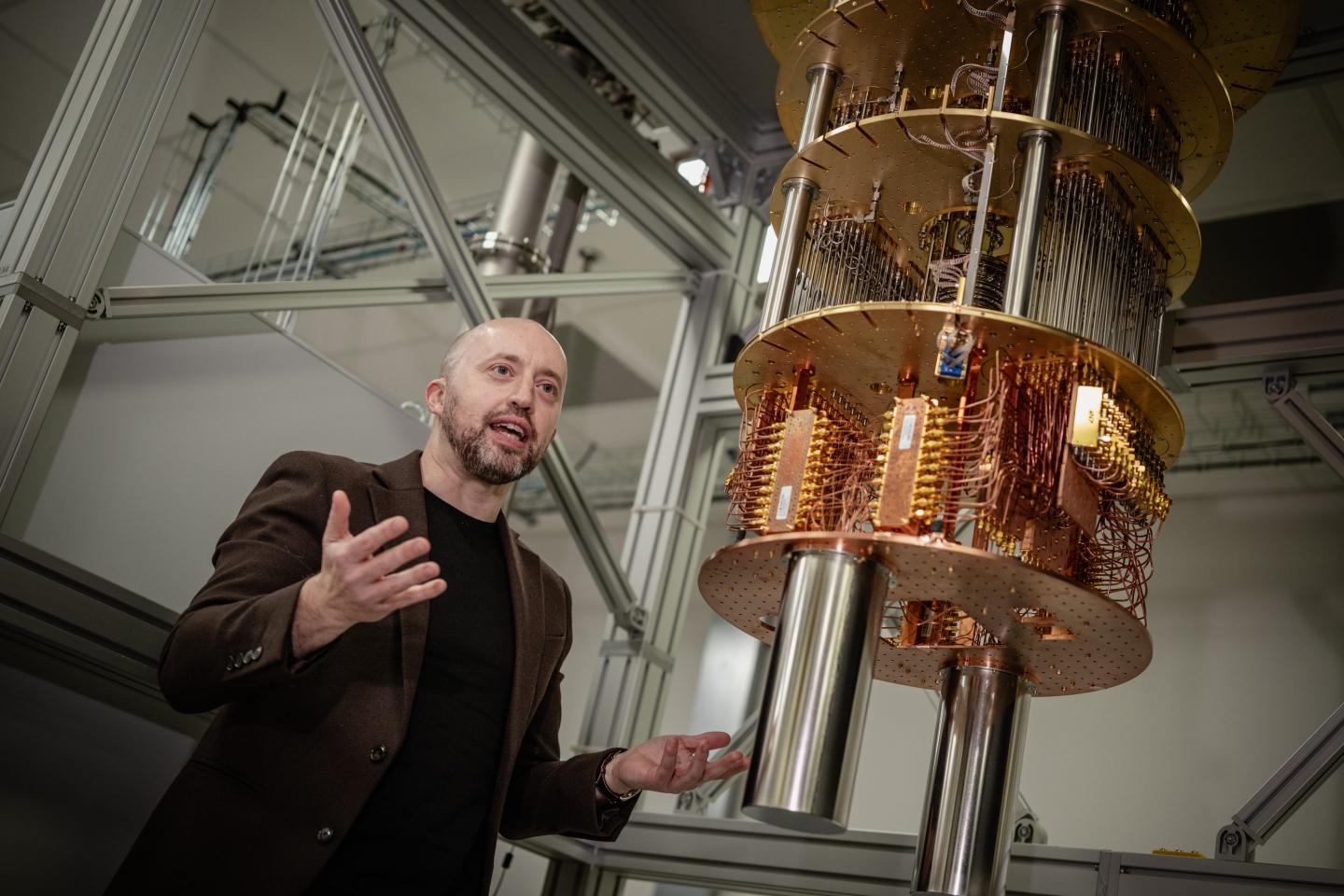
A boardroom’s job is to see around corners. Ten years ago, large language models were the approaching challenge, a fledgling technology with a wide range of plausible applications. Today it is quantum computing.
Quantum will change the way we consider computing power. At present, classical computing encodes everything using “bits”. Bits only have two states, 0 or 1. Quantum uses quantum bits, or qubits, which are more adventurous. They can be 0 or 1 or a mixture of both, called “superposition.” This flexibility allows them to perform many more tasks than classical computing at a speed high enough to revolutionize how we work.
This has advantages as well as risks. Most of life is more complicated than a series of ones and zeros. Understanding the delicacy of a human protein and its relationship to disease, how the climate works or the interaction of sub-atomic particles in fluids requires significant amounts of computing power. In the battle to keep business and personal data safe from bad actors, the more powerful the technical smarts at our fingertips, the better. Financial services firms already have quant capabilities to help them trade and would like more.
But qubits can be erratic and prone to error. Small fluctuations in temperature and atmospheric pressure can cause malfunctions. Expensive isolation chambers are the norm. We might all like to drive a supercar, but sometimes a basic family runaround—classic computing—is more reliable.
Many companies are working hard to make quantum computing the next ubiquitous technology. IBM, Google, and Microsoft have significant quantum divisions. Pure play operators such as D-Wave Quantum, Rigetti Computing, and IonQ are seeing valuations in the multiple billions of dollars.
Europe is getting in on the scene. In June, Oxford Quantum Circuits (OQC) executed the biggest C-series raise for a quantum computing company in Europe at £260 million ($345 million). The next stage is commercial applications with a clear return on investment.
“Some of the earliest use cases of quantum are the ability to conduct vulnerability analysis on your network, and also to be able to detect threats,” OQC’s CEO Gerald Mullally told me. “And that’s really where the possibility of strengthening our cyber security defenses through the earliest use of quantum compute becomes possible.”
“Quantum can have a profound impact on being able to identify the anomalous behavior of rogue agents.”
oxford quantum circuits CEO Gerald Mullally
The good guys need to get there first. A scenario where quantum computing becomes so powerful it can eat through all classical computer encryption defenses is not outside the realms of possibility. By then—and it could be as little as five years away—every company and individual will need powerful quant on their side.
“The first area where we generate advantage is anomaly detection—the ability to be able to spot something different in a pattern of data,” Mullally said. “Fraud detection and anti-money laundering are two of the very first use cases in financial services.
“Classical compute can really struggle to identify patterns or the relationships between data. Quantum moves that data to a higher dimensional plane, like a sphere, rather than two points. If it’s a sphere, you can then see more easily that there’s a relationship between data that you wouldn’t be able to spot if it was classical compute.”
When it comes to encryption, quantum will give businesses an “offensive capability” sufficient to head off the threat.
Fortunately, quantum computing’s capabilities are becoming stronger by the day. Average quant algorithms can regularly execute a thousand steps before being overwhelmed by errors. Soon that number will grow to a million steps.
“We will hit millions of steps before an error takes over in the years 2028 to 2031,” Mullally said. “That’s the point where we move past the capabilities of classical compute in those narrow areas like anomaly detection. That will be our version of the ChatGPT moment, and that will be the point where the confidence will grow. We’re going to hit billions, and we’re going to hit trillions of quantum operations, and we’ll start to then have this real commercial advantage for a corporate.”
Many executives are tired of tech bros bearing gifts and have spent considerable amounts of money experimenting with artificial intelligence. Bottom lines have remained resolutely flat.
Quantum is different, a mechanism for problem solving which comes closer to understanding the complexities of the world. OQC already has applications helping data centers operate more efficiently. As AI goes rogue with greater regularity, executives will be glad of a new, well-armed hunter to defeat the errant agent.
“I think quantum can have a profound impact on being able to identify the anomalous behavior of certain agents, and that’s the rogue agent type,” Mullally said. Nervous CEOs won’t be the only ones heaving a sigh of relief.