
Over the course of four decades, J. Crew’s style has woven cashmere cardigans, tweed jackets, and other preppy staples that have attracted high-profile fans including Michelle Obama, Demi Moore, and Meghan Markle.
Throughout the apparel brand’s history—beginning as a catalog, then growing to become a physical and omnichannel retailer—those styling decisions were made by humans. But beginning today, there’s artificial intelligence at work too.
On Wednesday, J. Crew announced a new consumer-facing, AI-enabled tool called Style Advisor, which runs on a collection of Anthropic’s models. Style Advisor is trained on data from thousands of outfit pairings from the company’s photo shoots and J. Crew’s styling principles, outfit and accessories pairings.
“It’s not just about the piece that you’re looking for, but how to style it,” says Danielle Schmelkin, chief information officer at J. Crew. “What those stylists bring to the table—and really recommend more than just the item that you may have picked up when you walked into the store—we are really looking to create that online.”
As more shoppers gravitate to agentic shopping, with more than 50% of global consumers using AI to buy goods within the past three months, new tools have proliferated ranging from Meta Platforms’ Muse agent and Alexa for Shopping from Amazon to AI shopping assistants created by retailers including Lowe’s, Ulta Beauty, and Macy’s.
But while 56% of consumers say they use AI chat or search tools including Anthropic’s Claude or OpenAI’s ChatGPT, only 27% are gravitating to retailer-created AI shopping assistants, according to consulting firm McKinsey.
“I think the visual piece is really important,” says Schmelkin of the distinctive edge that she promises Style Advisor will offer. In the future, the tool will also pull in data from a consumer’s past purchase history, allowing Style Advisor to make even more personalized recommendations, replicating that’s already possible during the omnichannel shopping experience.
She says Style Advisor is also grounded in contextual details, asking questions to better understand a shopper’s intent. If a J. Crew customer were to tell it that they were looking for an outfit to attend a wedding—in, say, Miami, but not too formal—the tool will make recommendations based on these nuances.
Style Advisor will debut on J. Crew’s desktop website and is expected to later be added to the retailer’s mobile app.
J. Crew’s Style Advisor runs on a variety of Claude’s models, including Fable 5.1, which is leveraged to handle the more complex and ambiguous judgment that allows the tool to think and respond like a stylist. Claude’s Sonnet 5.5 and Haiku 4.5 support the speed and efficiency of the back-and-forth responses between consumers and the AI stylist, while Claude Opus 5.5 was utilized by J. Crew’s team to build a working prototype.
“What is the actual experience that we want the shopper to have, and then, how do we think about making sure that we’re mapping the right models to be able to deliver that,” says Lauren Collett, Anthropic’s enterprise go-to-market leader.
Schmelkin says J. Crew built in a back-end observation layer that allows the retailer to closely monitor the costs. “We want to make sure we are constantly refining and using these models in the right way, both in terms of the outputs for our customers, but also the efficiency we want to see to make this scalable,” says Schmelkin.
Internally at J. Crew, to bolster AI adoption, the retailer has created an AI fluency program that begins with the basics and advances up through vibe coding. An internal AI lab, called “Second Thread,” began with just the tech team but has broadened to incorporate all corporate employees to discuss AI use cases and propose other technology solutions.
For four years, J. Crew has also run a two-day tech summit that features workshops, hackathons, guest speakers, and vendor presentations. Initially, this programming was only available to the tech team, but J. Crew has more recently democratized access. Employees are also encouraged to use AI enterprise tools from Anthropic and OpenAI.
The Style Advisor was conceptualized by a J. Crew digital product designer, who developed a working prototype before engineers were pulled into the project. The fact that the tool wasn’t mandated from the top of J. Crew’s C-suite reflects Schmelkin’s efforts to encourage employees to chart their own path on AI.
“I’ve been screaming to anyone who will listen for years now to get in there and build a habit,” says Schmelkin. “You have to find your a-ha moment and then all of a sudden…this could really change the way you think about your own life, work, and team productivity.”
John Kell
NEWS PACKETS
Nvidia’s shares rattled by CEO's affair and board probe. The biggest tech headlines swirling this week centered on an admission over the weekend that Nvidia CEO Jensen Huang had been unfaithful to his wife and that the AI chip maker’s board was investigating reports that he had been targeted by a business executive who U.S. intelligence says was a Chinese spy. Nvidia’s shares slipped on Monday as U.S. lawmakers are also asking for more information. Fortune reports that Nvidia controls about 90% of the market for high-powered GPU computer chips used in AI data centers. And yet another issue is poor succession planning by the board: Huang, who has been CEO for 33 years, has 60 direct reports and no clear successor.
Alphabet, meanwhile, takes aim at Nvidia. On Monday, Google debuted new AI chips that Bloomberg reports are intended to take some share from Nvidia’s dominant position and represent an acceleration in product development coming from the company’s chip division. But another corner of the search giant’s AI business is facing mounting criticism. Politicians are lamenting the company’s decision to block search for K-12 student accounts if districts have enacted AI bans. Sen. Edward Markey has demanded that the company reverse a policy; while Google says its AI features are so interconnected with search that it cannot offer the service without AI.
Anthropic continues to advance plans for IPO; debuts new frontier models. Yet another AI company aiming to navigate more turbulent times is Anthropic, which is reportedly planning to go public next week even as shares of AI companies have faced pressure as investors fret about high infrastructure costs and U.S. midterm election results that are divisively more “anti AI.” Separately, on Monday, Anthropic debuted two new AI models called Fable 5.2 and Mythos 5.2, which the company said generate outputs that are 30% faster than their predecessors. The models also cost 20% less than the prior generation. And on Tuesday, it unveiled a suite of new office productivity tools aimed at knowledge workers, putting Anthropic in closer competition with Microsoft.
OpenAI raises about $11 billion in a new funding round. The ChatGPT maker’s latest effort to raise more funds reportedly closed on Friday, with the remainder of the round, which could hit as much as $20 billion in total, expected to be completed “in the coming weeks,” according to media reports. OpenAI has reportedly sought out to raise $30 billion or more at a valuation of $1.4 trillion, but settled for a lower figure and a valuation of $1.25 trillion, amid the pressure AI companies are facing from investors. More optimistically, Business Insider reports on fresh research data from Graphite that found ChatGPT has captured 81% of worldwide AI chatbot traffic, easily outpacing rivals Google and Anthropic, who had been making some inroads.
ADOPTION CURVE
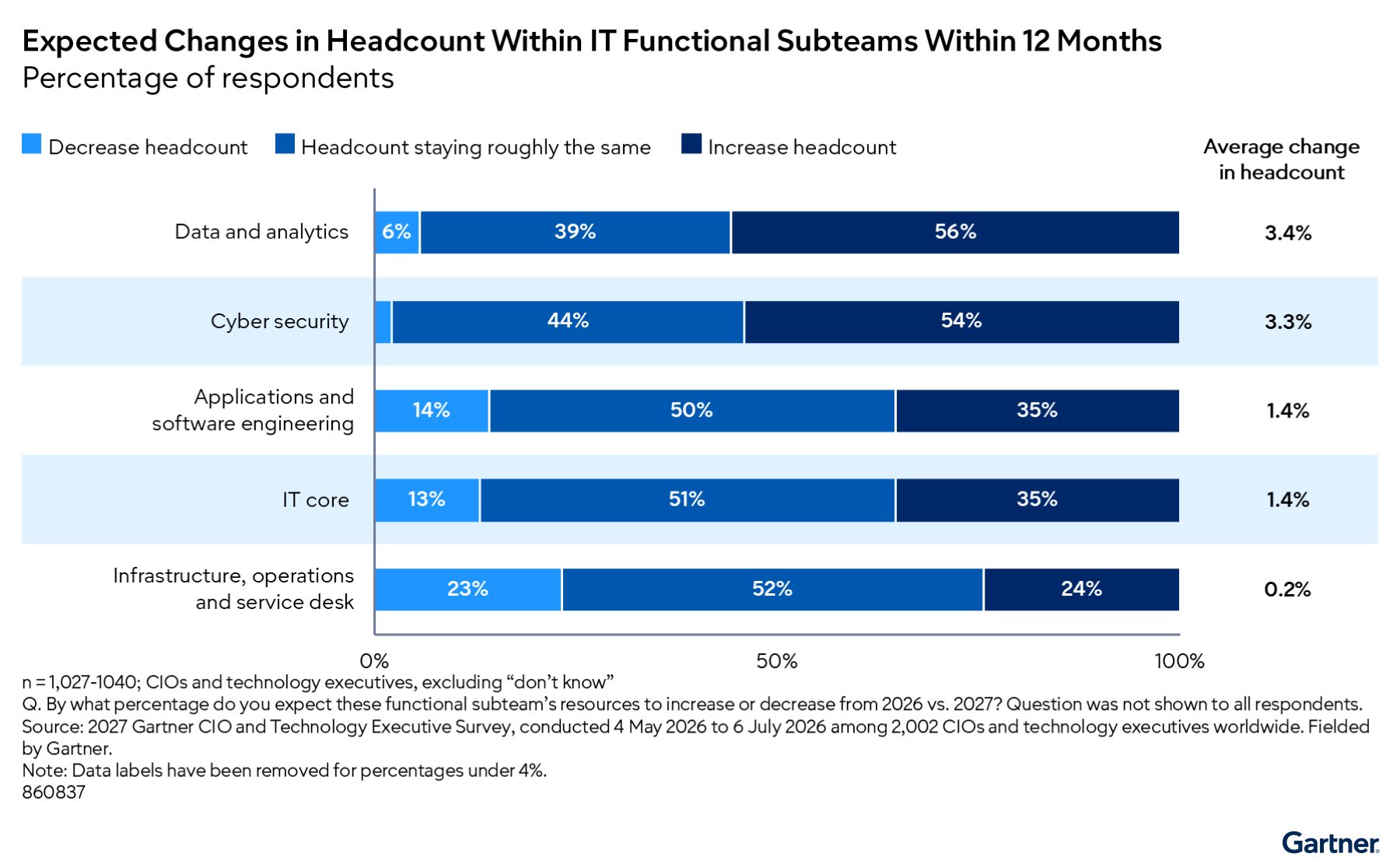
Data and analytics, cyber jobs will see the largest headcount increase in 2027. AI’s impact on jobs have loomed over the IT industry, magnified by younger, entry-level workers that have taken to social media to lament they can’t find their first role and as Meta, Microsoft, Amazon, and other tech giants have announced layoffs. Yet encouragingly, 40% of enterprises plan to increase their IT headcount in 2027, according to a survey of 2,002 CIOs and other tech leaders conducted by Gartner. The biggest changes will be for data and analytics and cybersecurity roles.
Alicia Mullery, VP analyst at Gartner, tells Fortune that much of the concern about AI in the workplace is that these systems will save organizations so much time, they’ll need less people. But that’s not always the case: AI can create a lot of so-called “slop” that workers need to rummage through. And, even when the outputs are more advantageous, there are still plenty of instances where human-machine collaboration is needed.
IT departments tend to be further along on their AI journey and this is where CIOs can continue to step in and guide, remaking workflows across other parts of the business, says Mullery. “I see the CIO as really being at the forefront of being able to say, ‘Hey our teams went through this first,’” adds Mullery. “Here’s what we learned, here’s what worked, and here’s what didn’t work.”
Courtesy of Gartner
JOBS RADAR
Hiring:
- FFB Bank is seeking a CIO, a remote-based role. Posted salary range: $275K-$375K/year.
- Citi is seeking a head of retail and wealth risk technology, based in Rutherford, New Jersey. Posted salary range: $250K-$500K/year.
- DBV Technologies is seeking a VP of IT, based in Bernards, New Jersey. Posted salary range: $300K-$350K/year.
- The American Board of Emergency Medicine is seeking a CIO, based in East Lansing, Michigan. Posted salary range: $200K-$250K/year.
Hired:
- Hyatt named Danny Miles to serve as the hospitality company’s chief digital and information officer, leading a newly combined organization that includes engineering, digital products, enterprise technology, data, AI, and cybersecurity. Miles most recently served as CTO at athletic gear maker Under Armour and also was CTO at Dollar Shave Club and a VP at Nike.
- Fox Factory promoted Troy Henige to the newly established role of CTO, leading the manufacturer’s enterprise technology and product roadmap strategies. Henige spent seven years in engineering roles at motorcycle and ATV suspension manufacturer Progressive Suspension before joining Fox a decade ago, most recently serving as VP of engineering.
- Time appointed Michael Dugan to the role of CTO. He joins the media company from peer G/O Media, where he served as CTO. Previously, Dugan served as CTO of Hearst Magazines and spent 17 years at Forbes, including four years as CTO.
- Authentic Brands Group promoted Adnan Somani to the role of CTO, expanding his responsibilities to include overseeing the brand management company’s AI strategy and IT organization. Somani joined Authentic Brands as EVP of digital technology in May 2024 and previously, founded the technology startup Aiva Labs.
- Presidio announced Doran Stienike will join the IT services firm as CIO, effective November 9. Previously, Stienike served as CIO and chief information security officer at software-as-a-service provider CSG International. He also served as CIO and held other technology leadership roles at ConAgra Foods.
- OneTrust named Tim Mullen to serve as CIO, overseeing the governance and compliance software firm’s enterprise technology strategy and accelerating its AI efforts. Mullen joined OneTrust in 2022 and previously served as CISO. He also held information security leadership roles at Change Healthcare, InterContinental Hotels Group, and Travelport.
- DNSFilter announced the appointment of Justin Foster as CTO. Foster joins the cybersecurity company from another cyber firm, Forescout, where he most recently served as CTO and oversaw the research and development organization. He joined Forescout through its acquisition of Cysiv, where he was co-founder and CTO.