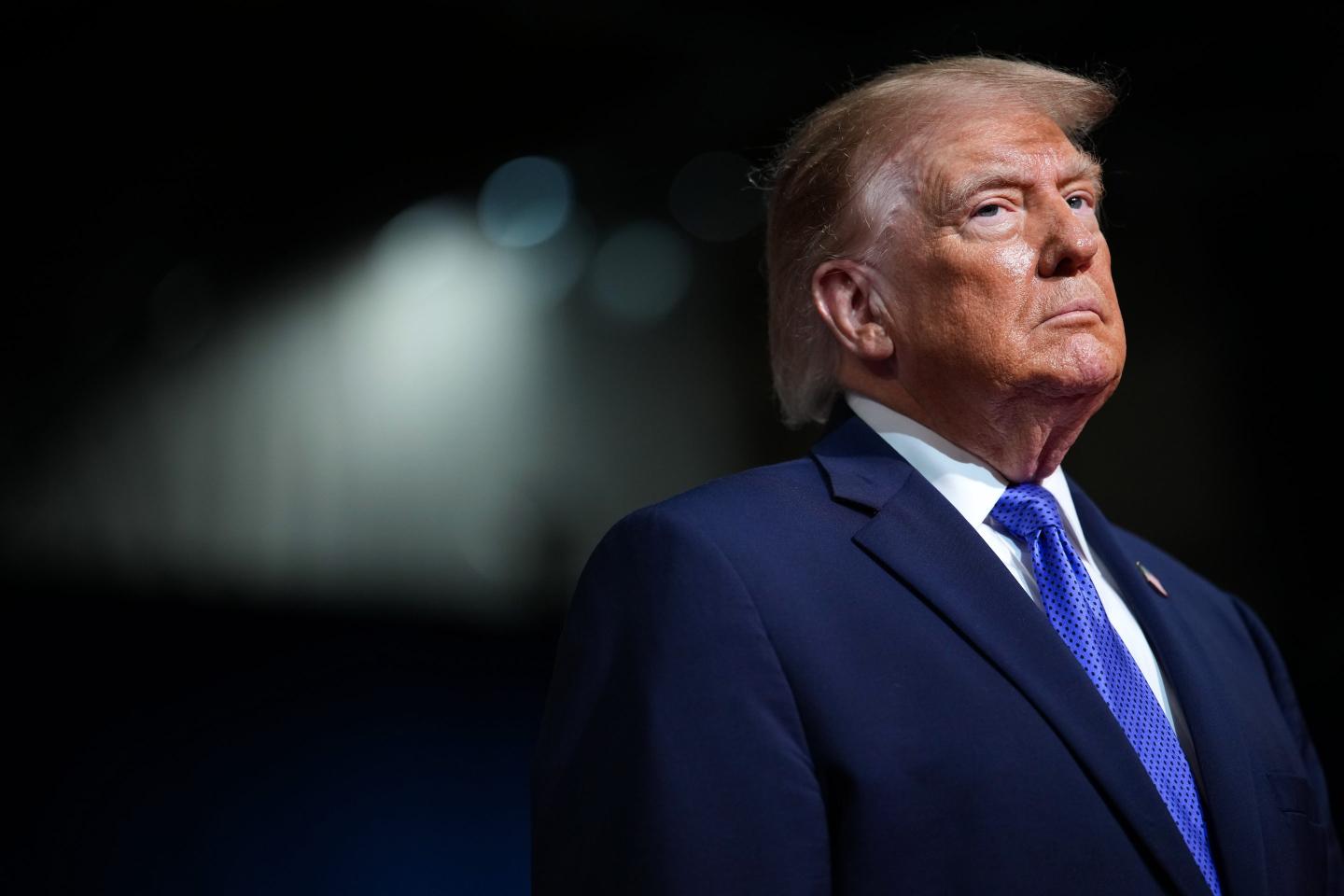
In 2024, Donald Trump appeared to make inroads with Indian Americans, a traditionally Democratic voting bloc. He won the support of 30% of Indian Americans that year, up from 22% in 2020, according to a report published on Nov. 2 by the Carnegie Endowment for International Peace. Its charts show that up until January of this year, GOP support was increasing among Indian women and men aged 40 and older.
But two years into Trump’s second term, and those gains vanished ahead of the midterms. Just 19% of the 1,000 Indian American adults surveyed from Oct. 7 to Oct. 27 by Carnegie intended to vote for the Republican in their House district, compared to 62% intending to vote for the Democrat. In Senate races, Democrats held a similar advantage over Republicans at 63% to 21%.
The reversal coincided with the Trump administration’s crackdown on legal immigration through H1-B visa restrictions, increasingly vocal anti-Indian rhetoric from some Republicans, and renewed concerns about the rising cost of living, contributing to the GOP’s declining appeal to even the Indian Americans it began winning over.
Devesh Kapur, a professor of South Asia studies at Johns Hopkins University who co-authored the Carnegie report, told Fortune that economic concerns drew Indian Americans toward Trump in 2024, when voters were frustrated by inflation and the rising cost of living under Joe Biden.
But those same anxieties, compounded by Trump’s immigration politics and a rise in anti-Indian racism, helped turn Indian American voters away again.
“It’s a combination of these three factors,” he said.
A blatant example of what Kapur refers to as the “racist rhetoric in the MAGA crowd” came in September, when Bo French, the GOP candidate for Texas’s railroad commissioner, posted a photo on X of a crowd of South Asian students celebrating a University of Texas at Austin football victory.
“I heard UT graduation this year looked like this,” French wrote. “I didn’t believe it. The problem is now obviously far worse than anyone imagined.”
While members of his party like Sen. John Cornyn condemned the post, its existence revived Indian Americans’ concern that Republicans don’t fully welcome the community.
Amrita Bhasin, the CEO of AI-powered supply chain platform Sotira, told Fortune that more vocal anti-South Asian rhetoric by political figures pushed away Indian American voters more than changes to immigration policy alone.
“I actually don’t think the racism is any worse than it was pre-Trump,” she said. “What’s different now is that politicians and people in power feel comfortable saying racist things out loud, specifically about South Asian people.”
In her view, Trump proposing a $103,265 surcharge on companies hiring workers with an H1-B visa in August also played a role. H1-B visa holders generally can’t vote, but Indian Americans may have relatives, friends, or colleagues whose ability to work in the country depends on the program.
Indians represent 71% of all H1-B visa approvals and have a strong presence in tech jobs and other highly skilled professions, so these restrictions send a message that they don’t belong, Bhasin said.
“I think the H-1B is part of it, but really the H-1B is a symptom of a bigger issue,” she said. “When you see that this work is not being respected in the same way, it feels like the Republicans maybe are not on the side of Indians.”
Religion as another wedge
Republicans have long believed Indian Americans should be receptive to their platform. David Frum, a former speechwriter for George W. Bush, called Indian Americans “natural conservative voters” because of their high incomes, educational backgrounds, and entrepreneurship.
Indian journalist and now Council on Foreign Relations senior fellow Sadanand Dhume penned a 2012 essay for the conservative American Enterprise Institute saying that “interests, values, and history all suggest that the natural political home for Indian-Americans is the GOP.”
But Kapur said the “growing grip” of evangelical Christianity in the GOP has limited its appeal to Indian American voters. The Carnegie report found nearly one in three Indian American Christians (31%) identified as Republicans, compared with 21% of Hindus, 10% of Muslims, and just 8% of those with no religious affiliation.
“Since the majority are not Christian, that alone becomes a singular sort of impediment,” Kapur said. “There’s no way to get around it.”
The tension over religion surfaced notably in Texas politics. In 2023, Democratic state lawmaker James Talarico pointed to the potential alienation of Hindu students during a legislative hearing on a GOP bill requiring public schools to display the Ten Commandments.
“How do you think it makes a Hindu student feel to have a poster in every classroom that says ‘thou shall not worship any God before me’?’ he asked.
Three years later, Talarico beat GOP candidate Ken Paxton to become the first Democrat to win a U.S. Senate seat in Texas since 1988. In Fort Bend County, which includes the Houston suburb of Sugar Land and its sizable Indian American community, Talarico won 63% of the vote compared with Paxton’s nearly 35%, according to county election returns.
But Indian Americans voting against Republicans in the midterms doesn’t mean they did it out of stronger loyalty to Democrats. About 35% of Indian Americans who planned to vote Democrat in the midterms said they were motivated by opposition to Republicans, rather than support for Democrats, per the Carnegie report.
“Anger or feeling of antipathy towards the Republican Party was clearly an important factor over and above the support for the Democrat Party per se,” Kapur said.