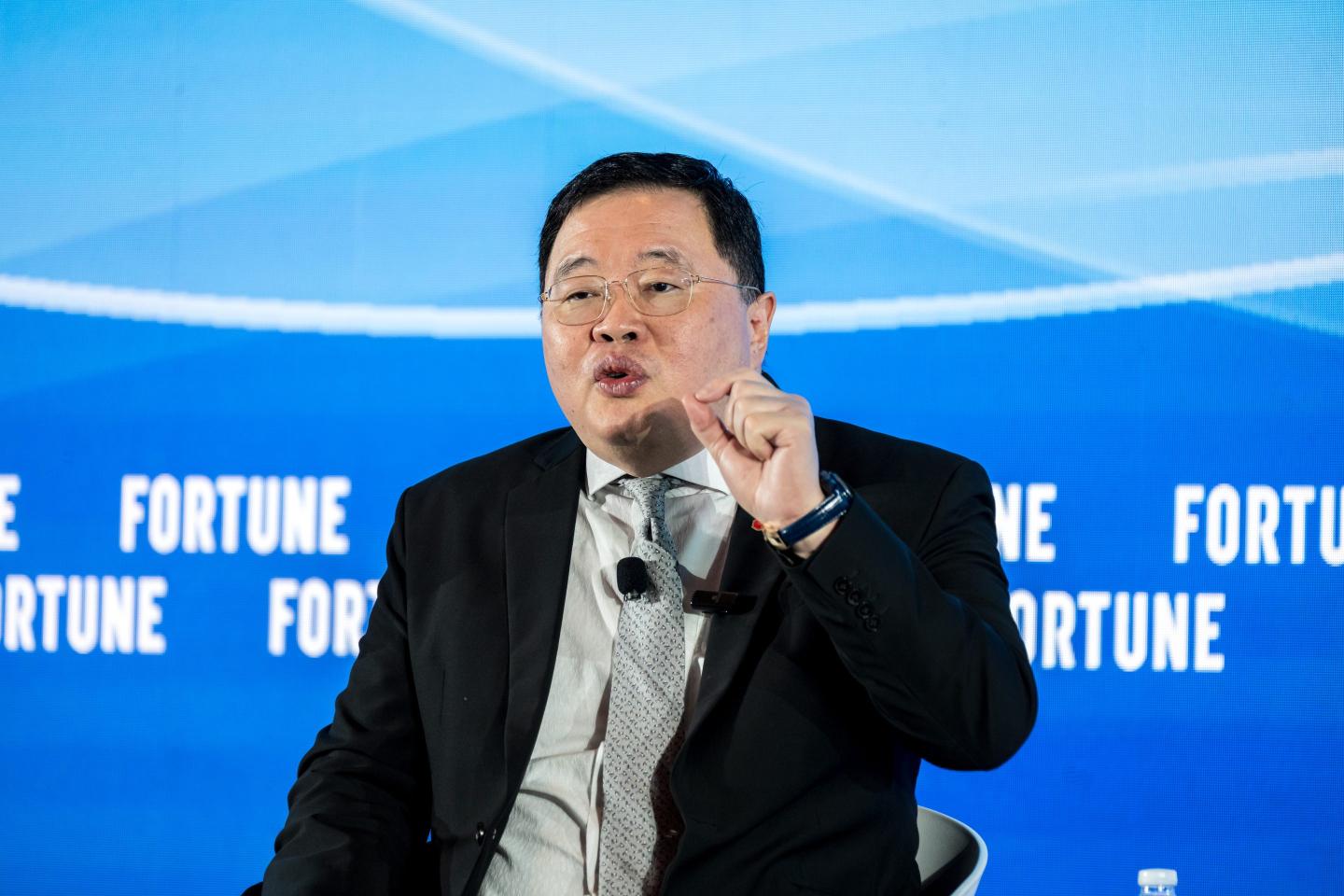
Chinese overcapacity is “a fact of life,” and Southeast Asia’s manufacturers must build plants big enough to sell across the whole region or get priced out, the CEO of Thai industrial giant Siam Cement Group said Tuesday.
“If you look at the current situation, we are facing overcapacity from mainland China,” Thammasak Sethaudom, president and CEO of SCG, said onstage at the Fortune Southeast Asia 500 Summit in Ho Chi Minh City on Nov. 3. “There is a lot of good and quite competitive product from China flooding into the whole region…To SCG, this is the fact of life, and we have to adjust.”
Overcapacity occurs when factories can produce more than customers are buying. In petrochemicals—the building blocks of plastics and other industrial materials—China’s rapid expansion has squeezed producers elsewhere.
China’s exports of polypropylene, a widely used plastic, rose from 1.3 million tonnes in 2022 to 3.1 million tonnes in 2025, according to industry research firm ICIS. An ICIS analyst estimates exports could reach about 5.1 million tonnes in 2026 if the January-May pace continues.
Individual Southeast Asian markets are too small to absorb that shock alone, Thammasak argues. “The scale that produces only for Vietnam may not be enough,” he said. “You need to build the scale that produces for the whole ASEAN.”
“Over the past year, we are scrapping the old small factory and building a big one,” he said, citing a new ceramic plant in Vietnam “much bigger than the one in the past.”
On Oct. 28, SCG Chemicals filed to combine its Thai olefins and polyolefins business with that of PTT Global Chemical, Thailand’s largest petrochemical company, in a deal valuing the combined businesses at 187 billion Thai baht ($5.5 billion). SCG Chemicals would hold 44% of the venture, with shareholders due to vote Dec. 3. “The global olefins and polyolefins industry is experiencing increasingly intense competition, placing continued pressure on product spreads and operating rates,” Thammasak said in a statement at the time of the announcement.
In Ho Chi Minh City, Thammasak called the idea that automation is mainly a way to cut labor costs “a big misconception.”
“The bigger advantage is [that it’s] better in terms of quality, because the precision that the robot can do is far better than humans,” he said.
‘Out of the middle income trap’
Thammasak’s fellow panelists were optimistic about Southeast Asia’s ability to climb up the value chain. “I visited a customer in Vietnam just yesterday. They used to make these industrial connectors—old-school industrial goods,” said Salil Chari, FedEx’s regional president for Asia-Pacific. “Now, with the growth in the AI data center space, they’ve moved up the value chain to creating fiber-optic cables for all these data centers.”
FedEx now runs about 42 flights in and out of Vietnam, with much of the demand driven by small and medium-sized enterprises, Chari said.
Liher Urbizu, president and managing director of SAP Southeast Asia, pointed to research spending as a way to help Southeast Asia climb “out of the middle-income trap and up into the value chain.”
Korea invests about 5% of GDP in R&D each year; Singapore manages about 2%, and the rest of ASEAN sits at 1% or lower, he said.
SAP, whose largest development centers have been in India and China for two decades, has spent the past two years building R&D capacity in Southeast Asia—including a Ho Chi Minh City lab Urbizu said now houses 500 developers writing code used by customers worldwide.
Urbizu said ASEAN SMEs are adopting AI faster than their peers in Europe and the U.S. “The conviction that AI can deliver business results is increasing year on year,” he said.
Thammasak said that SCG cannot match China’s R&D budget, so it has to be smarter about where it spends. “We need to be smart,” he said.