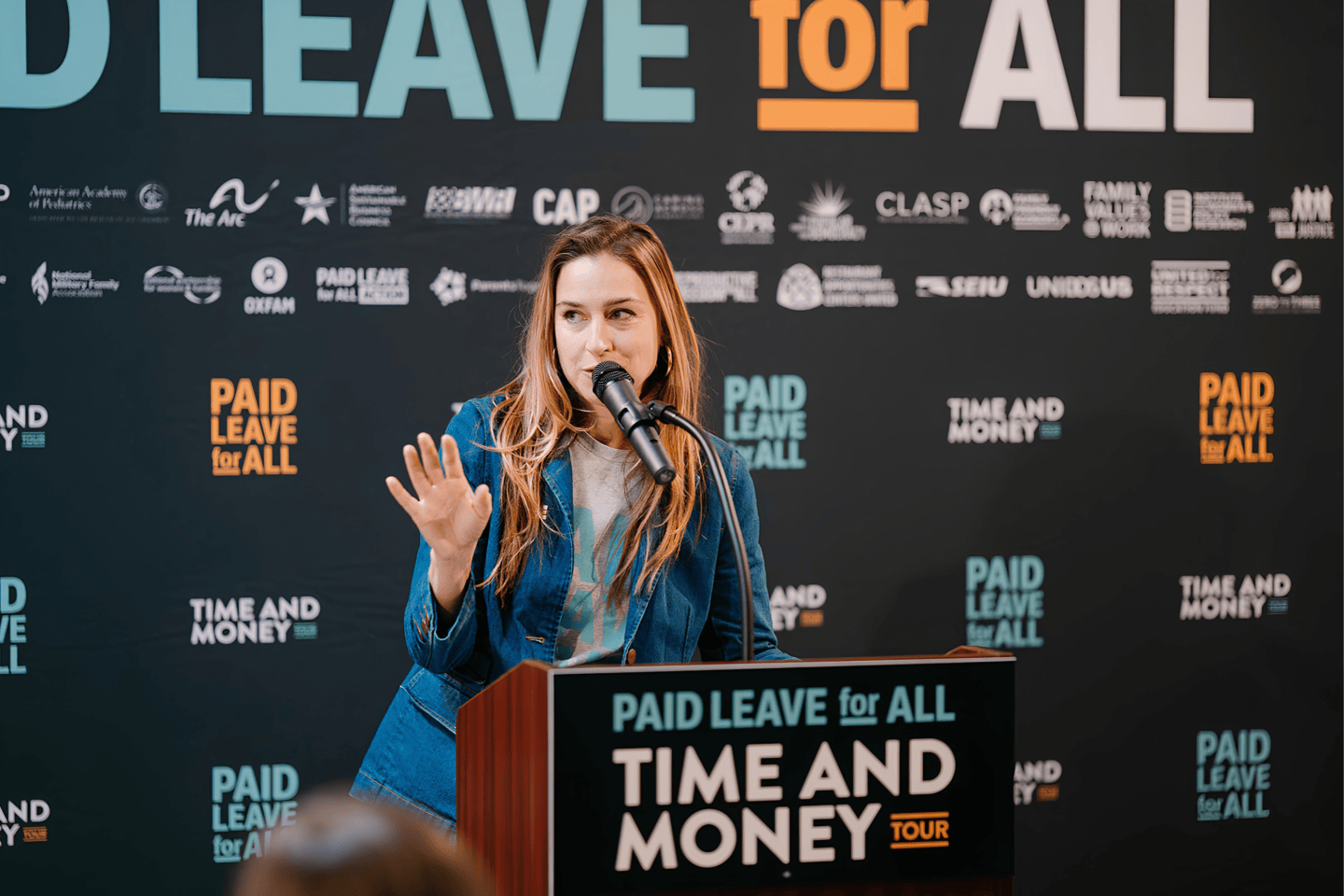
Today we have a guest piece from Dawn Huckelbridge, the founding director of Paid Leave for All. She just came back from a bus tour of three states, hearing from women about sacrifices they’ve had to make without paid leave from work. Here, she shares with us her reflections on what women are giving up—and why they have to:
It’s really fall here in Pennsylvania. Back in D.C., it still felt like summer when I left, the air humid and the trees still green. I’m on a bus tour—what my organization Paid Leave for All is calling the “Time and Money Tour”—across Pennsylvania, Ohio, and Michigan. We’re talking directly with families about the affordability crisis, and something that’s too often missing from that conversation: What happens when you can’t afford to take time away from work to take care of yourself or someone you love?
We wanted to understand what that means for women’s careers, their financial security, and the lives they’re able to build.
One of the women we met was Brittany, a mother in Philadelphia who has a thriving career as a content creator, documenting her family excursions and adventures in the city, from water parks to pumpkin patches. She has multiplying brand partnerships, influencer of the year awards, and a new travel page. She radiates happiness.
But her creator career didn’t start that way. It was a way to get her out of the house while she was battling postpartum depression and anxiety in the aftermath of giving birth prematurely and leaving her job as an elementary school teacher. She had only eight days of sick and personal leave.
We met countless women and caregivers from all walks of life who didn’t have enough or any paid leave, and heard so many of the same things: stories of incredible resilience, creative pivots, survival. A restaurant owner who had to close her doors after an injury, unable to both heal and pay the bills, but found a way to keep cooking with catering and pop-ups. A woman fired from her job while in the NICU with a 9-week-early baby, who opened a communications consultancy. Women forced out of social work who became influencers, women who left legal careers to become home organizers.
We live in a society that loves applauding women who succeed against incredible odds. And we should; these are stories of creativity, entrepreneurship, and determination. They spark joy and give back power. But what about women without the capital to start a business or the network to freelance? It shouldn’t take extraordinary resilience or luck to be a working mother or parent in America.
As of July, 845,000 women left their jobs this year; in that month, 100% of the job losses were for women. Post-layoff surveys by the Department of Labor show that nearly half of laid-off women received no severance, benefits, or placement help. Losing a job means more than wages. You may lose health insurance, benefits, promotions, retirement savings, and job security. Those losses can compound over a lifetime, even with a successful pivot. And as women told us, they also lost their identity, their economic security, their community.
One in four women have gone back to work in the United States within just two weeks of giving birth. Two weeks. Tens of millions of us have zero paid family leave from our jobs. And this means that every day, women are forced to sacrifice careers they’ve spent years building, give up benefits, and exhaust their savings.
We should all have the freedom, the control over our time, to decide our own career trajectories and life choices. In much of the world, there’s a safety net to catch you when life inevitably happens. Can you imagine what might be possible? How many new businesses and ventures might emerge, born not of trauma and necessity, but the ability to dream and determine the course of our own lives? What if we had the ability to care for ourselves and our families and then return when we were ready — if our benefits weren’t tied to our employers, but traveled with us?
Research shows that investing in paid leave and child care to keep more caregivers in the workforce could yield millions of jobs, billions in wages, hundreds of billions in GDP. Paid leave increases performance, productivity, and profitability. But what’s more, it lets us build the lives we want.
Before motherhood, Brittany had taught for 10 years. It was core to her identity, she says. But the stress of having to return to work with a preterm baby before she was ready took a toll on her mental health. She spiraled under the stress, left her secure position, and paid for COBRA herself. She accumulated debt to pay for diapers and groceries.
How many more survival and success stories would there be with the simple guarantee of paid leave? A national paid leave program could untap untold amounts of talent, of resources. It would protect working people’s jobs but also afford them paid leave benefits if they chose to freelance or open a business.
It’s time we imagined a country that valued women’s ingenuity and grit, not just the value derived from it.
Dawn Huckelbridge
Founding Director, Paid Leave for All
The Most Powerful Women Daily newsletter is Fortune’s daily briefing for and about the women leading the business world.
ALSO IN THE HEADLINES
At least two states will elect their first women governors next week. Democratic Sen. Amy Klobuchar and Republican state House Speaker Lisa Demuth are battling it out in Minnesota, as are Republican Sen. Marsha Blackburn and Democrat Jerri Green in Tennessee.
A Fed governor and a regional bank president dissented on the same side for the first time since October 1992. That was Cleveland Fed President Beth Hammack and Fed Governor Lisa Cook, who President Trump has attempted to fire. My colleague Catherina Gioino unpacks how rare that is and what it means.
Keep an eye on Cardi B's brand Grow-Good. Rather than move into Ulta or Sephora, Grow-Good is entering retail through Black-owned beauty supply stores. The brand has been posting videos with the Black women who own several of these stores, including in the Bronx and Harlem. The strategy seems to be working; Grow-Good already has 719,000 Instagram followers, outpacing many other celeb brands.
Female founders are on the rise in the U.K. Three-hundred-and-thirty-three women have built U.K. businesses with revenue over £50 million, up from only 80 two years ago.
ON MY RADAR
Sexism has plagued surfing for generations. A rape allegation has led to a reckoning The Athletic
What about the Cornell 50? The Cut
What if a crisis pregnancy center was pro-choice? The Cut
PARTING WORDS
"We forget sometimes that we haven’t met everyone we’re supposed to meet, that if we’re lucky, and if we’re still alive and we’re still here, that there’s stuff around the corner that we can’t anticipate that we would never know."
—Amy Poehler, who is the Wall Street Journal's comedy innovator of the year