
Dubai’s ambitions to advance technology-driven economic growth and government transformation are well known.
Its Digital Strategy, launched in 2023, aims to digitalise all aspects of life in the emirate and establish a system that enhances the digital economy. Its D33 agenda, meanwhile, is a 10-year plan that focuses on doubling Dubai’s economy by 2033 and includes generating an estimated AED100 billion ($27.23 billion) annually through digital transformation.
More recently, in April this year, the government announced an ambition for its AI-driven government initiatives to support more than AED10 billion ($2.72 billion) in GDP growth within two years of operation.
Central to this transformation is Digital Dubai, a government entity that is increasingly harnessing data to transform how decisions are made, services are delivered, and innovation is accelerated.
Its work supports Dubai’s broader vision of a digitally-driven economy, underpinned by integrated digital infrastructure that enables government entities, businesses, and residents to access more connected and seamless services.
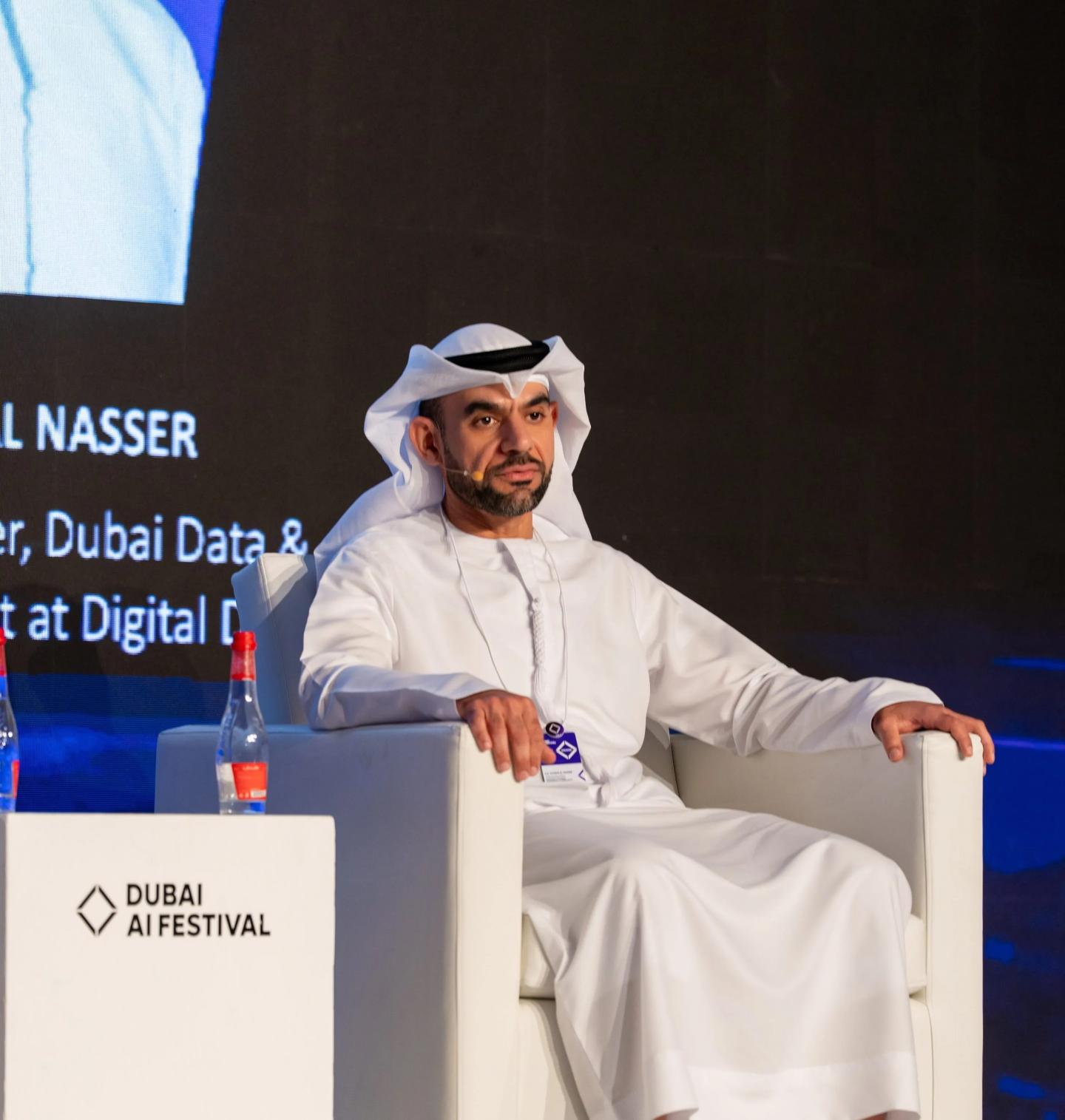
“Data acts as the glue of our cities,” says H.E. Younus Al Nasser, CEO of Dubai Data & Statistics Establishment at Digital Dubai.
“Leveraging data from different verticals in the city to paint one holistic picture of how Dubai is performing is really what we are trying to achieve.
“And an era in which AI provides trusted information is crucial, as it empowers us to analyse data more effectively and derive meaningful insights. This is the transformation we are driving through data, enabling faster, more reliable, and more informed decision-making across the city of Dubai.”
Rather than treating AI as a collection of separate chatbots or pilot projects, Digital Dubai has established an integrated system in which data can flow between government entities, AI can turn that data into decisions, and digital services can respond more proactively to people’s needs.
In April this year, Digital Dubai introduced its AI Integration Matrix Framework to coordinate AI adoption across government entities.
It has applied the framework internally to guide the deployment of more than 100 AI systems with the aim of reducing duplicated projects and making AI deployments more consistent and reusable.
Digital Dubai’s Dubai Population Now platform offers a compelling example of how this can work in practice. Combining AI, machine learning and predictive analytics, the platform generates continuously updated estimates of the number of people present in the emirate, capturing not only registered residents but also the wider population moving through the city.
It integrates data from multiple government sources, spanning residency, transport, utilities, healthcare, property, education, tourism and the public-sector workforce.
For a highly mobile city such as Dubai, understanding the difference between its resident population and the number of people it serves each day is essential.
At the end of 2025, Dubai’s resident population stood at 4.58 million, while the average daytime population peaked at 6.39 million. This additional 1.81 million people—equivalent to around 40% of the resident population—places significant demands on infrastructure and public services, from roads and hospitals to schools and housing.
By providing a continuously refreshed picture of population movements, the platform gives the public and private sectors a more timely and accurate basis for anticipating demand than a traditional census, which offers only a periodic snapshot of the city.
Digital Dubai is also working to strengthen data management standards. In July, it launched its updated Dubai Data Manual which establishes standards for data quality, governance, accountability and compliance, with a greater focus on ensuring data is ready for AI applications.
“If we feed AI with unreliable data, then the answers we are getting out of it are not necessarily reliable, and that means we cannot take action with it,” says Al Nasser.
“Therefore, we focus not only on the volume of the data but on how we source trusted, seamless, interoperable data that is high quality and has high integrity.”
In August, Dubai secured the second position globally in Boston Consulting Group’s (BCG) Intelligent Cities Index, which assessed 61 cities on their maturity in deploying digital technologies and AI to deliver tangible outcomes for residents and businesses.
Notably, within the index, BCG ranked Dubai first globally in the adoption of AI technologies and smart city solutions, highlighting its success in converting advanced technologies into practical services and solutions that improve quality of life, enhance government services, and create a more seamless business environment.
Al Nasser highlights three key areas where the use of data and AI are transforming Dubai today: enhancing people’s productivity, improving efficiency and global competitiveness, and building a resilient, future-ready city.
“We’re using data and AI to enhance people’s productivity, save time in service delivery, make better use of our resources and improve our competitiveness with the cities we compare ourselves with,” he says.
“We also believe we have a huge opportunity today to become a city that can provide a role model for how other cities can better serve their residents and visitors through data and AI.”