James E. Casey was a most improbable revolutionary.
To the public at large, he is an all-but-unknown figure. Those who study business may know his name, but not much else. Those associated with United Parcel Service, the company he cofounded, will have heard his merits praised frequently, but much of what they learn of him is incomplete or incorrect. Jim Casey would not appear on any list of twentieth-century tycoons: He did not command the world of finance, like J. P. Morgan, or make cars affordable for the masses, like Henry Ford, or dominate the emerging oil industry, like John D. Rockefeller, or bring radio and then television into homes all over America, like David Sarnoff. He did not advise presidents or date movie stars, nor did he host the great and good at a palatial estate. He had absolutely no ambition to be a master of the universe. Shy and even withdrawn, soft-spoken and often hesitant to advance an opinion, he was content to stay out of the spotlight, making sure the job got done and that others shared the credit.
So why, one might justifiably ask, would anyone wish to read about him?
The answer is that he laid the foundation of an industry that is central to our modern world. Born in 1888, Jim Casey spent his life, starting at the tender age of eleven, thinking about how to deliver things more efficiently. A self-taught executive, he introduced innovation after innovation into the stodgiest of industries, expanding the insignificant messenger service he cofounded in 1907 into a giant of freight transportation, patiently building the first company able to collect packages from hundreds of thousands of senders, plot their movement, and deliver them on specified dates, and often at specified times, to recipients far away. For twenty-one years more, he sat on the company’s intimate board of directors, helping UPS maneuver through social, political, and technological changes that could have derailed it. He lived and breathed packages for nearly the entire twentieth century, including a total of seventy-six years at UPS and its forebears, as he shaped a company that would become fundamental to the twenty-first-century world economy.
Although Casey died before China became the world’s manufacturing hub and before the internet revolutionized the way people shop, his work prepared the way for the logistical systems that allow consumers to obtain almost anything from almost anywhere with a credit card and a couple of days’ patience. Package delivery, as it developed thanks to his vision, has changed our expectations, to the point that it seems abnormal when an object of our desire—a water filter for the refrigerator, a red-and-green sweater to wear at a holiday party, a critical part for a factory machine—cannot be made to appear in front of us within a day or two. The long supply chains that routinely furnish us with everything from medicines to miter boxes would not be so easy to forge were it not for a very reserved man who had an obsessive fascination with parcels, an openness to new ideas—and, at times, a willingness to bend the rules and override his own stated principles in order for his company to succeed. That more than three hundred thousand packages are delivered somewhere in the world every minute of every day is a monument to his accomplishments.
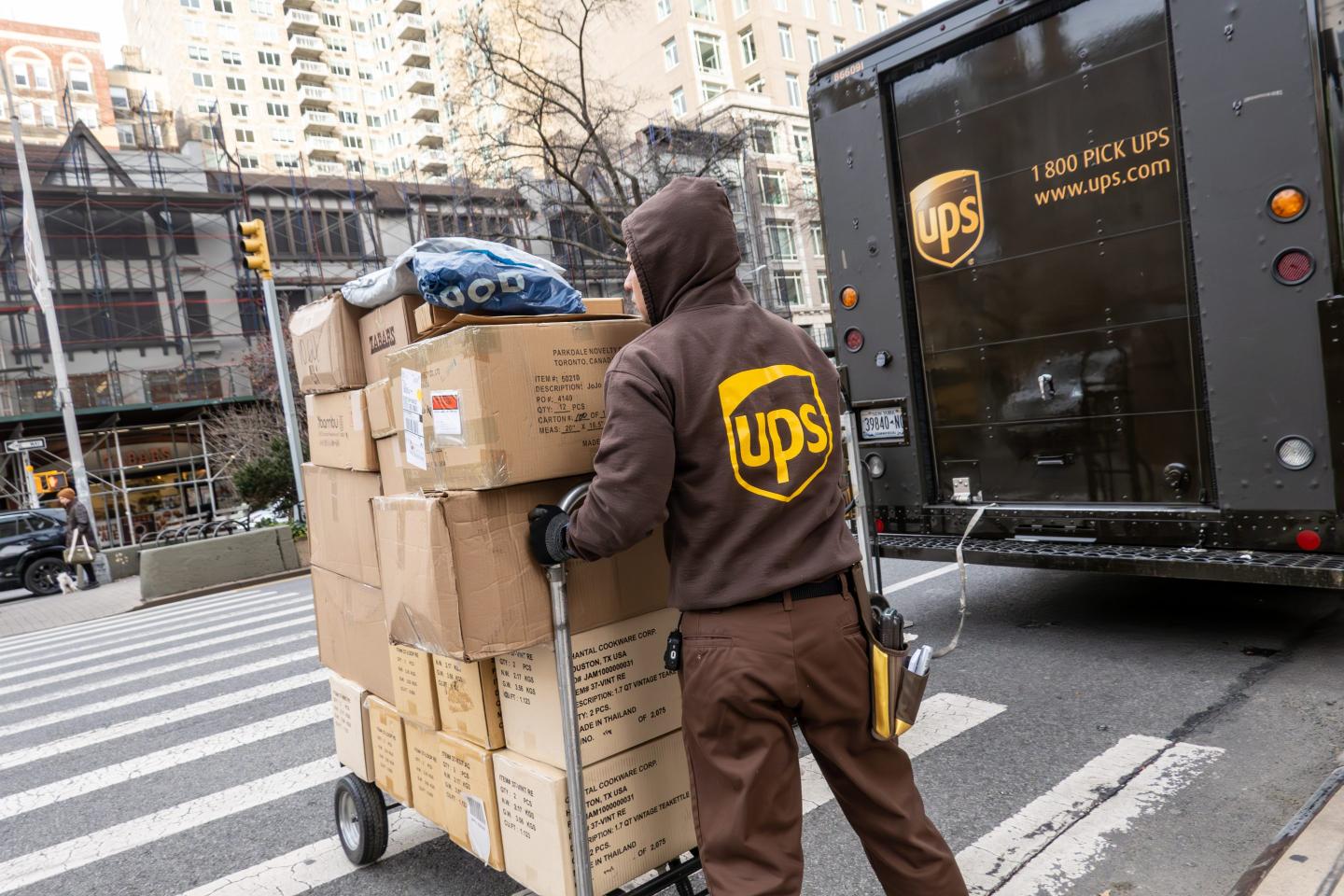
Most people will know UPS for its brown-clad drivers who distribute packages from their distinctive brown trucks—“package cars,” UPS calls them. From its original specialty, delivering shoppers’ purchases on behalf of big-city retail stores, the company has expanded beyond all recognition: it manages warehouses for retailers, tests replacement parts for manufacturers, organizes temperature-sensitive supply chains for biotech companies, and oversees a network of thousands of franchised retail outlets offering printing, packing, and other business services to households and small businesses. It is famed for its organizational discipline, its voluminous rules and procedures, and its software that enables drivers to avoid time-wasting left turns. Its jet fleet ranks it among the world’s largest airlines. In terms of revenue, it is one of the biggest transportation companies on the planet.
Yet its history is rather obscure.
This statement may come as a surprise. UPS frequently invokes its past to inspire its employees and instill confidence in its customers. Photographs of its early days, showing neatly clad deliverymen and immaculate brown trucks, are readily available on the internet. Casey himself has become a company icon. UPS-sponsored books and videos preserve his words and hail his achievements. He is honored on the UPS website, and the company’s leaders routinely pay him reverence. But the story of how he went about building an unremarkable messenger service into a far more consequential organization remains shrouded in myth and misinformation. That would probably have been Casey’s preference. “The past . . . is only something to learn by,” he once told his colleagues. “I am not much interested in the past. I am interested mainly in the future.”
Jim Casey was an introverted man whose education ended with the seventh grade. He learned management on the job, ceaselessly pushing new ideas for delivering parcels more reliably, extracting opportunity from a near-catastrophic business deal, and engineering his company’s aggressive expansion despite his deep-seated aversion to risk. After nearly half a century as chief executive, he brought his employees along with him as UPS confronted economic change by turning its business upside down and negotiating difficult relationships with the many external actors—customers, labor unions, competitors, regulators—who at times threatened to interfere with his ambitions.
But those accomplishments are only part of the story. While Casey was an inspiring leader, he was also a ferocious competitor. Under his leadership, UPS frequently acted in ways that it prefers not to include in its corporate mythology. Some of these actions were dubious. Others were flat-out illegal. Certain of them might not make current employees proud yet were indispensable in UPS’s transformation into a global transportation powerhouse. These are as much a part of Casey’s legacy as the company’s successes, even if UPS never mentioned them publicly during his lifetime and does not acknowledge them in recounting its past today.
The Jim Casey of official legend was a wise and thoughtful leader who rarely, if ever, made a mistake. The real Jim Casey was, of course, more human than that. Yet he was and remains an enigma. By all accounts, he was a courteous and gracious man; he liked nothing more than meeting rank-and-file workers and had a facility for remembering people’s names. If an employee had occasion to cross paths with him, Casey would likely have introduced himself by his first name, shaken the person’s hand, and recollected a past encounter or shown an interest in what the employee was doing. Yet even those who knew him personally struggled to find interests in common, other than the company to which he was so intensely devoted. “He lunches every so often with the heads of stores he serves,” The New Yorker reported in 1947. “Aside from ordering his meal, he talks only about parcels.”
Casey cherished the notion that UPS was a “democratic company,” a community of partners. “Good management is taking a sincere interest in the welfare of the people you work with,” he said in 1949. A few years after he retired as chief executive in 1962, when the company’s annual revenue exceeded $4 billion, UPS refused to allow reporters to interview a newly installed CEO because, in the words of a public relations official, “We’re kind of a team and we don’t feel it’s useful that one or another member of the team should stand out front and get his personality in news events.”
This is a most unusual style of management. Yet even as Casey could be friendly with employees and attentive to customers, he could be ruthless, or could protect his reputation by giving those who worked for him implicit permission to be ruthless. Competitors were to be harassed, or simply eradicated. Workers were to obey strict rules and meet high performance expectations. Holding a second job was prohibited, regardless of an individual’s financial situation, to ensure that employees devoted all their energy and attention to UPS. When it came to expanding the business, whether by adding customers in existing markets or barging into new ones, Jim Casey recognized no contradiction between establishing “friendly relations” with other parcel delivery companies, as company policy dictated, and giving no quarter. He was nothing if not determined.
Historians rely on records and memories. With respect to Jim Casey, little of either is available to the public.
UPS curates its history as carefully as any company in the world, molding the story of its past and suppressing anything that might show it in a less-than-stellar light. During the time Casey ran UPS and for decades after, it avoided disclosing the sorts of details—annual revenue, profit, or loss—that are fundamental to evaluating an executive’s accomplishments. Any records of internal discussions, disagreements among board members, or conflicting visions of the company’s future during his tenure, as well as any surviving personal papers, are likely to reside in the UPS archives, locked away from outsiders. UPS declined to grant access to this author, possibly leading to errors that could have been avoided were a more complete historical record available to the public.
All this challenges a biographer who would plumb Casey’s decades as chief executive. In many cases, the absence of documentation leaves Casey’s personal involvement in key decisions unclear. Even so, the limited information to which we do have access helps us understand a great deal about Casey as a manager by closely examining the environment in which UPS operated and the actions it took. Casey, always eager to praise others and unwilling to seek the spotlight for himself, undoubtedly would have rejected this approach. He frequently emphasized that building UPS was a collaborative effort. The notion of the heroic manager, struggling against entrenched resistance to drag a company into the future, was not one he would have embraced. “No single individual should be given a disproportionate share of credit for the development of the United Parcel Service you are writing about today,” he insisted to a rare interviewer in 1947.
It is a commonplace that the success of a large organization rests on the contributions of many people. But it is also the case that the founder’s personality often has an outsize influence on the organization’s culture. That was undoubtedly true of UPS. While Jim Casey did not run UPS by himself, he was indisputably the driving force behind the company’s remarkable evolution.
Unlike many corporate chieftains, Casey was not a financial whiz but an expert in the nuts and bolts of his business. He was more concerned about a messy garage or an undelivered package abandoned in a corner than an inquiry from a Wall Street banker. He was an inspirational leader with a deep interest in his company’s day-to-day work and the people who did it. It was due to his insistence on constant improvement that UPS was a pathbreaker in many different ways, from centralizing parcel sorting for messenger boys who delivered by streetcar in the 1910s to redefining the way employers screened job applicants in the 1920s, developing leading-edge package-sorting equipment in the 1930s, and employing operations research to select the optimal locations for sorting stations in the 1950s. And, counterintuitive though it may seem, thanks for our ability to send a package before 5 p.m. today and have it delivered by noon tomorrow should be extended, at least in part, to the lawyers who, at Casey’s instigation, devoted half a century to battles, first in the United States and then in other countries, to obliterate the regulatory obstacles that would have made modern logistics impossible.
Marc Levinson is a historian and economist living in Washington, D.C. This article is excerpted from his book The UPS Man: James E. Casey and the Creation of Modern Logistics, to be published in October.