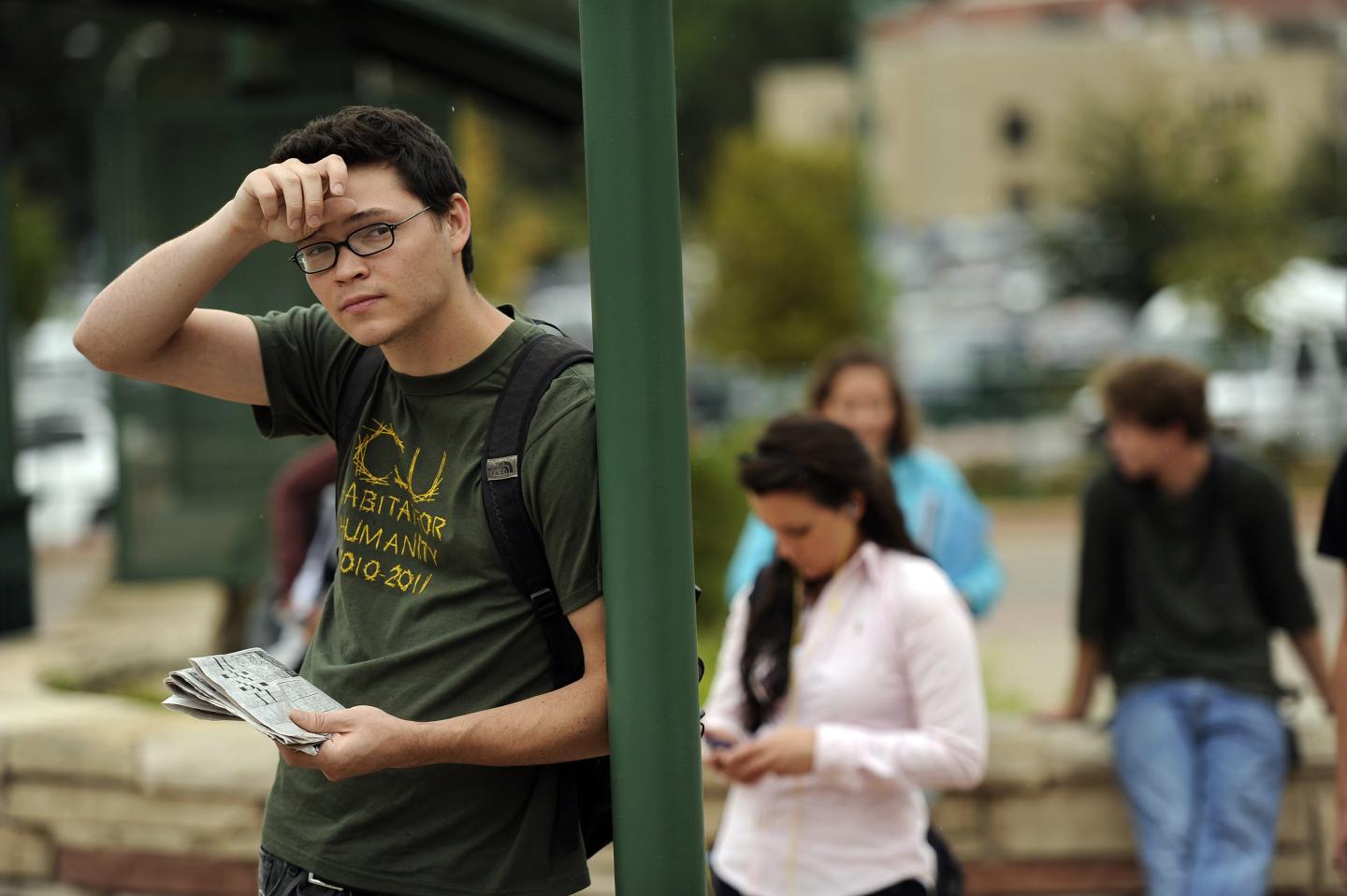
Every fall, we ask millions of 17-year-olds to make one of the most expensive bets of their lives on a guess.
Pick a major. Pick the college that fits it. Commit four years and tens of thousands of dollars to that hypothesis. And whatever you do, don’t change your mind, because that costs time and money most families don’t have.
It’s a ridiculous system, and I say that as someone who helps run it. I’m the president of Ohio Wesleyan University, a liberal arts college 30 miles north of Columbus, Ohio, and I’ve spent much of my career in higher education. I’ve also spent it watching our industry penalize students for doing the single most predictable thing an 18-year-old will do: figure out who they are.
The research on this is remarkably clear. A meta-analysis of 66 longitudinal studies tracking vocational interests from age 12 to age 40 found that those interests remain stable through most of adolescence, then climb sharply between ages 18 and 22. The “college years” are precisely when people figure out what they want to do with their lives. We ask students to declare a direction just before they’re equipped to know it.
Unsurprisingly, many change course. Federal data show about 30% of undergraduates switch majors within three years of enrolling. Broader institutional and academic estimates place the lifetime number closer to 80%. These students are the exploratory majority: undecided, uncertain, and multi-decided. Most of higher education (and nearly all of the enrollment marketing industry) treats them as a problem to fix. That’s a costly blind spot.
Add artificial intelligence to the picture and the cost of asking teenagers to specialize early climbs higher. Lumina Foundation-Gallup research released in April found 47% of enrolled college students said they’ve seriously considered changing their major because of AI’s potential effect on jobs, and 16% already have.
For a decade, the prevailing wisdom told colleges to get specific: narrow the majors, build pipelines into defined jobs, and shrink humanities departments. Plenty of institutions took that advice. Many are still taking it.
That bet is aging like a fax machine. The highly specific domain expertise many programs sell is exactly what machines can now replicate at scale. Employers are searching for people who can ask good questions, read a room, weigh shades of gray, apply context to a hard decision, and write persuasively without a large language model (LLM) telling them what to say. Those uniquely human skills, and the arts, humanities, and social sciences are disproportionately good at building them. Students sense this, too. In a recent Inside Higher Ed Student Voice survey, students’ second most common request of their colleges, right behind help using AI well, was preserving authentic learning. That, to me, raises the question of how universities should build the human competencies such as deep thinking, analytical reasoning, judgment, and taste.
So I’ll say plainly what I believe: AI is the best thing ever to happen to liberal arts colleges smart enough to realize the moment we’re in.
Most aren’t acting like it. I spend a lot of time with other college presidents, and what I see is a sector in a defensive crouch. They’re reacting by cutting. They’re discounting tuition further. They’re waiting for demographics, Washington, or a clever sales pitch to rescue them. I understand the impulse. The number of high school graduates is projected to fall 13% by 2041, and 70% of Americans told Pew Research that higher education is headed in the wrong direction. Fear is a rational response.
It’s also a losing strategy. When the table is set against you, flip it.
At Ohio Wesleyan, we’re building the entire institution around the exploratory majority. Students can’t declare a major until their sophomore year. Our general education requirements are organized around competencies that carry into any profession: reasoning quantitatively, questioning scientifically, thinking aesthetically, listening across perspectives, writing and speaking effectively, acting responsibly. Because those courses count toward the degree, exploring is part of the path to graduation. Every student is required to get out of the classroom through an internship, research, study away, service, or starting a business. And we’re building pathways designed so a student who changes direction doesn’t lose time or money doing it.
We’re also running back toward the arts and humanities while much of the sector runs away. The John F. Milligan Library, currently under construction, will become the only fine arts-infused main campus library in American higher education. This month, we’re naming and elevating our arts and humanities division into the Mecum College of Arts and Humanities, anchored by a $40 million commitment to permanently raise faculty pay. Faculty are the people who actually deliver this kind of education. A college can’t credibly build itself around human judgment while underpaying the humans who teach it.
The model rests on something every parent, employer, and adult who switched majors already knows. Seventeen-year-olds are still becoming who they’ll be, and college is where much of that becoming happens. We should build higher education for that work and be exceptionally good at it.
The sector has spent years waiting to be saved by policymakers, demographics, and the next enrollment gimmick. At Ohio Wesleyan, we’re done waiting. We’re saving ourselves, strategically repositioning as America’s University for Ambitious Self-Discovery, and bringing the “exploratory majority” along with us.
The opinions expressed in Fortune.com commentary pieces are solely the views of their authors and do not necessarily reflect the opinions and beliefs of Fortune.