
Good morning. On Fortune’s radar today:
- 9% of workers might lose their jobs in the great AI transition.
- Markets: It’s horrible.
- Saturday’s French protest route looks like a map for looters.
- CoreWeave’s $20 billion shortfall.
- Why you’re probably going to overpay for U2 tickets.
ONE BIG THING
AI is killing 10,000-plus jobs per month
AI is causing job losses in the U.S. at a rate in excess of 10,000 roles per month, according to Pantheon Macroeconomics’ Samuel Tombs and Oliver Allen. The pair have been tracking job sectors exposed to AI, and the net effect is not good. While construction sector jobs have gone up—because tech companies are building data centers as fast as they can—jobs in accounting, advertising, office admin, legal services and the like are slowly disappearing.
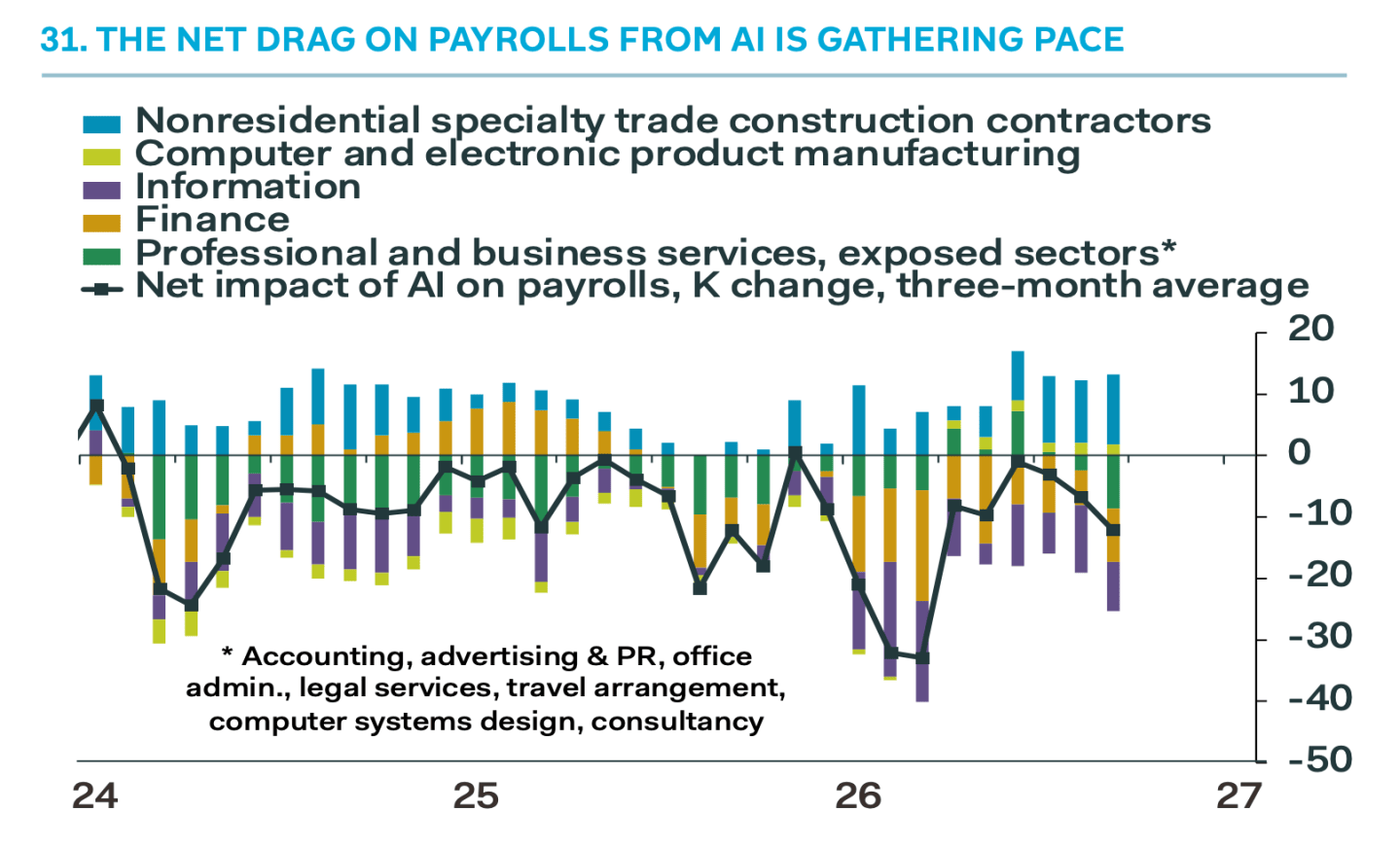
At Goldman Sachs, Joseph Briggs came to a similar conclusion:
“Concerns of imminent AI-related job losses [in the media] have cooled. But recent labor market data show some signs of AI-related hiring headwinds,” he told clients. “Under our baseline forecast for a 15% productivity increase from AI, around 9% of workers could be temporarily displaced during the AI transition.”
- Read more: AI could displace one in 11 workers, Goldman says, but the layoffs are likely waiting for a recession - Nick Lichtenberg
MORE FROM FORTUNE
Inside Asha Sharma's Overhaul of Xbox | Fortune Daily
Trump wanted a ‘Trump Ocean’ on Google Maps. He says CEO Sundar Pichai shut it down - Bilin Lin
Judge: Federal government lawyers ‘barely defend’ giving Elon Musk’s DOGE illegal access to government data - Sasha Rogelberg
Palmer Luckey teams with dire wolf billionaire Ben Lamm to launch $200 million Warhound, unleashing genetically engineered clone dogs of war - Nick Lichtenberg
Europe wants more than promises from American tech - Margot Edelman and Camilo Lascano Tribin
Mark Zuckerberg owns 13% of Meta but controls 61% of its votes. California’s wealth tax would bill him on the 13% - Catherina Gioino
‘They are trying to intimidate us’: Indonesia’s Prabowo remains defiant in the face of an MSCI double downgrade - Jay Ganglani
The Taiwan Strait is not on the verge of war: The ‘2027 invasion’ countdown is a mirage - Ningrong Liu
THE MARKETS
It’s another horrible day in the markets, and the usual suspects are to blame: AI, oil, and the French
Stocks in Asia and Europe were broadly down today following a terrible day in the U.S. that saw the S&P 500 lose 1.21%. Much of the damage came from tech stocks. The Nasdaq fell 2.9%. AI cloud provider CoreWeave fell 10.06% and is now down 22% for the year. Meta fell 6.98% yesterday, and lost another 0.33% in overnight trading.
There are some signs of traders buying the dip this morning. Nasdaq futures were up 0.28% before the open in New York. S&P futures were flat.
The usual suspects were to blame for the carnage: AI, oil, and France. “The wobbles of recent weeks all collided at once,” as Deutsche Bank’s Jim Reid said this morning in an email to Fortune.
Traders have not lost their angst about AI, especially after reports that OpenAI was forced by private equity investors to reduce the valuation it wanted in its latest fundraising round, from $1.4 trillion to $1.25 trillion.
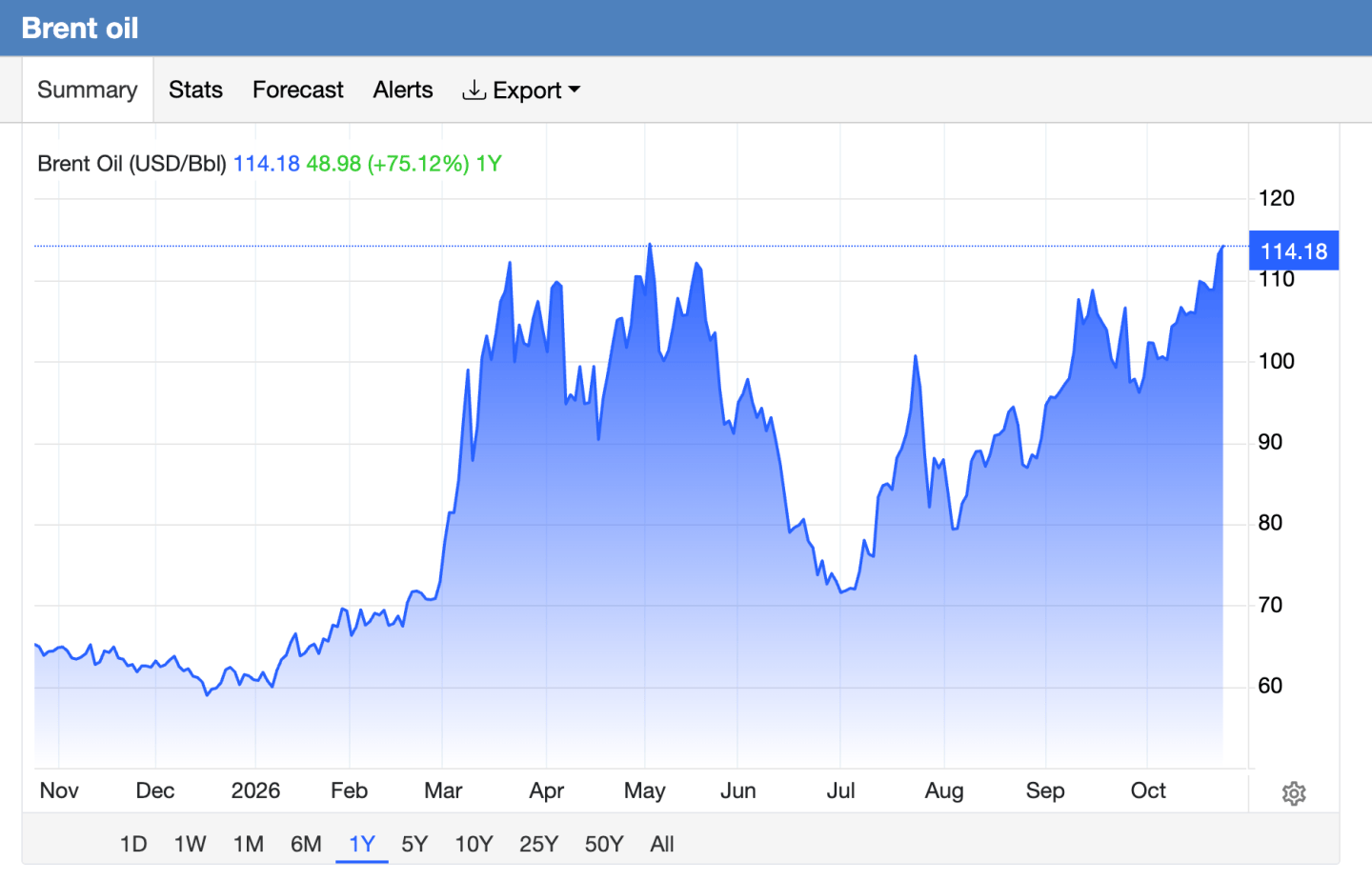
The price of oil rose to $114 this morning after The Financial Times reported that President Trump’s envoy to the UN said that the U.S. was prepared to fight Iran for at least another year.
Yields on France’s 10-year bonds hit 5.1%, a new high, before falling back to 5.05%. The ever-rising risk premium demanded by investors for holding those bonds shows that traders are still unconvinced that the French government has a plan to resolve its budget crisis.
By contrast, the yield on the 10-year U.S. Treasury fell to 4.9% after its recent peak above 5.3%—which suggests that some traders once again regard American Treasuries as a haven from the storm.
“At times like this, it pays to zoom out. It has been a horrible month for tech stocks, but the Nasdaq 100 was at a record high just a few weeks ago … the index is up 20% from a year ago and nearly 30% from March. The Nikkei 225, another one hard-hit this week is up 24% from March and 35% from last year,” Chris Beauchamp, chief market analyst at trading platform IG, told Fortune. “Those screaming that the bubble is popping need to put these moves in context. It has been a summer and early autumn to forget, but such periods are the price you pay for huge gains. This is digestion, not a crash.”
- S&P 500 futures were flat this morning. The index fell 1.21% yesterday.
- In Europe, the Stoxx 600 fell 0.36% in early trading, and the U.K.’s FTSE 100 fell by 0.56% before lunch.
- Asia: South Korea’s KOSPI was up 0.30%. Japan’s Nikkei 225 was down 0.34%. India’s Nifty 50 was down 0.96%. China’s CSI 300 was up 1.71%, and is now down 15% year to date—clearly in correction territory.
- Brent crude rose to $114 per barrel.
- Bitcoin declined to $81,683.
Read more coverage of the markets from Fortune here.
CHART OF THE DAY
Liberté, égalité, fraternité, saccager*: French protest route looks like a map for looters
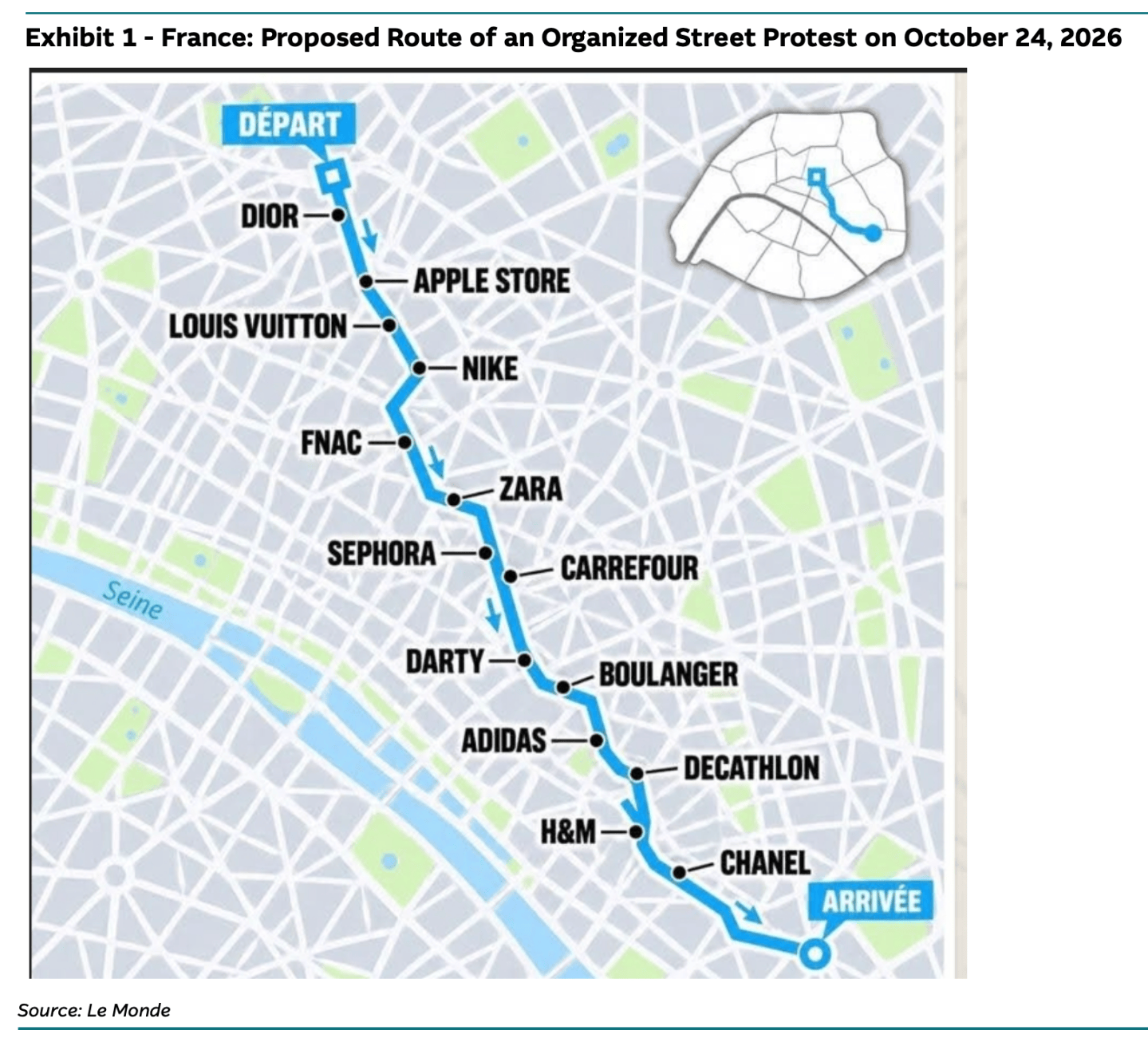
On Saturday, protesters in France will stage another massive demonstration on the streets of Paris against the lack of state funding for education. But the planned route for the march looks like it was plotted to encourage looting. Until a curfew was imposed, the protests had devolved into widespread shoplifting after sundown.
“Those protests seem to be designed to create the greatest retail-level economic disruption in Q4 2026 as they make their way along Paris' luxury shopping routes,” Thierry Wizman and Gareth Berry at Macquarie said in a note. “We do believe that France's Q4 GDP growth will be adversely affected by the protests and the risk of deposit flight from France remains very real too.”
*Saccager means “to ransack” in French.
NUMBER OF THE DAY
$20 billion
The amount of additional funding needed by CoreWeave to support the contracts for future work it has in its “remaining performance obligation” pipeline, according to an estimate by Bank of America’s Tal Liani. The number is interesting because analysts at BNP Paribas made the same estimate and concluded the shortfall was $30 billion.
THE FRONT PAGES TODAY
OpenAI trims valuation target to $1.25tn after pitching higher price - FT
Nvidia’s Huang heads to Kazakhstan for the first time — and he’s not the only one with big plans - CNBC
Trump ordered to sit for deposition in $10 billion BBC lawsuit - Axios
The Signal Chats That Cost OpenAI Researchers Their Jobs - WSJ
France Plans Military Presence to Contain Weekend Protests - Bloomberg
Trump Asked Musk to Reverse Limits on Ukraine’s Military Internet Use - NYT
Polymarket fires top executive who was closely allied with CEO Shayne Coplan: sources - NY Post
ONE MORE THING
The unusual economics of U2 ticket pricing: The best seats will be the cheapest
There is a wide spread in the available prices for tickets to see U2 on their 2027 tour. The best views in the house—general admission floor tickets—will be available for as little as $100 in some venues, according to Fortune’s James LaForge. At the top end, the Ultimate VIP Hospitality package will cost $1,150.
The reason: U2 has a longstanding tradition of making sure the best tickets are the cheapest. “What we do in our band is we take the best seats in the house—we’ve done this all our life—and make sure that they’re often the most affordable,” lead singer Bono said.
“We also have no problem separating rich people from their money,” he said. “You know, as we say, rich people have feelings, too. If they want to pay very high prices, we’ve no problem.” He also admitted that many fans will “probably pay too much for it.”
- ➡️ Would you like to sponsor this newsletter? Contact advertising@fortune.com for details.
- ➡️ If you would like to receive this information in your inbox every morning before the markets open in New York, sign up here.