
The Colossal and Anduril founders want to clone, gene-edit and armor America’s working dogs, and bring the supply chain home from Europe.
The U.S. military’s oldest autonomous system has a supply-chain problem: most of its dogs come from Europe. Fewer than half make it through training. And the Pentagon is bidding against foreign governments for the ones that are left.
Ben Lamm is the co-founder and CEO of Colossal Biosciences, the Dallas de-extinction company that announced in April 2025 it had brought back the dire wolf, a predator that died out more than 10,000 years ago. What Colossal actually produced was three pups, Romulus, Remus and Khaleesi. Its scientists took gray wolf cells, edited about 20 sites across 14 genes to match DNA recovered from ancient dire wolf remains, cloned the pups from those edited cells and had domestic dogs carry them to term.
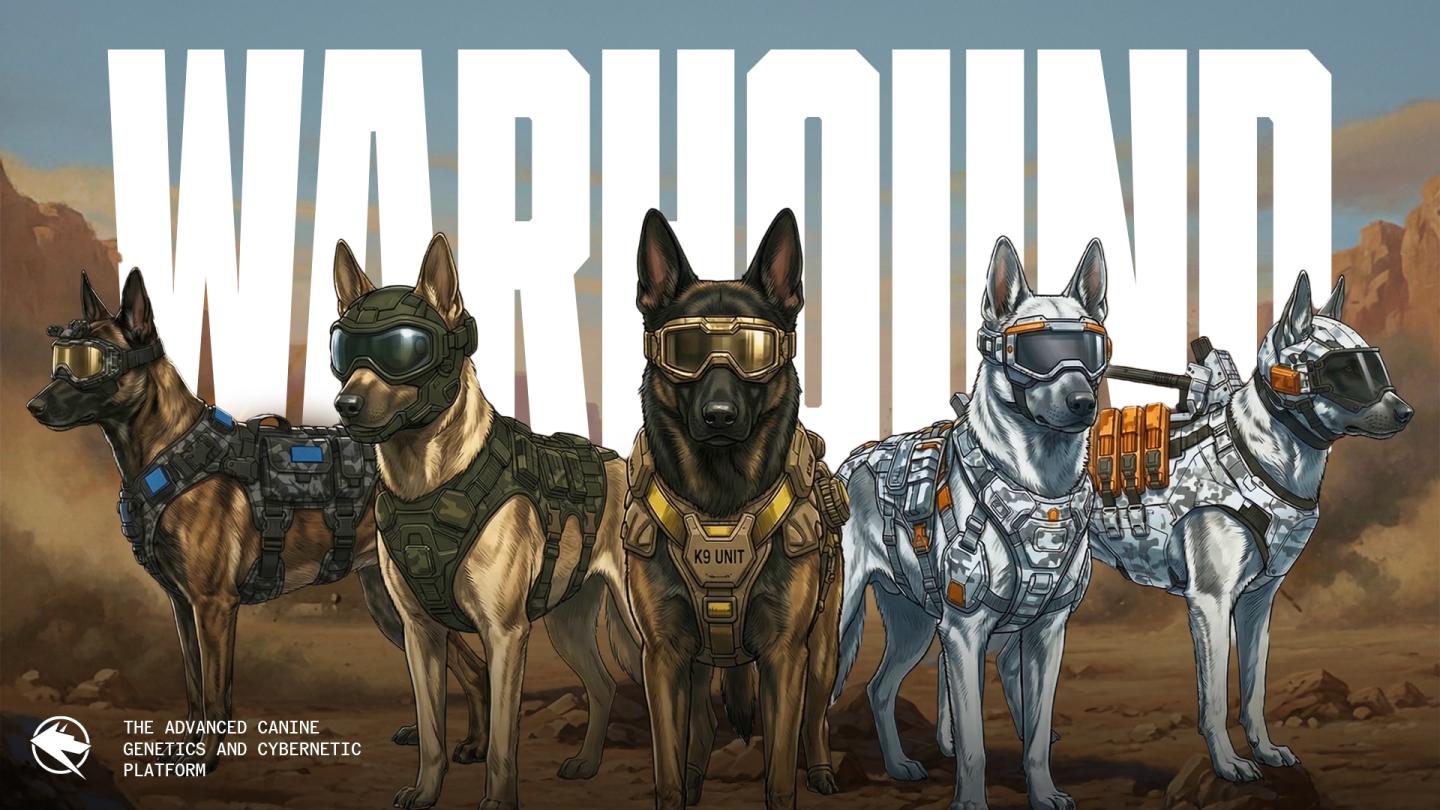
Lamm and Anduril founder Palmer Luckey think the same tools, plus defense hardware, can fix that. Warhound, a defense tech startup the two came up with, is coming out of stealth with a $200 million seed round, Fortune can exclusively report. David Spirk, a former Marine and the Pentagon’s former chief data officer, is CEO. The company is based in Texas.
The backers are In-Q-Tel, Sequoia Capital, ARK Invest, Franklin Templeton, 8VC, USIT, Bob Nelsen, Breyer Capital, CAZ Investments, Neogenesis, Builders VC and Lux Capital, among others.
“A dog is the oldest autonomous system there is,” Lamm said in emailed responses to Fortune’s questions. “For thousands of years, dogs have gone into danger ahead of the people they protect.”
Importing the good boys
The Army set up the K-9 Corps in 1942. Today the Department of War’s Military Working Dog Program has more than 2,200 dog teams, according to the company, and more than 80% of U.S. military working dogs are bought from Europe. Lamm cited a Senate Armed Services Committee warning that “due to the finite number of breeders overseas, as well as rising market demand, the cost… to procure whelped military working dogs from Europe is skyrocketing.” He also cited the American Kennel Club’s assessment that “there is now a shortage of even mediocre quality foreign dogs available.”
The U.S. is “competing against other country governments” for the same animals, Lamm said, China and Russia among them.
The losses after purchase are expensive, too. According to the company, fewer than half of the dogs bought are judged fit for service after a roughly three-year acquisition and training pipeline. That means the U.S. has to buy and train about 200 dogs today to field 100 working animals later.
Biobank, clone, edit
Lamm described the plan in stages. Warhound will find top dogs that have finished training and biobank their genetic material. It will then clone those proven dogs, though Lamm said “training and environment will always influence performance.” Alongside that, it will work on targeted gene edits.
The first group of dogs has already been biobanked and is being edited now, Lamm said. He expects to deliver the first dogs in about two years. “Breeding and raising a dog takes the time it takes,” he said.
Warhound will screen out known harmful variants tied to muscle degeneration and other inherited diseases, so that “no dog enters service carrying genetic markers known to cause common career-ending conditions.” Lamm said the company is still working out which other traits are “scientifically and responsibly actionable.” Even so, he said Warhound is “planning future genetic enhancements to improve their already exceptional performance.”
Anduril is supplying equipment including eye and ear protection, body armor, and integration with its Eagle Eye system, so that “dogs, handlers, and autonomous systems operate as one team.” The release announcing Warhound calls these “cybernetic Augments.” Lamm said the dogs are not a step toward robot dogs, nor a hedge against them. “No machine today matches a dog’s nose or its judgment in complex environments,” he said.

No contract, no price tag
Warhound has no signed customers yet, as Lamm said the company is working with canine experts across the national security community. It also isn’t quoting a price per dog, because “a young dog, a partially trained dog, and a cloned dog of proven health with training and support through retirement are very different things.”
Lamm said Warhound is discussing a “Canine-as-a-Service model,” in which the government would buy a steady supply of trained dogs instead of individual animals. Software companies have sold to the Pentagon by subscription for years, and now the model is coming to the kennel.
Cloning working dogs isn’t new. South Korea’s customs service deployed six cloned sniffer dogs in 2009. A decade later, Chinese scientists said they had cloned a top police dog, a Kunming wolfdog named Kunxun, to cut training time, and talked about producing more. By that November, six cloned K-9s had joined the Beijing police.
Nothing at the scale needed exists yet, Lamm said, so the company plans to build national-scale kennel and training infrastructure step by step, “starting with private capital.” It has hired what Lamm called “one of the top dog handlers ever to serve in the U.S. military” as director of canine operations. The American Humane Society will certify Warhound’s training programs and help reunite retired dogs with their former handlers.
The Captain America dog program
The company says Lamm and Luckey came up with Warhound after a conversation at Peter Diamandis’ Moonshots Summit. Lamm said Luckey “loved our dire wolf announcement,” and the two got talking about the military’s working dog programs: where the dogs come from, how many wash out and what it costs to replace them.
“I’m all about origin stories, especially when we’re talking about the Captain America dog program,” Lamm said. In the comics, the super-soldier program took a scrawny Army reject and made him the best soldier in the service. Warhound is aiming at the dogs who don’t make the cut.
Then the two founders mostly stepped back. “Palmer and I don’t describe ourselves as co-founders,” Lamm said. “We developed the concept.” Luckey “doesn’t even own equity in the business,” he said. “I decided to be the one of us to join the board and tap Dave Spirk to do this,” Lamm added, saying he knew him well, as Spirk had spent four years as an adviser to Colossal and had watched the de-extinction work up close.
Spirk spent eight years in the Marine Corps and close to 20 more as a government civilian in the intelligence community and special operations. He was the first chief data officer of U.S. Special Operations Command and then of the Department of War, and he was a plank holder on Project Maven, the Pentagon’s AI targeting program. He also served as deputy associate director of national intelligence for Afghanistan and Pakistan. More recently he was a senior counselor at Palantir, a stint Lamm said Spirk calls his “Palantir diploma.” For four years he advised Lamm at Colossal and watched the de-extinction work up close.
“My focus is building a team that can turn scientific advances into capabilities that work in the field,” Spirk said in a statement.
The dire wolf launch drew some criticism from scientists who said Colossal had made gene-edited gray wolves and not a revived species. Lamm dismissed that criticism, while noting that doesn’t come up here: “Our warhounds are genetically modified dogs just like our dire wolves were genetically modified wolves. I assume there is no way for anyone to debate the definition of a dog.”
Lamm rejected the idea of forming some kind of combined Colossal-Anduril company. “LOL no there is no Colossal – Anduril conglomerate,” he said. Colossal licenses technology to Warhound and has an economic interest in it. Spinning companies out of Colossal’s research is “an intentional part of our model,” Lamm said.
Luckey offered a statement in the release: “Man’s best friend deserves man’s best tech.”
Generative AI was used for research assistance and/or transcription of this article. The reporter independently reported and verified the factual claims in this article, and a human editor reviewed it before publication.