
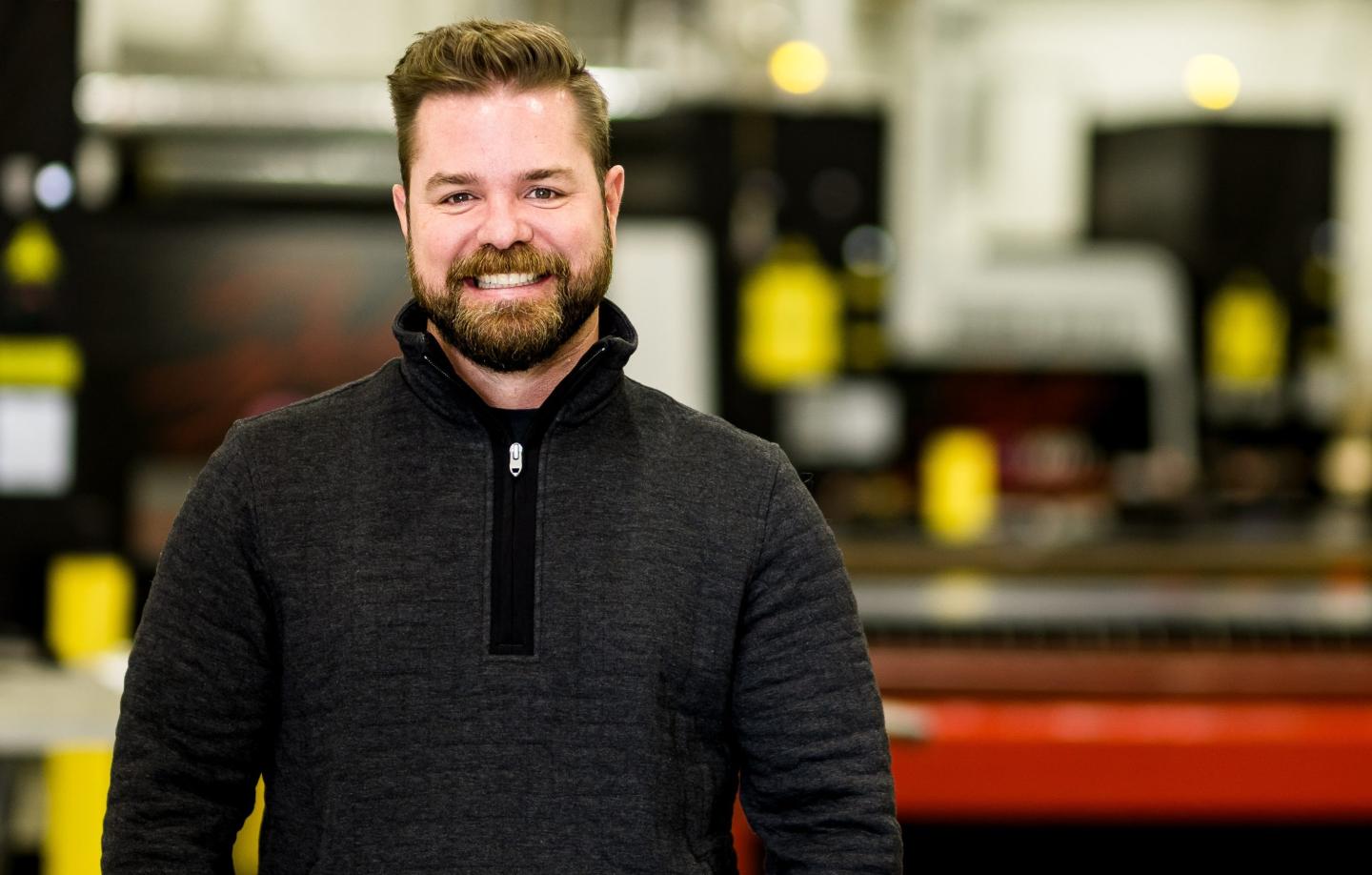
It started with a steam-powered car.
That’s precisely what it sounds like, by the way. In 2017, Jim Belosic was building out what was once a Ford Model A—most famously produced in the late 1920s—to run on a steam engine.
“It’s an art,” said Belosic of engineering and re-engineering classic cars. “It starts small, and at some point you’re building drag-racing cars, or a custom chassis, or a big crazy motor. I’d done a lot of that, but it had started getting boring. But saying: ‘Hey, I want to build something powered by steam and drive it around the block,’ that was problem-solving in uncharted territory.”
The result: a skeletal cyberpunk wonder that could take a head-turning swirl around the block. However, halfway through the process, Belosic ran into a problem. He wanted the throttle control to have three labeled speeds, inspired by the oxen of the computer game Oregon Trail—“steady,” “strenuous,” and “grueling.” For this to work, he needed tiny, intricate letters, and had no obvious place to get them, until a friend of a friend laser cut them.
Laser cutting—the process by which a powerful, concentrated beam of light slices through materials like metal—was ultimately the basis for SendCutSend, the company Belosic cofounded in 2018 that turns customers’ designs into custom metal parts. The very first order was pickleball-centric.
“We made the pickleball keychains,” said Belosic. “Then orders trickled in from there, and it kept going, and going, and going.”
SendCutSend, based in Reno, Nev., solves a longstanding manufacturing problem: if you need custom metal parts, getting them made can be somewhere between tough and impossible (especially if the order’s small). So, customers have flocked to SendCutSend, including Zipline, Telo Trucks, Neros, Waymo, K2 Space, Relativity, Anduril, and Castelion, along with 60% of the Fortune 500. The company grew, but for years Belosic eschewed VCs.
That changed in spring, when Sequoia partner Andrew Reed connected with Belosic and quickly hopped a plane from San Francisco to Reno. “Jim was like ‘wear boots,’ and maybe 14 hours later, I was bending some metal,” Reed quips. The resulting round, a Series A, valued SendCutSend at $1.1 billion.
Now, about five months later, SendCutSend has raised another round, led by Spark, plus participation from CRV, MHS, Sequoia, and Paradigm, a deal valuing the company at $2.1 billion. (Today, SendCutSend is announcing the Series B, but didn’t give me the exclusive, per se. Belosic said he’d rather communicate directly with customers, but that he didn’t mind if I published this story, since I’d been working on it anyway.)
“I never wanted to be a Silicon Valley entrepreneur,” said Belosic. “I never said: ‘Oh, I’m going to build a company and do financial gymnastics to IPO.’ No, I want to build a business. There’s a difference between a Silicon Valley entrepreneur and an owner.”
This filters into how he thinks about where VC dollars go.
“My favorite use of VC dollars is turning it into mortgages, turning it into baby formula, turning it into onesies, turning it into opportunities for our guys to go from a bicycle to a car,” said Belosic. “I can take their dollars and employ people, give them an opportunity to own a home, to have kids. I love taking VC dollars and putting it directly in the payroll.”
To Belosic, who’s constitutionally direct, that’s where the resilience of the business will stem from. Reed, who’s been at Sequoia for over 12 years, is on board.
“The fact that Jim was able to build this business to the scale of nine digits of revenue without a major institutional VC round, it’s the ultimate example of suction,” said Reed. “But it’s also a business where they can turn dollars into shorter lead times, which is better for customers. They can build locations closer to customer sites and take on more work. There’s such a good use of proceeds here. This money isn’t going to be sitting in the bank forever, just as a rainy-day fund.”
SendCutSend’s rise comes amid the backdrop of a broader societal conversation (and growing wave of VC dollars) around U.S. reindustrialization, a process in which Belosic believes the company can be a “foundational layer.”
“I would love to see that we can mine metal, process it in the U.S., SendCutSend it out, and then someone else can add their layer onto that,” said Belosic. “The future of manufacturing will be made in America.”
In 2017, Belosic’s goal was ambitious for its technical challenge and unknowns: How do you get a steam car around the block? The territory he’s in now is a whole lot bigger—and even more uncharted.
See you tomorrow,
Allie Garfinkle
X: @agarfinks
Email: alexandra.garfinkle@fortune.com
Submit a deal for the Term Sheet newsletter here.
Joey Abrams curated the deals section of today’s newsletter.
VENTURE CAPITAL
- Town, a San Francisco-based developer of AI assistants designed to help teams work together, raised $108 million in Series B funding. Forerunner Ventures and Menlo Ventures led the round and were joined by a16z, First Round Capital, Better Tomorrow Ventures, and others.
- Dream Labs, a San Francisco-based developer of AI designed to power everyday robots, raised $90 million in seed funding. B Capital and Kindred Ventures led the round and were joined by A.Capital, Unusual Ventures, SV Angel, Wing VC, Scribble VC, Adrian Aoun, and others.
- Different, a Campbell, Calif.-based developer of AI software designed to help small marketing teams attract customers, raised $48 million in seed funding. General Catalyst led the round and was joined by Lightspeed Venture Partners.
- XRlabs, a London, U.K. and Palo Alto, Calif.-based developer of an AI assistant designed to help users operate surgical equipment, raised $8.4 million in seed funding. Playground Global led the round and was joined by Eka Ventures.
- Vectorial, a San Francisco-based developer of software designed to simulate human behavior, raised $3 million in seed funding from Berkeley SkyDeck, Berkeley AI Research Lab, Stanford GSB Fund, Dent Capital, Smilegate, SenseAI Ventures, and angel investors.
PRIVATE EQUITY
- ARCHIMED acquired a majority stake in 3verest, a London, U.K.-based provider of private cloud infrastructure for medical imaging data. Financial terms weren’t disclosed.
- Arlington Capital Partners acquired Gooch & Housego, an Ilminster, U.K.-based manufacturer of photonic and optical components and systems for aerospace, defense, industrial, and life sciences markets. Financial terms weren’t disclosed.
- Forward Consumer Partners agreed to acquire Welly, a Minneapolis, Minn.-based maker of bandages and other first aid products, from Unilever. Financial terms weren’t disclosed.
PEOPLE
- THL Partners, a Boston, Mass.-based private equity firm, hired Bruce Robertson as a managing director on its healthcare investment team. Previously, he was with H.I.G. Capital.