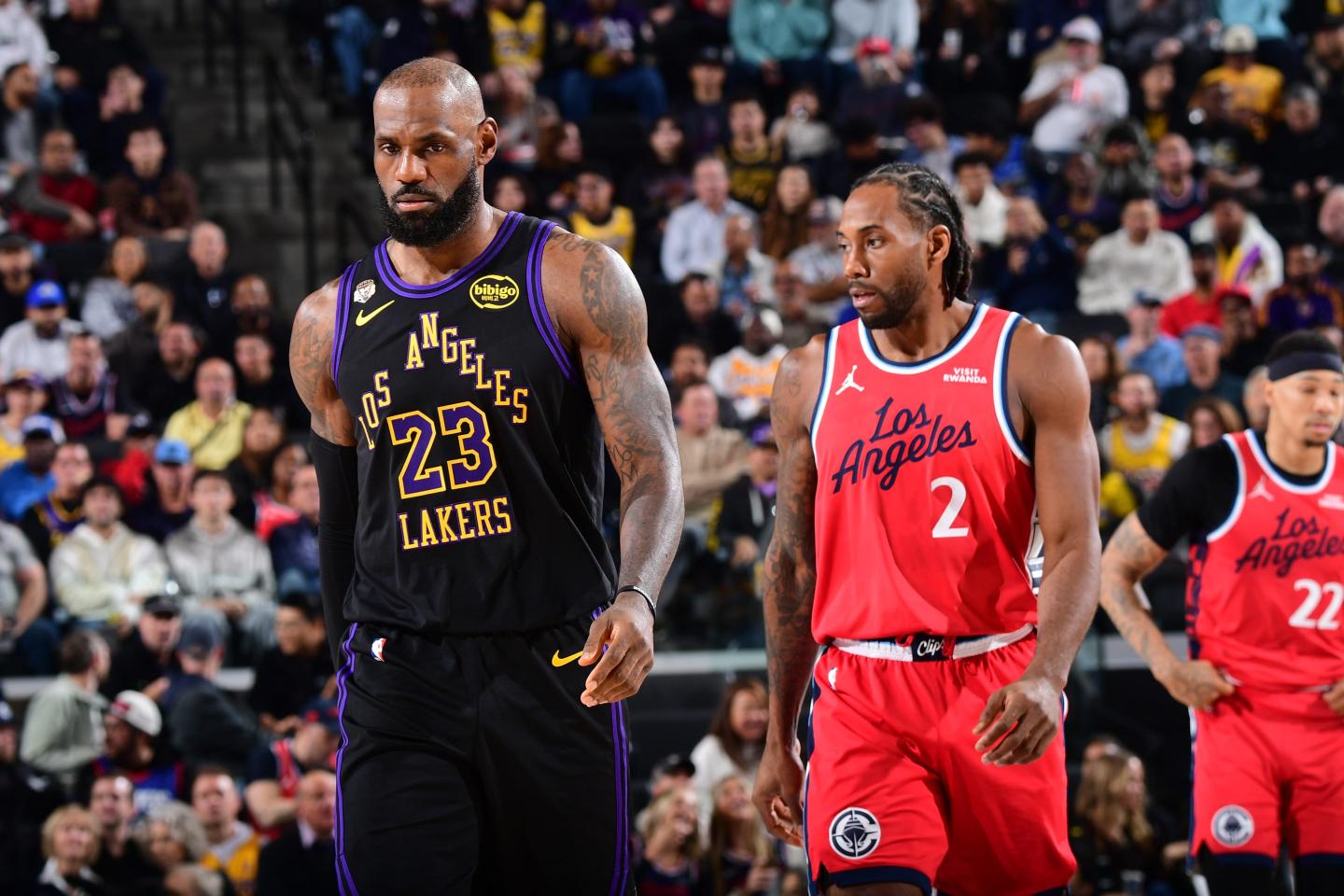
It takes a fortune far bigger than any sports team to buy one—and that fortune rarely sits still. It’s invested in startups, private holding companies and insurers. This year, three of the richest owners in sports have come under scrutiny for deals in which they had money on both sides.
Steve Ballmer had invested in Aspiration, the financial services company that signed his star player, Kawhi Leonard, to an endorsement deal. Manchester City’s owner, through his investment vehicle, covered some of the fees the club’s sponsors were supposed to pay, an independent commission found. And insurers controlled by former Los Angeles Lakers owner Mark Walter lent billions to companies tied to his financial empire, leading to lawsuits and an SEC investigation.
The consequences are piling up. The NBA fined the Clippers $30 million, a ruling the team is contesting, while ordering Ballmer to have zero contact with the team for a year. An independent Premier League commission found City guilty of financial charges, findings the club is appealing, with the much-rumored sanctions still to come. Walter sold the Lakers after owning them barely more than a year, and federal prosecutors are examining Walter’s companies; he denies any wrongdoing.
Related-party transactions, or business arrangements between entities that are connected through common ownership, are at the center of the biggest sports scandals this year. These transactions aren’t inherently illegal—companies routinely do business with affiliates, and sports owners can legitimately hold investments across multiple industries. After all, how else would they afford a team in the first place?
But the risk surfaces when those same relationships create conflicts of interest that obscure the true flow of money or help owners get around rules designed to protect investors, policyholders and the integrity of the sport.
“Certainly the possibility is inevitable,” Rachael Jones, a principal at law firm McKool Smith and former state and federal prosecutor, told Fortune. Whether those conflicts will result in a violation, she said, depends on the rules governing the transaction. Part of why more of these cases may be surfacing now, she suggested, is that they’re easier to find: Filings that once required a trip to the library are increasingly online.
Sports are not unique in attracting potentially abusive arrangements, according to Jones. But as the industry grows more lucrative and the owners expand into additional businesses, the opportunities for exploitation grow.
“Sports is a big business,” Jones said. “It’s profit, so it just can attract misuse.”
Who stands to lose depends on which rules are at stake. In the NBA, it’s rival teams that play under the same salary cap. In the Premier League, it’s rival clubs held to the same spending rules. In Walter’s case, it’s policyholders, who have sued, alleging that his insurers misrepresented their investments.
Getting around the cap
Last month, NBA owner Steve Ballmer and the Clippers were hit with major penalties, including a $30 million fine, following an investigation into endorsement arrangements involving two-time NBA Finals MVP Kawhi Leonard. The league found that the Clippers and Ballmer facilitated off-court income opportunities for Leonard, which included arrangements with the now-bankrupt financial services company Aspiration. Ballmer had invested $50 million in Aspiration beforehand—and $10 million after Leonard’s arrival in LA.
That put Ballmer’s money on both sides: He owned the team paying Leonard’s salary and was an investor in the company that signed Leonard to an endorsement deal.
“The NBA’s collectively bargained system for determining player compensation is a fundamental component of the basketball competition that the league oversees for the benefit of the teams and players and ultimately the fans,” NBA Commissioner Adam Silver said in a press release. “I am deeply disappointed by the flagrant violations of our rules and by the Clippers’ institutional and leadership failures that led to this misconduct. The severity of the penalties reflects the seriousness of the violations.”
Ballmer is by far the richest owner in the NBA—with a net worth of $156 billion—and the Clippers are now worth roughly $7.5 billion, nearly four times what Ballmer had bought the team for at $2 billion, according to Forbes. And Ballmer and the Clippers remain adamant the penalties—and the allegations of misconduct—are incorrect.
“We are exploring every legal remedy to address this gross injustice,” a letter from the Clippers sent to Silver shared by reporter Marc Stein on X read.
Ballmer and the Clippers did not respond to requests for comment from Fortune.
Manufacturing revenue
In September, an independent Premier League commission found that Manchester City arranged “sham” commercial agreements that artificially inflated revenue. The club also filed misstated accounts and concealed its finances, the commission found. The club is appealing the decision.
According to the investigation, Manchester City arranged commercial deals with a number of its sponsors which were only required to pay a portion of the relevant sponsorship fees. The remainder was funded by Abu Dhabi United Group Investment & Development Ltd, which owned the club—making the owner’s money sit on both sides of the sponsorships.
The football club was found guilty of 114 out of 115 financial charges from the Premier League from an investigation on a period between the 2009-10 and 2017-18 seasons. Manchester City artificially inflated revenue and understated expenses by roughly the equivalent of $1 billion, according to the Premier League’s statement following the investigation’s findings.
The charges concerned the league’s financial rules at the time. Since 2021, the Premier League has also had Associated Party Transaction (APT) rules, aimed at commercial deals between clubs and entities tied to their owners.
“It is a key responsibility of the Premier League to ensure that the Rules, approved by the clubs themselves, are upheld to protect the integrity of the competition,” Richard Masters, chief executive of the Premier League, said in a press release. “It is paramount that the league remains competitive and fair for all clubs and for the fans.”
Manchester City is owned by City Football Group, which is majority-owned by Sheikh Mansour bin Zayed Al Nahyan, a member of Abu Dhabi’s royal family.
Manchester City did not respond to a request for comment from Fortune.
When the money is retirees’
Mark Walter, CEO of Guggenheim Partners and former majority owner of the Los Angeles Lakers, has financial holdings across separate firms that have become the focal point for interconnected businesses in sports—and the subject of a federal investigation.
In July 2026, disclosures about affiliated investments at insurers linked to Walter drew scrutiny to how they were tied to his sports ownership. Federal prosecutors are examining whether companies tied to his financial empire improperly handled billions of dollars in loans from insurance companies that he separately controls.
Amid the ongoing investigation, the Los Angeles Lakers were then sold in August by Walter to new owners Josh Kushner and Bob Iger in a $12.5 billion deal—making Walter’s majority ownership of the team last less than a year when he bought it from the Buss family in June 2025. However, Walter and TWG Global—Walter’s holding company—posit the move was unrelated to the investigation completely.
“Regarding the proposed sale of the Los Angeles Lakers for $12.5 billion, Mr. Walter was approached by Josh Kushner and his team about this transaction and the agreement represents a 25% premium to the price paid by Mr. Walter less than a year ago,” a TWG press release read. Walter and his company were also clear that his other sports assets—such as the Los Angeles Dodgers—were not for “fire sale” as well.
“Regarding the Los Angeles Dodgers, to be clear, the team is not being sold and no sale process has been initiated,” the statement continued.
Two insurers in Walter’s orbit, Delaware Life Insurance Co. and Clear Spring Life and Annuity Co., conducted internal reviews after receiving federal grand-jury subpoenas and significantly restated what they described as errors in prior financial reporting.
Policyholders and retirees have since filed lawsuits alleging that the insurers misrepresented their investments. But Guggenheim and Walter deny any wrongdoing or fraud.
“As it relates to Guggenheim, while the investigations originated with a whistleblower concern, TWG and Guggenheim have demonstrated there was no wrongdoing,” a press release from TWG read.
Guggenheim Partners and Mark Walter did not respond to requests for comment from Fortune.
Jones said the potential consequences for policyholders could be severe if an insurer’s financial position deteriorated enough to stop it from meeting its obligations. Someone who had purchased an annuity expecting retirement income, for example, could face uncertainty if the insurer can’t pay the claim, she said.
Why it’s so hard to stop
But Jones thinks we haven’t seen the end of it yet.
“Certainly, with the more somebody controls, the more power they have, and things could be manipulated,” Jones explained. “I think that there’s always, to some degree, related party transactions. Sometimes they’re not illegal—often, it’s that it has to be disclosed so that somebody goes in with their eyes wide open and understands the risks.”
“What I notice is with Abu Dhabi and Steve Ballmer, it’s like we’re trying to circumvent the rules that are there,” she continued. “So what’ll be interesting to me is to see if the sports leagues will have more rules that come into play in the future.”
Sports leagues have all employed certain financial rules to prevent misconduct. But those rules govern the team’s side of a deal. The owner’s other businesses—a fintech startup, a private investment group, a life insurer—answer to other regulators, or to none. In the U.S., insurers are overseen by state insurance departments, which have no role in policing sports.
Private ownership can also limit how much outsiders know about a team’s finances. It can make it more difficult to determine whether a sponsorship reflects genuine commercial value, whether a loan is being made on market terms or whether money is moving between related entities in ways that benefit one party at another’s expense.
“Somebody said to me one time, you know, we haven’t created a government program yet that hasn’t found somebody that’s going to try and perhaps successfully defraud it, and I think that’s true in any industry,” Jones said.
(