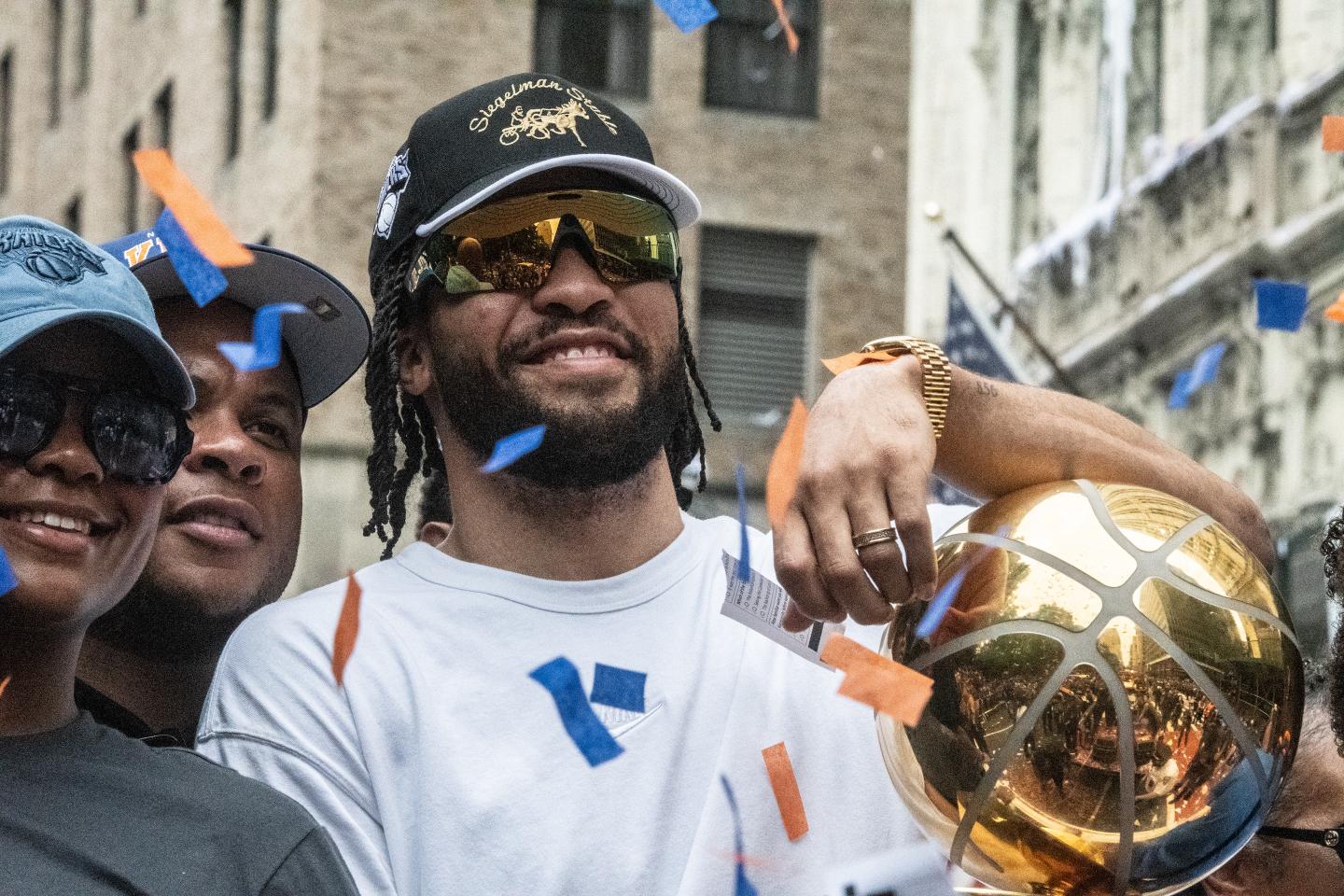
Investors are watching how the New York Knicks perform today on two very different courts: the hardwood at Madison Square Garden, and the floor of the New York Stock Exchange farther downtown.
The Knicks tip off their drought-ending NBA championship defense tonight against LeBron James, who makes his debut with his new team, the Philadelphia 76ers. Resale tickets have averaged about $2,600 apiece on SeatGeek as fans clamor to see the team raise its first championship banner in 53 years. (The Knicks beat the San Antonio Spurs in five games in June—a title run worth at least $380 million to New York City.)
Meanwhile, the team’s parent company, Madison Square Garden Sports (NYSE: MSGS), is making its own spin move. It’s breaking up the title-winning franchise—at least as far as investors are concerned.
MSG Sports is spinning off its New York Rangers hockey business from the Knicks. The Rangers are chasing an end to their own drought: The Broadway Blueshirts haven’t won the Stanley Cup since 1994.
The two businesses will be renamed and trade independently after the spin-off, a structure that could make it easier to sell either team separately down the road—or simply give investors better visibility into what each is worth.
Investors and sports fans can now take their shot at becoming partial owners of one or both teams through pure-play sports stocks, or just pass. There are headwinds: Higher inflation could stymie revenue growth, regional cable fees are shrinking, and valuations look stretched after the shares have gained more than 50% this year.
The parent company’s stock hit all-time highs on a heater of its own during the Knicks’ run to the title, and it has stayed near those levels since the board approved final terms of the split, which MSG Sports announced on Sept. 30.
Why spin-offs tend to beat IPOs
Jay Ritter, a finance professor at the University of Florida and director of The IPO Initiative, told Fortune that buyers invest in sports teams for a financial return but also for other perks, such as rubbing elbows with celebrities and earning bragging rights for bringing a championship to their hometown.
For individual investors eyeing the spin-off, Ritter offered a measured outlook. “I would expect that most publicly traded sports teams will be priced to offer investors a competitive financial return,” he said. “There is less chance of a complete failure (compared to IPOs), but also less chance of huge upside potential than is true with other businesses—especially compared to the pharmaceutical business or tech.”
New products in those industries can boost revenue and profits “enormously,” he noted, in a way sports teams are unlikely to replicate.
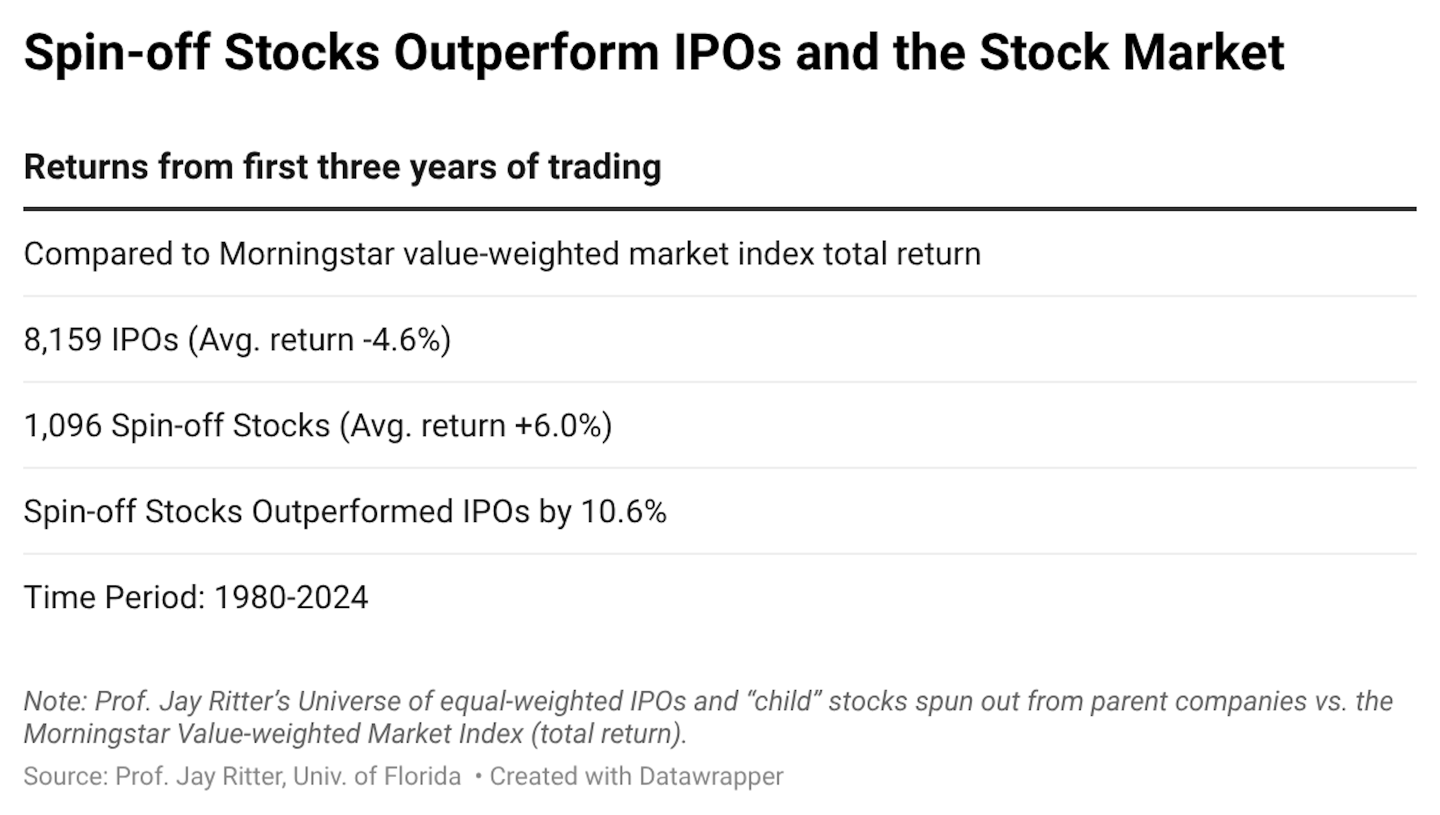
Ritter also shared data exclusively with Fortune showing that, from 1980 to 2024, stocks spun out of parent companies performed better on average than IPOs over their first three years of trading.
Spun-off stocks beat the total return of the Morningstar value-weighted market index by 6% over that three-year period, while the average IPO trailed the market by 4.6% from its offer price. That gives spin-offs, on average, a 10.6-percentage-point edge.
Ritter found that spin-off shares often notch much of their outperformance relative to the broader market on their first day of trading on their own.
One big factor behind that outperformance, he said, is size and stability: Spin-offs tend to be established businesses, while IPOs are often nascent growth companies with riskier profiles. In his study, 70% of spin-offs had inflation-adjusted sales of $100 million or more, compared with just 41.4% of IPOs.
What the Knicks and Rangers are worth
MSG Sports has a market capitalization of roughly $9.8 billion—a steep discount to estimated values of its two New York teams. Sportico values the Knicks at $12.8 billion, nearly twice the NBA average of $6.64 billion, and the Rangers at $4.15 billion. Both rank second in their respective leagues, behind the Golden State Warriors and the Toronto Maple Leafs.
Those aren’t official price tags, but bankers and buyers quickly point out that the supply of teams for sale is finite and demand easily outstrips it, especially in the Big Four leagues: the NFL, NBA, MLB, and NHL.
Franchise valuations have been climbing across the board, with record-setting deals in the NFL—the Khosla family’s $9.612 billion purchase of the Super Bowl champion Seattle Seahawks, which closed in September—and the NBA, where Bob Iger and Josh Kushner agreed in August to buy the Los Angeles Lakers for $12.5 billion, pending league approval. Private equity’s entry into ownership groups has also helped underpin record prices, and private capital is reshaping the sports business more broadly.
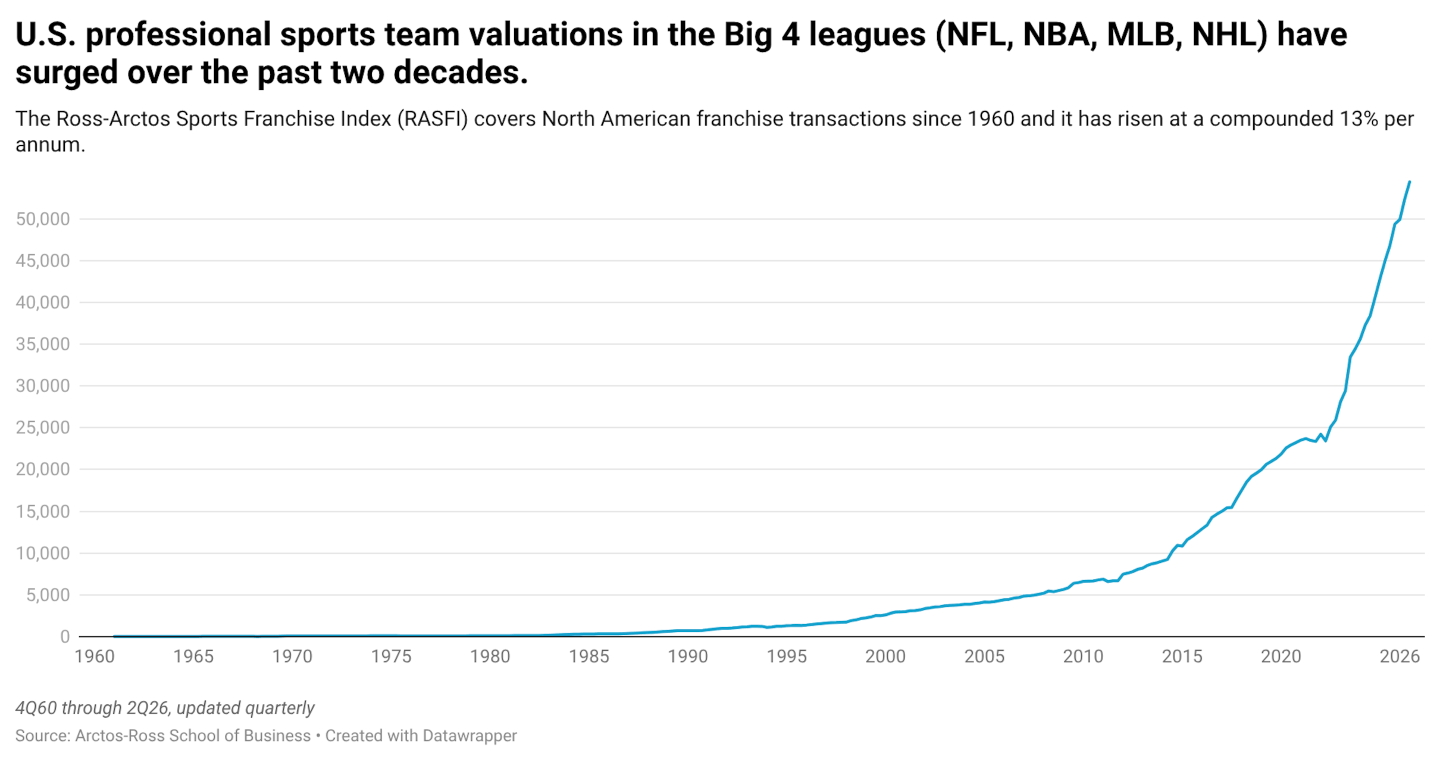
The Ross-Arctos Sports Franchise Index, which tracks franchise values across the Big Four leagues, has risen sharply since the pandemic. Franchise values have compounded at 13% a year for more than six decades as team ownership evolved from a vanity project into an asset class.
How the Knicks-Rangers split works
MSG Sports will be renamed MSG Knickerbockers Corp., or MSG Knicks (new NYSE ticker: MSGK), and will hold the defending NBA champions and the G League’s Westchester Knicks.
The spun-off MSG Rangers Corp. (new NYSE ticker: MSGR) will hold the NHL’s Rangers, the American Hockey League’s Hartford Wolf Pack, and the MSG Training Center in Greenburgh, N.Y.
In the intended tax-free distribution, MSG Sports shareholders of record as of the close of trading today, Oct. 20, will receive one share of MSG Rangers for every two MSG Sports shares they own. The distribution is set for Oct. 26, subject to final league approval and other conditions, and both companies are scheduled to begin regular-way trading under their new tickers on Oct. 27. When-issued trading in MSG Rangers begins tomorrow under the symbol “MSGR WI.” Shareholders will keep the same number of shares in the renamed MSG Knicks.
James Dolan will serve as executive chairman and CEO of both companies, and the Dolan family will retain control of both.