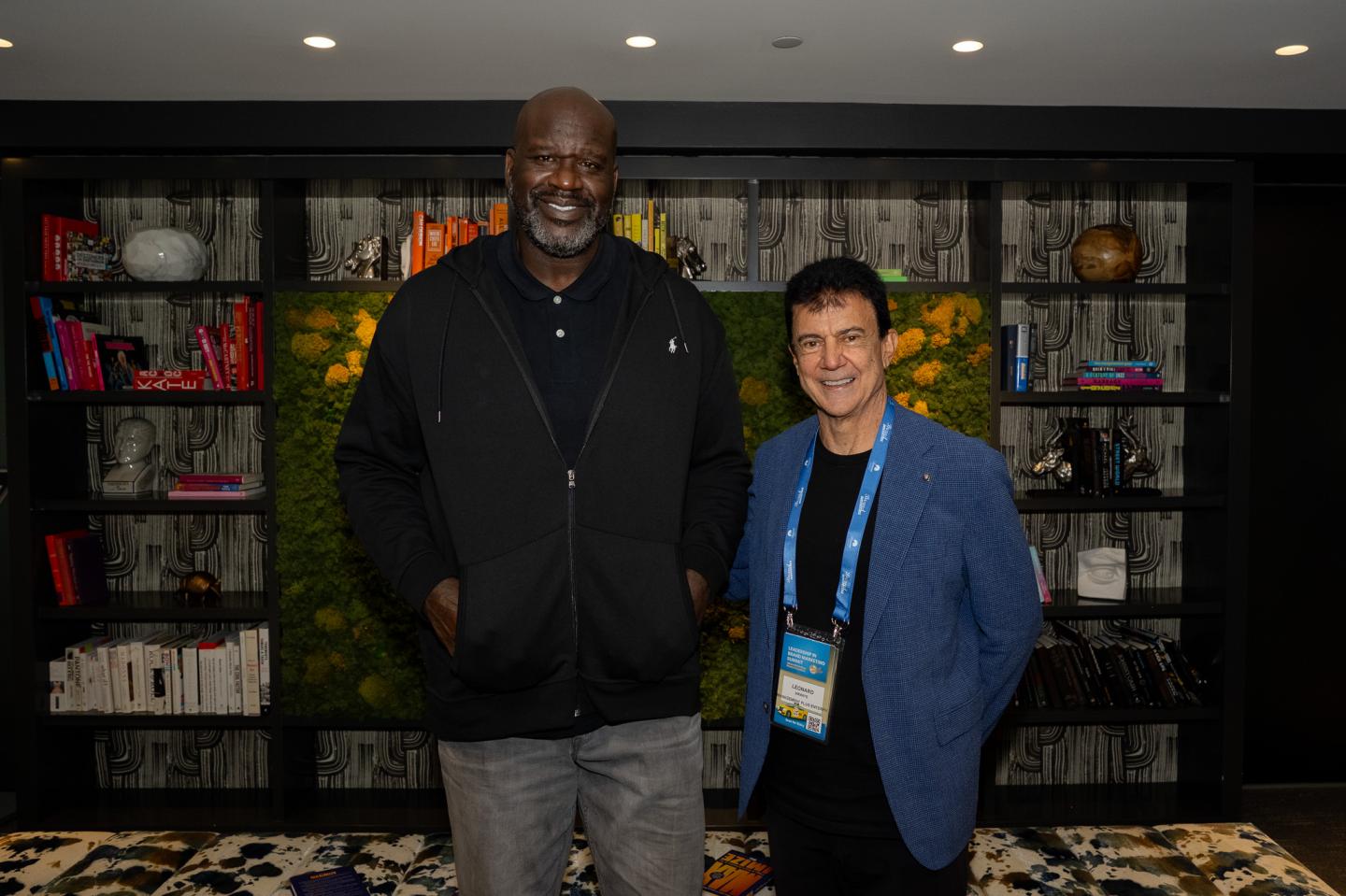
One thing was for sure when you were a kid sneaking in some late-night TV on basic cable: you were going to get an ad for back pain relief. Maybe some car insurance. Maybe some candy or soda, and absolutely a few pairs of shoes. And more likely than not, you were going to see one person in those Icy Hot, The General, Nestle Crunch, Pepsi, and Reebok ads: the 7-foot-1-inch self-described “Big Aristotle” mononymously known as Shaq.
Over the years, Shaquille O’Neal has sold part of his name for more than $100 million, appeared in ads for everything from printer ink to car (and car insurance) commercials, and owns the logo on hundreds of millions of sneakers. And yet, he still says he has never had a job.
“I really respect people such as you guys who have to do real jobs. I’ve never had a real job,” O’Neal told Fortune on the sidelines of the Brand Innovators Marketing Leadership Summit at Paramount’s New York headquarters.
“There was a time in my life where my son asked me to help him fill out a resume. I had no idea what I was doing because I’ve never filled out a resume.”
O’Neal was there with Leonard Armato, the agent who signed him out of Louisiana State University, to promote Armato’s new book, Maximize: 7 Keys to Unlock Greatness in You, out in November from Sports Business Journal Publishing, an imprint of Amplify Publishing Group. O’Neal wrote the foreword. The book lays out the plan the two made in 1992: O’Neal would own his name and logo outright, and other companies would pay to market it.
“He owned his own brand, and then we had to find companies to help build value in his brand by using it in their marketing in creative ways,” Armato told Fortune. “Basically it’s called OPM. You build your brand using other people’s money.”
‘He was my version of ChatGPT’
O’Neal said he didn’t understand much of it at first. “Coming out of college, a guy with no college degree, no business experience, I’m fortunate that I hired somebody that was loving, caring and teaching,” he said. “He taught me everything there is to know about business.”
“He was my version of ChatGPT,” O’Neal added. “My favorite prompt on ChatGPT is, explain it to a fifth grader. He would break it down in terms that I could understand.”
The logo was the first lesson. Nike developed and owned Michael Jordan’s Jumpman logo, and Armato wanted O’Neal to keep control of his own.
“He was like, ‘You need a logo.’ I was like, ‘What do I need a logo for?’ And he showed me the Michael Jordan logo, and I said, ‘Well, if I ever had a logo, this is what I want it to be,’” O’Neal said. “He gave me like five, six different scenarios on why we need to own it, in case we need to leave, in case you want to do this, in case you want to do that.”
Leaving turned out to matter. According to the book, O’Neal turned down Nike and signed with Reebok, whose ad agency designed the Dunkman logo that O’Neal owned and licensed back to the company. Reebok pulled its marketing support after two years, Armato writes, on the theory that big men don’t sell shoes. O’Neal told the summit crowd that a college marketing professor had told him the same thing. Reebok itself later became a costly misstep for Adidas, which sold the brand in 2021.
Because he owned the logo, O’Neal took it with him. The Dunkman has since appeared on more than 400 million pairs of affordable shoes, according to O’Neal’s foreword. In 2015, Authentic Brands Group acquired the rights to manage O’Neal’s name in merchandise and endorsements. Terms were not disclosed at the time; Armato writes that O’Neal sold part of the IP for more than $100 million. Beyond ads, O’Neal has bought into businesses he endorses, including a Krispy Kreme store in Atlanta.
Why he picked The General but not Wheaties
O’Neal said the long list of ads is not a sign that he’ll take any deal.
“I’ve never ever taken the deal just because it was a high value monetary deal. If I don’t believe in your product, I don’t do it,” he told Fortune. “How many times Wheaties has offered me money to be on a box? I just can’t do it because I’ve never eaten Wheaties.”
He said he has asked Wheaties to send Kellogg’s his way instead, naming Frosted Flakes and Froot Loops.
The deals he takes, he said, have to match something in his own life.
“I’m only with The General for one reason. When I was in college and I got my first car, I couldn’t afford regular insurance. The General was the only guy that gave me insurance,” O’Neal recalled. “So as I’m watching The Maury Povich Show every day, and I’m hearing that crazy song, I told my people, call The General and see if they want to do it, because my brand is all about affordability. I’m not trying to break people’s bank accounts.”
“People may look and say, oh, he does a lot of deals,” he added. “I only align myself with brands that I’m comfortable with.”
He told the summit crowd he has renewed with Icy Hot 19 times, and credited an early lesson from Armato. “I remember one time we was getting a deal, and I was so focused on money,” O’Neal said. “He said, ‘No, never focus on the money. Let’s focus on the renewals.’”
Don’t show off your wealth
O’Neal said the biggest change since his playing days was learning social media. He avoided Twitter for years because he didn’t think it would work. That changed in Phoenix, he said, when he tweeted an offer of five tickets to watch him play Kobe Bryant and the Lakers, and saw a car stop in the street about 30 seconds later.
“But then I said to myself, I have to use it responsibly. Like I hate wealthy athletes that show off their wealth on social media. It upsets me, makes me sick,” O’Neal said. “Mine is 60% to make you laugh, 30% to inspire you, and then 10% to promote whatever’s going on.”
Armato said he had to rein in O’Neal’s spending early on. O’Neal said he would buy expensive cars as a young player, and Armato would make him return them. “I think I have to give myself a lot of credit for listening,” O’Neal said.
Terminator on the court and Bambi everywhere else
In the book, Armato describes pitching O’Neal to sponsors as part Terminator, part Bambi. O’Neal said the description fits.
“In my line of work, I try to eliminate all threats, which is everybody. But in real life, I’m not like that, and I had to show that,” O’Neal told Fortune. “In real life, I’m a nice guy. I respect everyone. Doesn’t matter how much you make. Doesn’t matter where you’re from. It’s ‘yes, sir,’ and ‘yes, ma’am,’ to everybody.”
Armato said the softer side was something they had to put on screen. “When he first came out, he was doing these crazy things that nobody had ever done before, like shattering backboards, pulling down basket stanchions on national television,” he said. “So we were kind of thinking, okay, but he also has a softer side, and that has to show through as well. So Pepsi did a really fun commercial with him, with a little kid, to show that he was not only powerful but he also was emotionally intelligent. So that combination really made people fall in love with him.”
During the summit, O’Neal recounted an instance when Armato interrupted an image consultant. “Leonard stops the guy in the middle of the meeting and says, ‘You know what? For this guy right here, image is reality.’ And what we meant by that is, you have to be yourself,” O’Neal told the crowd. “You always have to be your true, authentic self.”
Even his nickname came from Armato. Before O’Neal accepted his MVP award, the two talked about Aristotle’s line that excellence is a habit. “He was like, ‘You got to give a speech.’ I was like, ‘I don’t know what to say.’ He just started talking about Aristotle. I was like, ‘Say that again,’ and I wrote it down, and I just delivered,” O’Neal said. “And from that day on, I was known as the Big Aristotle.”
Armato also took on O’Neal’s music career. “I tell him I want to do a rap album, and he says okay, and he got me a $10 million deal for three albums,” O’Neal said.
The split
The partnership did not last. In the book’s chapter on failure, Armato writes that O’Neal fired him after a run of fights over which deals fit the brand and over O’Neal’s wish to curse on his rap records. Armato writes that he called O’Neal 20 times from an Orlando hotel without an answer, and that his own ego played a part. He writes that O’Neal was generous in the separation and that the two never fought over money.
They are close again. Asked what advice he gives younger athletes, many of whom now sign seven- and eight-figure NIL deals while still in college, O’Neal said he leaves that to them.
“I would never tell a person what to do and who to sign with,” he said. “I just know that if I don’t believe in your product, I can’t promote it to people. That’s not me.”
Former LSU gymnast Livvy Dunne, one of the top college earners under NIL rules, has made the same case about athletes owning the rights to their names.
On stage, O’Neal said of Armato: “We had a lot of tough conversations, but 70% of the time he won, and he was always right, because he’s smarter than I am, especially in this business.”
He closed the session with a pitch to the room of marketing executives.
“If you haven’t signed me up to your company, I’m available,” O’Neal said. “I don’t have enough commercials on TV yet. So you want to do business with me? I’m available.”