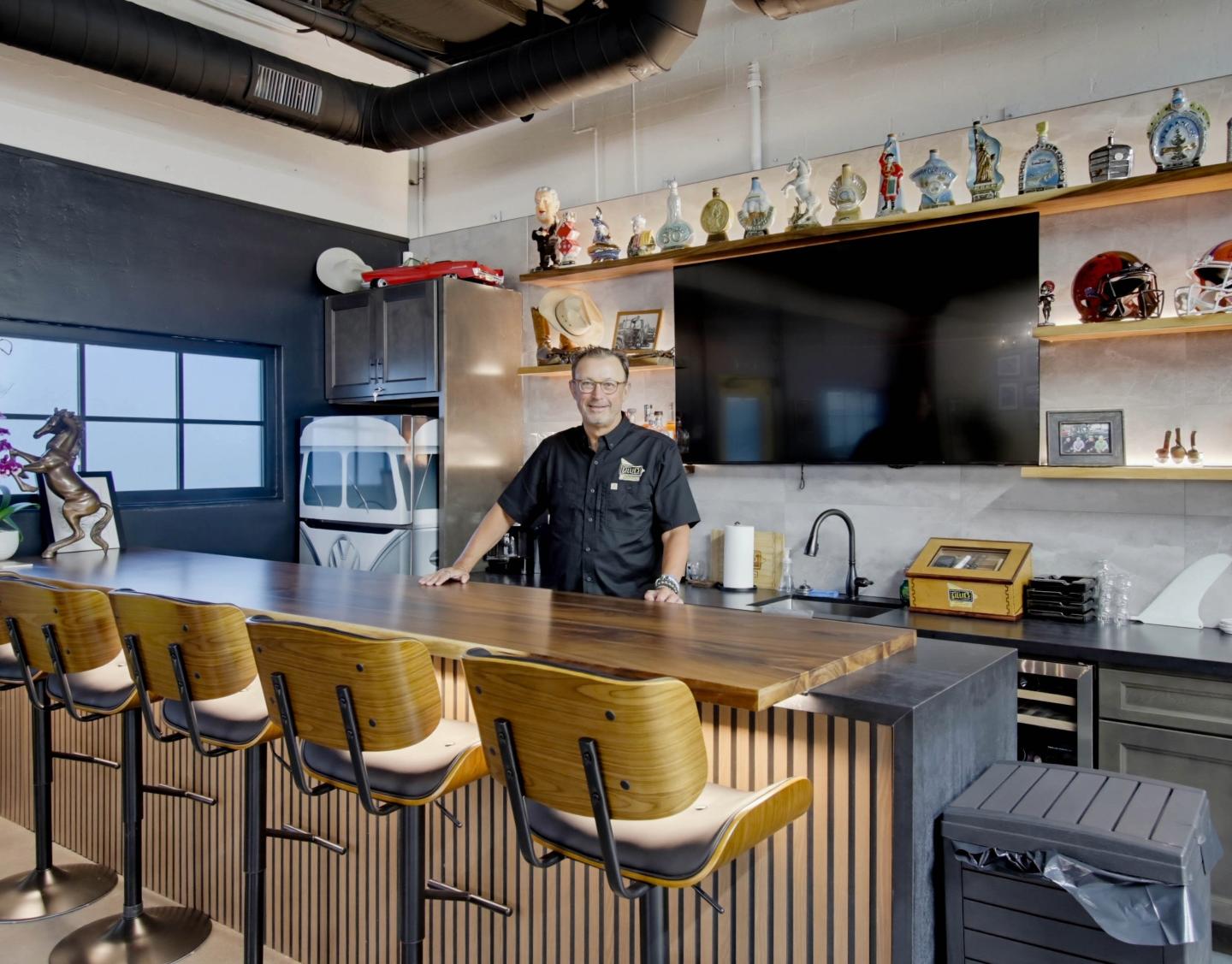
When Michael Olguin was a child in Barstow, California, a desert town on Route 66, money was tight. To entertain Michael and his three brothers—four of eight kids in a Mexican American family of “very meager means”—his father would take them to car dealerships after hours. They’d walk the lots while he explained the years, makes, and models of the gleaming machines on display.
His father drove diesel trucks for the local Marine base and competed in “truck rodeos,” contests of backing up trailers and tying down loads. The boys moved on to model cars, then slot car racing.
Decades later, those memories laid the foundation for Gillie’s Auto Lounge, a private car storage facility and social club in San Diego that Olguin opened in April. His brother suggested naming it for their father.
“He’s where our love for cars came from,” Olguin says, “and that never went away.”
Now in its first year, Gillie’s is also a lesson in what it takes to break into a tight-knit community from scratch—and why a founder’s own story can be his best marketing.
A detour through Minneapolis
Olguin’s first career began in San Diego in 1992, when he launched the public relations agency Formula PR. He ran it for more than 30 years, expanding nationwide and selling it to French communications giant Havas in 2014. He stayed on through the end of 2023.
The seeds of Gillie’s were sown during one of the long road trips he took in those final years in a 2003 Volkswagen EuroVan. “I love to venture,” he says. One winter, he stored the van in Minneapolis for three months.
“It was this old, beautiful brick building that used to be an indoor car dealership,” Olguin remembers. The owner told him the business was more of a real estate play—the building had been his father’s, and he planned to sell it eventually—but that “it really is a fun business.” Olguin filed the conversation away.
After retiring in December 2023, he flew to Chile for a running trip up glaciers and volcanoes in Patagonia. When he got home, he started writing a business plan for a running adventure company, then stopped, giving himself six months to see whether the urge lasted.
“That’s the problem with being an entrepreneur,” Olguin says with a laugh. “You start thinking everything can be a moneymaker.”
A prime opportunity
Meanwhile, he moved back to San Diego after 16 years in New York. An avid real estate investor, he came across an intriguing property in Point Loma, a scenic neighborhood near the water, and a familiar idea began to take shape.
“It’s a very cool building in an area that’s going to be highly redeveloped over the next decade,” Olguin says. “I thought about that chat in Minneapolis, and what a great business it would be to open an auto storage facility.”
He bought the building in April 2025 and started on the design that summer with a distinct vision.
“I didn’t want to build a man cave, but a place where men and women who love cars would want to come for a cocktail, some music, or a party,” Olguin says. “An ‘if you know, you know’ kind of thing.”
The result is part garage, part speakeasy (visitors have to be buzzed in), designed to resemble a 1950s service station, with a single neon sign outside. Inside, family lore surrounds the leather couches, cold drinks, and big-screen TV. A Mercedes-Benz hood in the entryway bears the number eight, styled like a racing number, for the eight Olguin children. Vintage Jim Beam bottles above the bar came from his sister, a vintage art collector. (Gillie’s has no liquor license, so it can serve alcohol but not sell it.) A set of 124 diecast model cars belonged to his oldest brother, who died in 2020.
“Basically every person who comes in and takes a tour asks who Gillie is, and wants to hear the story,” Olguin says.
The model is simple. Gillie’s holds about 30 cars in climate-controlled storage monitored around the clock. Members pay $600 a month to keep a car there, which also gives them access to the lounge. Detailing, battery tenders, and tire-pressure monitoring are available, and staff can “regularly exercise” cars on request, because “the worst thing for a car is to not be driven,” Olguin says. Hours are 10 a.m. to 6 p.m., but he can open the back gate remotely for after-hours pickups.
Cracking the car-world code
Pulling together the building and the business model was the easy part. The real challenge was winning over local car lovers. The high-end car world, where some models have doubled in value in two years, can be as guarded as a Rolex dealer’s waiting list.
“The car community is very careful about who they let in,” Olguin says. And after 16 years away from San Diego, he had to build a network from scratch.
Luckily, the city is “72 degrees and sunny year-round, so there are ‘Cars & Coffee’ events virtually every weekend,” he says. To get the word out that Gillie’s was open for business, he canvassed those gatherings with flyers and hosted a pop-up. He found his first employee—a recent graduate of a local university who can drive a stick shift (a requirement, since “very few people can anymore”)—after noticing his standout social media feed full of local car content.
Instead of waiting for enthusiasts to find him, Olguin sought them out. Gillie’s has partnered with local BMW, Porsche, and Thunderbird clubs, and a Ferrari Club partnership is in the works. The space has also become “a really neat event venue,” as Olguin continues to court local meeting planners and destination management companies. In November, Gillie’s will host the Saturday-night featured event of the San Diego Wine & Food Festival, complete with wine, art, and plenty of exotic cars parked out front.
“Always be realistic,” he advises other founders. Acceptance, he’s learned, takes time.
Building a brand
While business is humming along, Olguin sees Gillie’s as a warm-up lap for a much bigger ambition.
“This is a beta test for us,” he says. “I didn’t call this an auto storage facility because I want to build a brand.”
The car storage business isn’t new, Olguin explains, but it’s highly localized: “There isn’t a national brand.” Within three years, he wants to be storing 200 cars across at least three more locations, in North County, Palm Springs, and Orange County.
He also has a backup plan built into the land. Gillie’s is about a minute from San Diego’s aging sports arena, currently Pechanga Arena San Diego, which the city hopes to rebuild as it courts NBA and NHL teams.
“In the long run, I think it will probably be a real estate play here,” he says. “But in the short run, our plan is to learn how to manage the inventory, and what car guys and gals really like and want, and then scale.”
Until then, Olguin—whose favorite car is a 1965 Chevrolet Malibu he bought 32 years ago and restored to mint condition—gets to do what he’s wanted all along: “Just hang out with car people and talk about cars and be around cars.”
What first-year founders can learn from Gillie’s
Make your story part of the product. Gillie’s is named for Olguin’s father and filled with family artifacts, and nearly every visitor asks who Gillie is. A small business can’t outspend bigger rivals on marketing, but a genuine origin story gives customers something to remember and repeat.
Go where your customers already are. Rather than waiting for a guarded community to discover him, Olguin showed up at weekend Cars & Coffee events, handed out flyers, ran a pop-up, and partnered with established car clubs. In year one, borrowed credibility can open doors faster than advertising.
Hire your first employee for fit, not just a résumé. Olguin found his first hire through a social media feed that showed real passion for local car culture, and set one nonnegotiable skill: driving a stick shift. Knowing exactly what the job requires makes it easier to spot the right person, even in an unconventional place.
Treat your first year as a beta test. Olguin is using his first location to learn what members want and how to manage inventory before expanding, with the property’s real estate value as a fallback. His advice to other founders: Be realistic, because acceptance takes time.