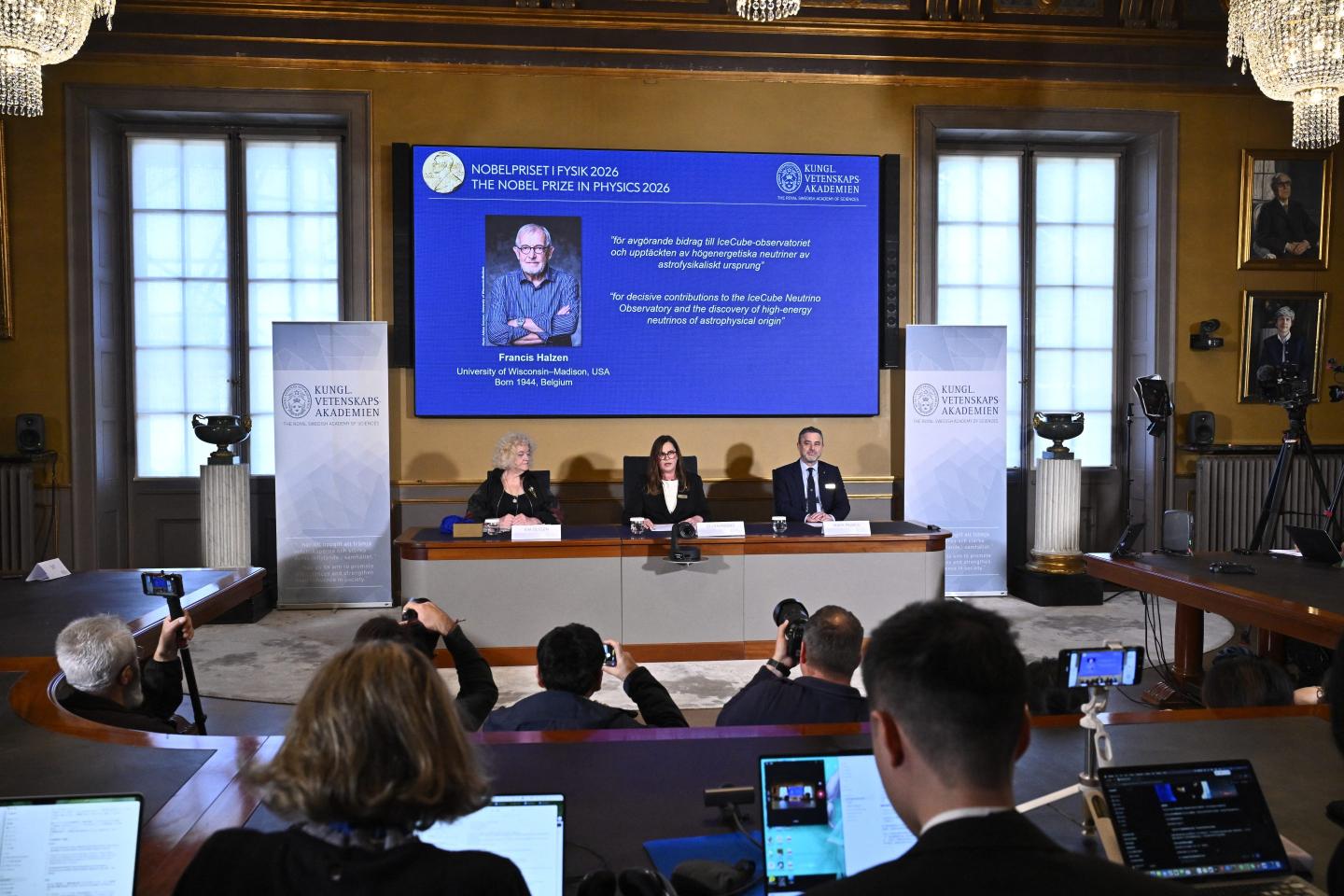
Belgian-born scientist Francis Halzen won the Nobel Prize in physics Tuesday for his efforts to demystify a rare group of neutrinos, tiny cosmic particles that researchers believe offer clues to how the universe evolved.
“It was a great surprise, and I obviously didn’t expect it,” Halzen said, speaking to the Nobel Physics Committee by phone from Italy, in a call broadcast at the news conference to announce the winner.
Halzen said it was predicted that he would win the prize, but the announcement still made him feel “strange.”
“I am working on a proposal, and I hope that this prize will help getting it approved,” he said to chuckles from the audience.
Halzen paved the way for a new kind of astronomy
Neutrinos are tiny cosmic particles with no electrical charge and extraordinarily small mass, making them difficult to detect. Yet they are everywhere: They spew from stars like the sun, and trillions zip through our bodies every second.
Scientists cannot glimpse the mysterious ghost particles zooming around on their own, so they measure what happens when the particles collide with other bits of matter. Neutrinos bump into other particles only rarely, so scientists build large detectors to improve their odds of catching collisions.
Halzen had the idea to turn the vast Antarctic ice into such a detector. The Nobel committee said his work was instrumental to the construction of the IceCube Neutrino Observatory in Antarctica, which glimpsed the first high-energy neutrinos from faraway galaxies.
“This experiment in the Antarctic is a revolutionary way of understanding the universe that we didn’t have before,” said Michael Moloney, chief executive officer for the American Institute of Physics.
When a neutrino interacts with ice in the detector, it produces a flash of light that’s picked up by sensors. The transparent ice makes it easier for scientists to pick up on faint signals from the mysterious ghost particles, and the sensors are buried about 8,200 feet (2,500 meters) deep to protect against interference from cosmic rays and radiation.
The 82-year-old scientist is affiliated with the University of Wisconsin–Madison in the U.S., which operates the observatory. Efforts by The Associated Press to reach him were not immediately successful.
Halzen helped pull the curtain back on a rare gang of neutrinos that scientists say hold clues about the development of the universe.
“It’s all part of working out the story of where we are in the universe, what’s our place in the universe, how did our galaxy form?” said Jonathan Bagger, chief executive officer of the American Physical Society.
In a post on social media, Belgian Prime Minister Bart De Wever said Halzen is the 11th Belgian to win a Nobel Prize. De Wever called the award “impressive recognition for a lifetime dedicated to shedding light on the great mysteries of the cosmos through its smallest components.”
A representative from the IceCube Neutrino Observatory did not immediately return a request for comment. The University of Wisconsin–Madison did not immediately comment when reached by the AP.
Prize money is about $1.2 million
Ellen Moons, secretary-general of the Royal Swedish Academy of Sciences, announced the award Tuesday in Stockholm. She is the first woman to head the prestigious academy and present the award.
The prize money this year is 12 million Swedish kronor (about $1.2 million), whether for an individual, a small group of laureates or an organization.
Last year, three scientists won the Nobel Prize in physics for research on the strange behavior of subatomic particles called quantum tunneling that enabled the ultrasensitive measurements achieved by MRI machines and laid the groundwork for better cellphones and faster computers.
The announcements of this year’s prizes began Monday with the Nobel Prize in medicine being awarded to three scientists whose work led to a tool that uses light to help unravel how the brain works.
This week’s awards continue Wednesday with the chemistry prize and literature on Thursday. After Friday’s peace prize is awarded, the Nobel Memorial Prize in Economic Sciences will be announced Monday.
___
Dazio reported from Berlin, and Ramakrishnan reported from New York. Alexa St. John in Detroit contributed to this report.