
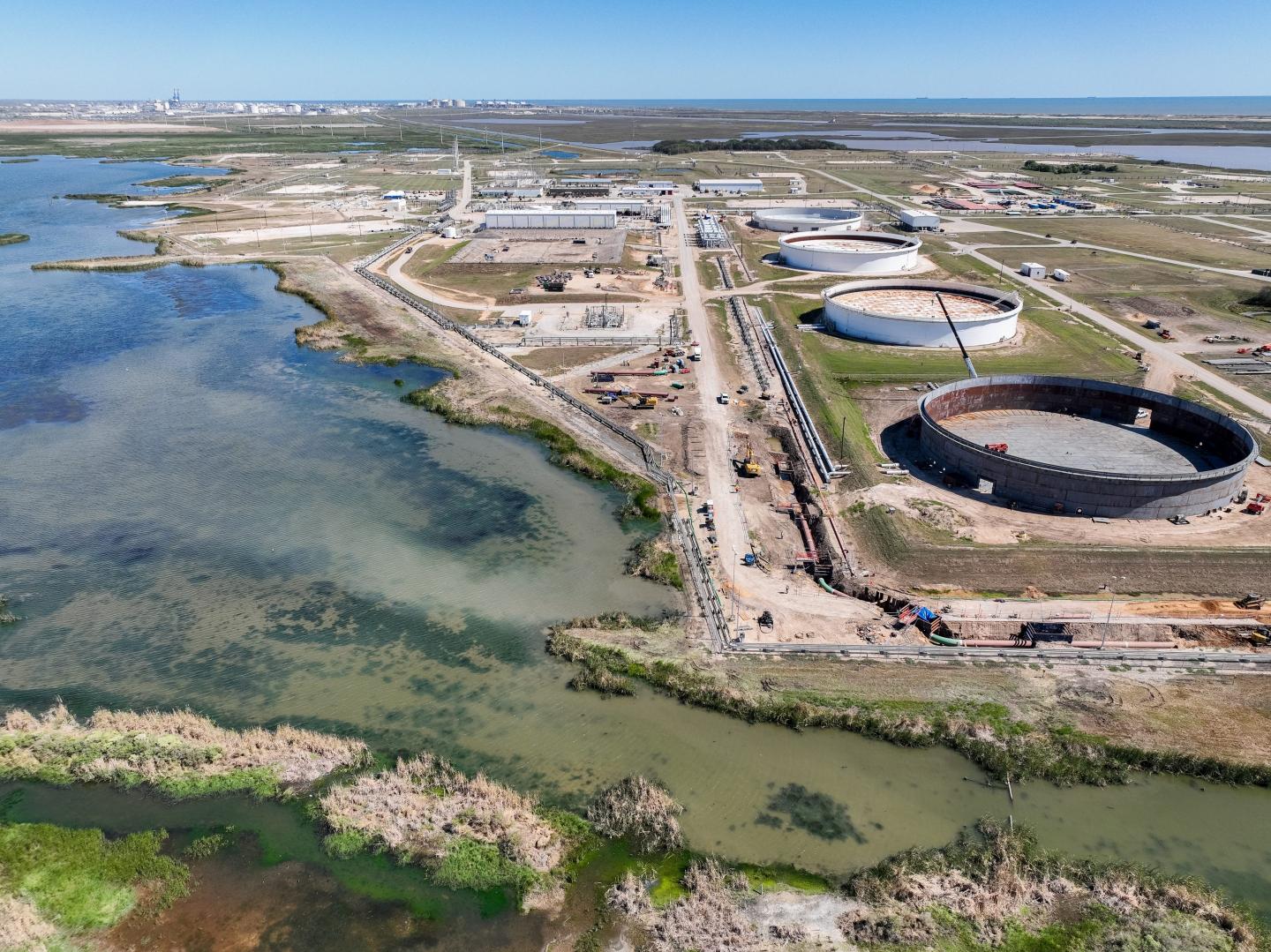
One of the biggest questions looming over the oil market is when the U.S. Strategic Petroleum Reserve will reach its effective minimum level, but industry executives have offered a wide range of answers, underscoring the uncertainty hanging over prices.
The Trump administration agreed to release SPR reserves in March as part of a coordinated effort by the International Energy Agency to address the supply shock from the Iran war.
The conflict is now entering its eighth month with little sign of diplomatic progress to end it, and global inventories are continuing to drop toward critical levels.
On Monday, Saudi Aramco CEO Amin Nasser estimated more than 1 billion barrels of oil have been withdrawn from stockpiles around the world, including those from companies and governments.
“The system is already straining,” he said at a conference in London. “And with precious little else the world can turn to, the supply resilience cushion is scarily thin.”
While Persian Gulf oil exports have returned to prewar levels, the rebound is fragile, and there are already signs a resurgence of Iranian attacks on shipping has slowed traffic.
That means oil inventories will continue to be tapped. But once they hit so-called tank bottoms, the spigot that has been keeping oil markets from going off a cliff will run dry—and crude prices will likely soar.
In the U.S., the latest reading on the Strategic Petroleum Reserve shows that it’s fallen to about 284 million barrels, the lowest level since 1982. And once the Trump administration is done releasing the final batch as part of the IEA agreement in March, it will drop to 243 million.
That sounds like a lot. But because the SPR consists of underground salt caverns that also hold water, the additional amount that can be realistically withdrawn is much less. A minimum level of crude is necessary to keep extraction pipes submerged in oil rather than water.
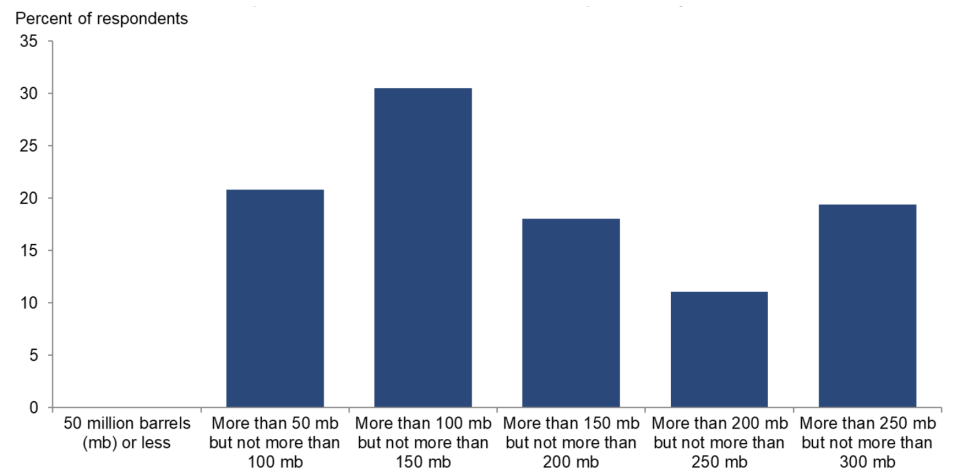
A recent survey of oil executives conducted by the Dallas Fed, which covers the Permian Basin, found that even those at the epicenter of U.S. shale are all over the place on what that number is.
The biggest share, 31%, believe the absolute minimum inventory level is 100 million to 150 million barrels, while 21% put it at 50 million to 100 million, 18% said 150 million to 200 million, 11% said 200 million to 250 million, and 19% said 250 million to 300 million.
While more than half see substantial margin remaining, almost one-third of oil executives think the SPR is already below or nearly at tank bottoms.
Since oil floats on top of water in the salt caverns, the water level rises whenever oil is released, potentially damaging the walls, pipes, and pumps that are needed to bring crude to the surface.
“Eighty percent of the Strategic Petroleum Reserve is in phase 2 and phase 3 caverns, giving them reasonable recovery rates (we are assuming 90%) with limited damage to the cavern during drawdown,” one executive told the Dallas Fed. “Twenty percent of SPR is in phase 1 caverns, and we’re carrying at 50% due to their limited remaining drawdowns versus cavern integrity.”
For its part, the Energy Department has said at least 70 million barrels must remain in the SPR to safely manage the caverns.
But industry experts have similarly wide-ranging views. Amos Hochstein, a senior energy advisor to President Joe Biden, told CNBC in August going below 300 million barrels risks damage to the caverns. Rapidan Energy said the SPR has a “soft-ish floor” of around 170 million barrels.
Meanwhile, Siddharth Misra, a petroleum engineering professor at Texas A&M University, wrote in a Fortune op-ed in August that 70 million barrels is the structural floor where the salt rock might physically hold together, but the “practical operational floor” is around 250 million barrels.
“The Strategic Petroleum Reserve is rapidly losing its physical ability to act as an immediate economic buffer,” he warned. “We are no longer limited merely by how much oil is left in the ground, but by the physical and engineering limits of how fast the earth will let us take it out.”