
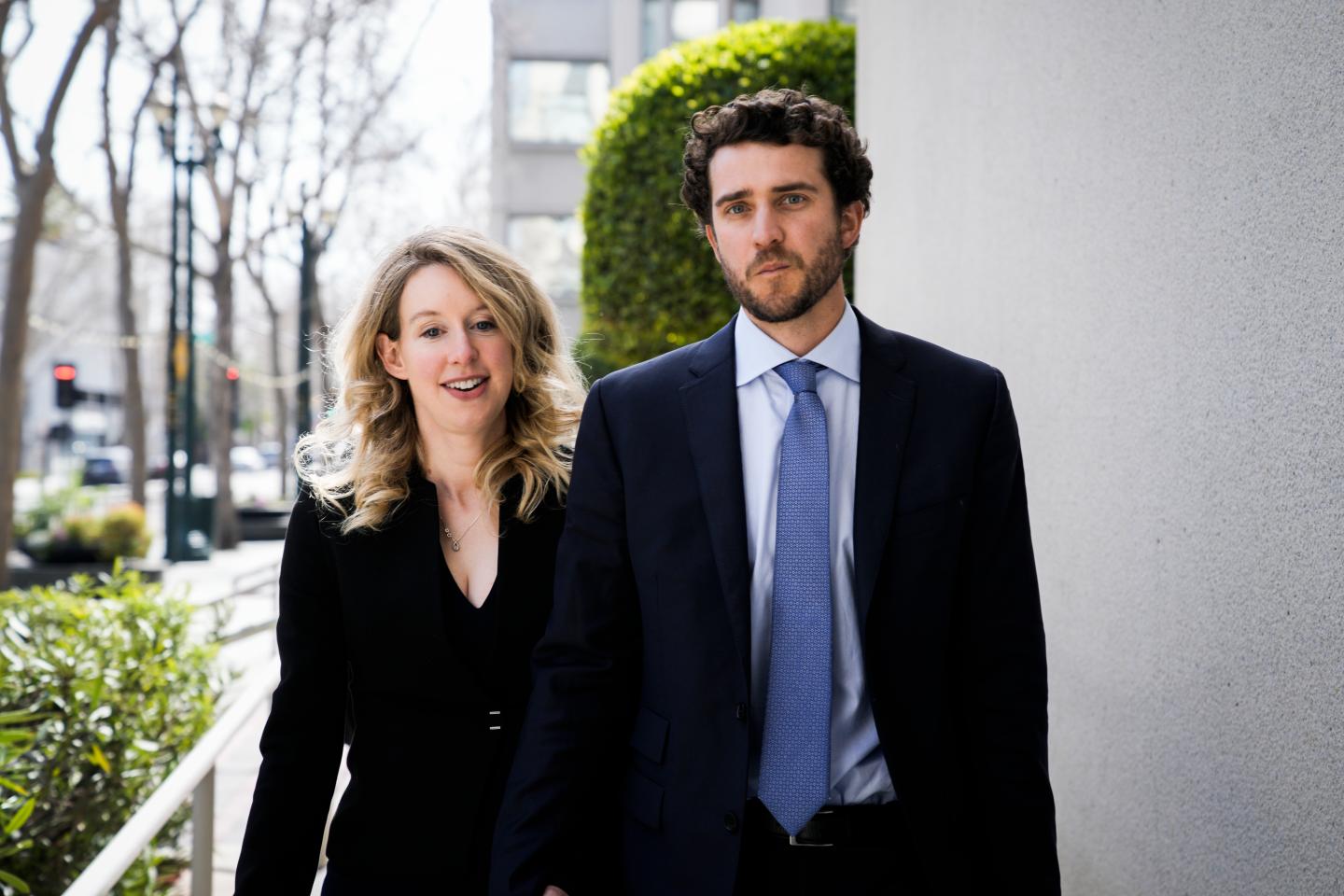
On Wednesday night, I sat alongside 1,000 other people inside Lincoln Center’s Alice Tully Hall; we were all unsure just quite what we were getting into. It was the New York Film Festival premiere of You Can See Everything, the new documentary about disgraced Theranos founder Elizabeth Holmes.
Calling this film a documentary doesn’t quite do it justice. Nathan Fielder, the comedian best known for absurdist, surrealist shows like Nathan for You and The Rehearsal, embedded with Holmes and her family in the 34 days before she entered prison in 2023. As Fielder himself told us after the screening, he didn’t quite understand why. “I cannot tell you how weird it was that we were there. … I wouldn’t think I’d be the person you’d want for your final…” he said, trailing off to laughs from the crowd.
In case you need a refresher, Holmes built Theranos to a $9 billion valuation with the claim that it could revolutionize diagnostics by testing just a few drops of blood. She was the youngest female self-made billionaire in the U.S. Then, in 2015, the Wall Street Journal and reporter John Carreyrou began to uncover that the technology did not work. In 2022, she was found guilty of defrauding investors but acquitted of defrauding patients; her ex and Theranos COO Sunny Balwani was convicted of both. For about seven years, she didn’t have any kind of public presence.
The first half of the film follows Holmes in her cozy domestic life in southern California. We see her spend time with her husband, Billy Evans, and their two young kids. (They met in 2017.) They’re working the phones with investors, still attempting to bring back a new version of Theranos 2.0. We see them dig Theranos’s discredited blood testing device out of the garage, and Holmes is still a believer in the technology. It seems as if they are able to forget that Holmes will be surrendering herself in Bryan, Texas for an 11-year sentence in just a few weeks.
Fielder and co-director Lance Oppenheim explore a familiar question: Is Holmes lying? Most of the time, the camera is up close on Holmes’ and Evans’ faces. We stare directly into her big, blinking blue eyes. This project was kept top secret until just about a month ago; the first clip released was of Holmes looking directly at Fielder and asking him, “Why would I deceive you?” It went completely viral.
Fielder asks, in his signature style, some disarmingly direct questions, like to Evans: He met the Theranos founder post-exposé, probably on her way to jail, and said, yes, this is what I want?
Fortune makes a few cameos; there is of course the famous magazine cover, and the film spends time litigating a line from the founder’s interview with journalist Roger Parloff, in which she says that Theranos’s device can perform any test. (She says she meant it could, if they were to successfully develop the chemistry for those tests.)
The second half of the film is like nothing I’ve ever seen before. Holmes is off camera, in prison. We follow her husband, Evans, who has been continuing Holmes’ efforts to build a diagnostics company again and aggressively running her X account. There’s another twist too—but A24 has asked us not to share more before the film’s release.
All I can say is that you will come away from this documentary feeling uncertain about what you just saw, confused, conflicted, and probably even concerned for Holmes (which might be hard to imagine until you see it!). Fielder and Oppenheim say they are no longer in touch with Evans and Holmes, and the couple hasn’t seen the film yet. They probably won’t be sure what they just saw either.
Emma Hinchliffe
emma.hinchliffe@fortune.com
The Most Powerful Women Daily newsletter is Fortune’s daily briefing for and about the women leading the business world.
ALSO IN THE HEADLINES
Letitia James takes on the Cornell case. The New York attorney general will be special prosecutor investigating the alleged gang rape, appointed by Gov. Kathy Hochul. "The young woman at the center of this case deserves to know that every fact will be examined and justice pursued," Hochul said, adding that she and the public have lost faith in the district attorney to handle the case.
Shivon Zilis says she was "let go" as Elon Musk's partner. The mother of four of his children posted screenshots of a conversation in which he apologized for not taking her to the White House's recent state dinner with Xi Jinping. Then, she added, "It’s hard to go from in love to let go in a week with no warning, but that’s just how it is sometimes. I feel happy that I got to show Elon how it feels to be deeply understood, nurtured, and peacefully loved with stability and gentleness."
The end of size inclusivity is hitting indie brands. Many still want to offer extended sizing but are constricted by what retailers, responding to the rise of GLP-1s, are willing to carry.
Kathleen Kennedy takes on AI in Hollywood. The former Lucasfilm president behind Star Wars is tackling the hot-button issue in her next chapter. "There was a lot of anxiety around anybody talking about this very publicly," she says of the secrecy around AI in entertainment. "People are recognizing that we have a bit of a leadership void in the industry right now. Everybody’s looking for guidance as to how we’re going to go about using these tools."
ON MY RADAR
The spectacular collapse of my six-figure life Marie Claire
What's really behind the baby bust? The New Yorker
Min Jin Lee was underestimated for half her life. Then she started to write NYT
PARTING WORDS
"I wanted to be known for my songs, not for being the pretty girl or wearing crop tops."
— Miranda Lambert, on bursting onto the scene as a country singer in the 2000s