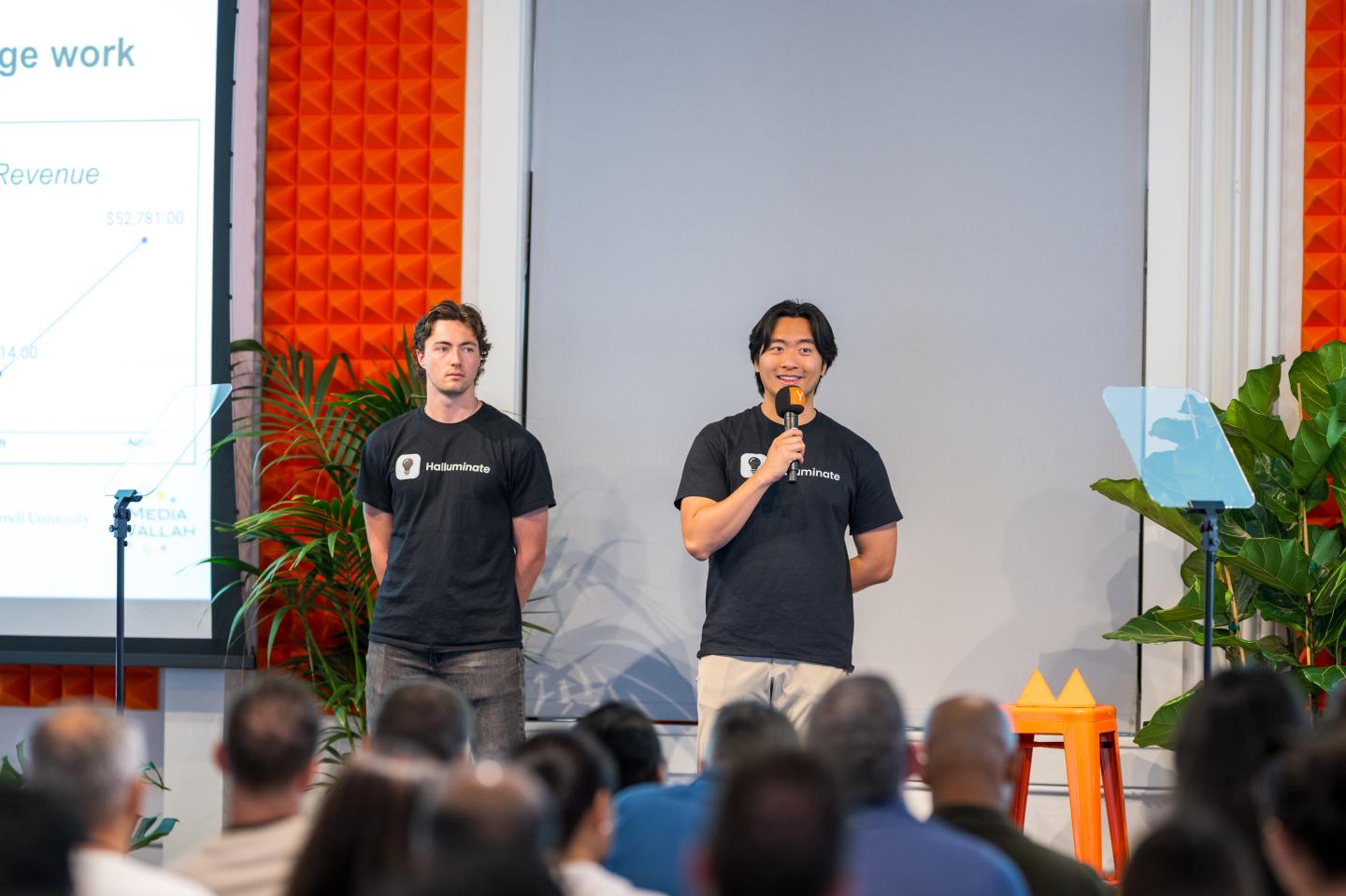
Halluminate, a nine-person San Francisco startup building AI training environments for financial work, has raised $30 million in a Series A led by Oak HC/FT, bringing its total funding to $38.5 million.
Halluminate benchmarks AI models on financial tasks to find where they fall short and builds simulated training environments aimed at those gaps. Founded in 2024, Halluminate is betting that the data and environments used to train AI will become increasingly specialized by industry.
Simulating an investment banker’s work is fundamentally different from simulating a software engineer’s work, CEO Jerry Wu tells Fortune. He refers to the systems the company builds as “verticalized data research labs.” Wu expects AI training data to become more specialized by industry, with companies focusing deeply on areas such as finance, coding, or health care rather than across many domains.
A benchmark released by the company in August asked seven frontier models to work through a simulated company-acquisition due-diligence process. The 88 tasks were based on anonymized private-equity transactions and written and reviewed by practicing deal professionals. The highest average score was 51%.
One task asked an agent to redline a statement of work using a 160-file data room, 21 emails across nine threads, and four meeting notes. As deal terms changed, the agent had to identify the latest instructions while preserving provisions meant to remain unchanged. Across the benchmark, agents struggled to carry instructions through to the final deliverable: They left out required changes, used the wrong analytical method, or relied on information that had been superseded.
Benchmarks like this would identify where agents break down in complex financial workflows, then turn those failure modes into reinforcement-learning environments.
That focus helped convince Oak HC/FT general partner Matt Streisfeld. He tells Fortune that finance offers a broad range of complex knowledge work, from banking and private equity to consulting and accounting. As AI agents take on work that stretches from hours into days, he expects the quality of specialized training environments to matter more. Halluminate’s finance expertise and infrastructure for building high-quality environments stood out to him. “When the agent starts getting into long horizon work,” he said, “testing work and specialization will really be key.”
Demand for this kind of post-training infrastructure is beginning to show up in both customer projects and dealmaking. Scale AI wrote in February that nearly half of its new data-training projects involve reinforcement-learning environments. Deeptune, which builds simulated work environments for training AI agents, raised a $43 million Series A led by Andreessen Horowitz in March and agreed to be acquired by Mercor four months later.
According to Wu, four of the top five closed-source U.S. AI labs are paying customers. Halluminate has crossed the mid–eight figures in annualized revenue run rate, based on quarterly revenue from work already delivered and paid for, and is profitable, he said.
The ‘Moore’s law’ of environments
For now, Halluminate is deliberately concentrating on a small group of frontier model labs rather than expanding broadly into enterprise customers. Wu sees that focus as a strength. He said Halluminate wants to work first with frontier model labs, where it can help push model capabilities forward and develop its approach to building training environments. Enterprise customers and other industries could come later, but neither is a priority today.
Halluminate argues that specialization allows it to compound finance expertise, its expert network, and domain-specific verification and data-generation methods.
As models improve, Halluminate has to make its environments more complex to keep them useful for training. Inside Halluminate, Wu has a name for that pressure: the ‘Moore’s law of environments.”
He estimates that every six to eight months, the complexity of the company’s environments needs to roughly double to keep pushing frontier models. That complexity can mean longer trajectories, harder reasoning tasks, and more files in an environment.
Wu described the company’s IP as its ability to keep producing that complexity “generation after generation.”
Existing Halluminate investors Y Combinator, Orange Collective, and Heavybit participated in the round, along with individual researchers from Anthropic, OpenAI, and Meta, according to Wu.