

Older millennials are pulling away from the rest of their generation in the housing market. Now, they are pulling ahead in the hobby economy, too.
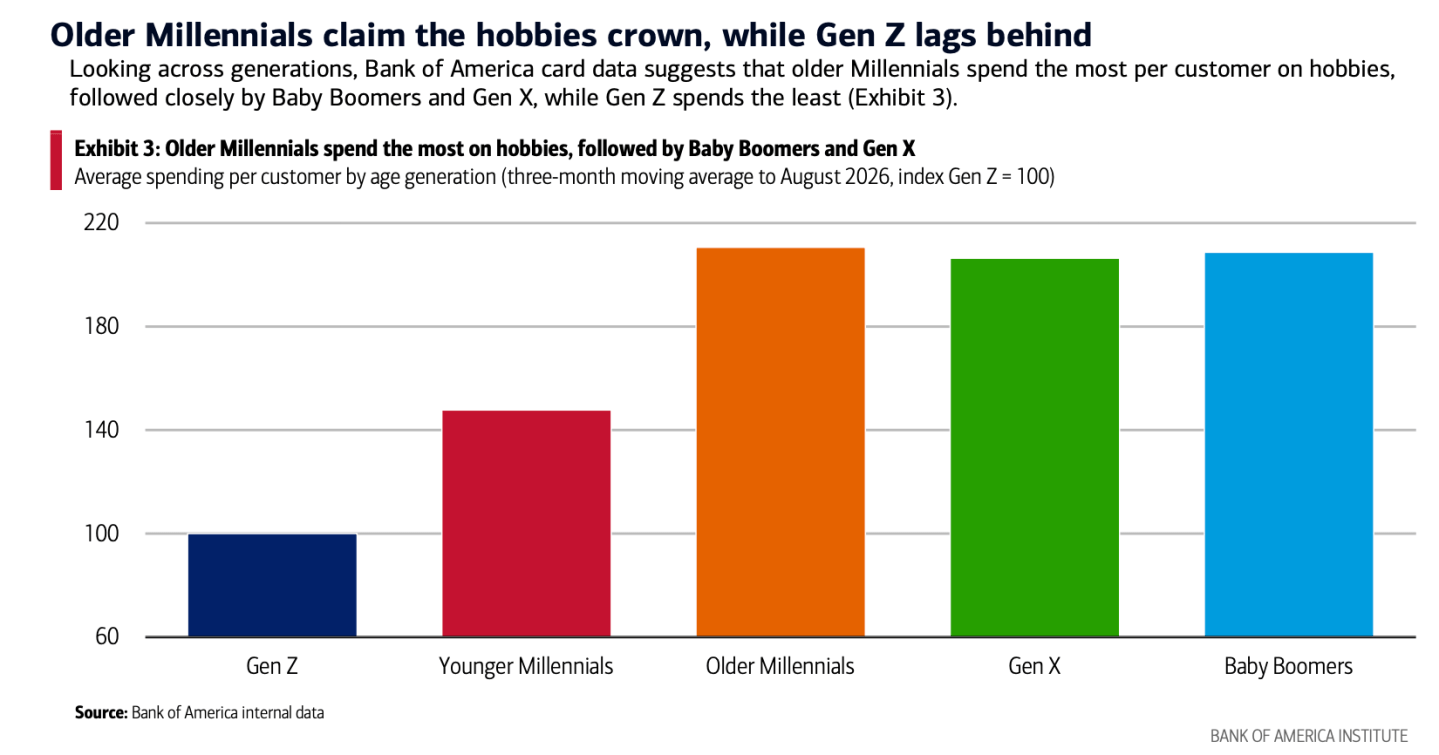
A new Bank of America Institute analysis finds that older millennials spend more per customer on hobbies than any other generation, outpacing Gen X, baby boomers, younger millennials and Gen Z. The group’s hobby outlays were a little more than twice those of Gen Z in the three months through August, based on an index that sets Gen Z spending at 100.
In fact, BofA Institute economist Joe Wadford told Fortune over email, older Millennials lead in hobby spending across multiple measures. Not only do they spend the most per customer/buyer, but a higher share of older Millennials have hobby spending compared to any other generation. Millennials have seen accelerating hobby-related spending over the past two years, he added, while most other generations have seen cooling in both their spending or transactions.
The result mirrors an emerging divide in housing. Older millennials have become the highest-earning homebuyers, are more likely than younger millennials to be repeat buyers, and are moving into larger homes as their families and incomes grow. Many have had the chance to accumulate housing wealth and, if they locked in lower mortgage rates, enjoy more stable monthly housing costs than renters now facing high rents and down-payment hurdles.
Jessica Lautz, deputy chief economist and vice president of research at the National Association of Realtors, told Fortune in April that a “definite split” was happening in the millennial generation, attributing it to those who locked in low mortgage rates — and those who didn’t. When asked if she thinks this is a structural issue, she said “I think we’re at that point right now … It becomes a renter versus an owner economic scenario.”
This does not mean that all older millennials are prosperous homeowners, or that home equity directly pays for craft supplies, ski trips or educational toys, but the consumer spending data is mirroring the housing-market data. The oldest millennials are increasingly entering a more asset-backed, family-oriented phase of adulthood, while younger members of their own generation remain more exposed to housing costs and delayed ownership.
Wadford agreed that it’s unclear whether Millennial homeowners spend disproportionately more than renters on hobbies and said he thinks it’s more an age/life-stage effect, rather than a sign of a wealth divide. “Older Millennials seem to have more in common with younger Gen Xers than they do with Gen Z or even younger Millennials. That’s why older Millennials’ hobby spending aligns more with Gen X and Baby Boomers, rather than younger members of the same generation.”
“Older millennials are entering their peak earning years, and some are increasingly putting those earnings toward homeownership,” Lautz told Fortune in an email when reached for comment for this article. “As their incomes have grown, many are also at a stage of life when they may be looking for more space, whether for a growing family or simply to accommodate their lifestyle and interests.”
The biggest hobby spenders
Bank of America defines hobbies as spending at arts-and-crafts stores, hobby shops, outdoor-recreation retailers and service providers, ski resorts, scuba retailers and rentals, adventure-activity providers, educational-toy sellers, outdoor retailers and some toy stores. It excludes travel, golf and video games, which it assesses separately. (Gen X is particularly prone to golf, according to the BofA Institute.)
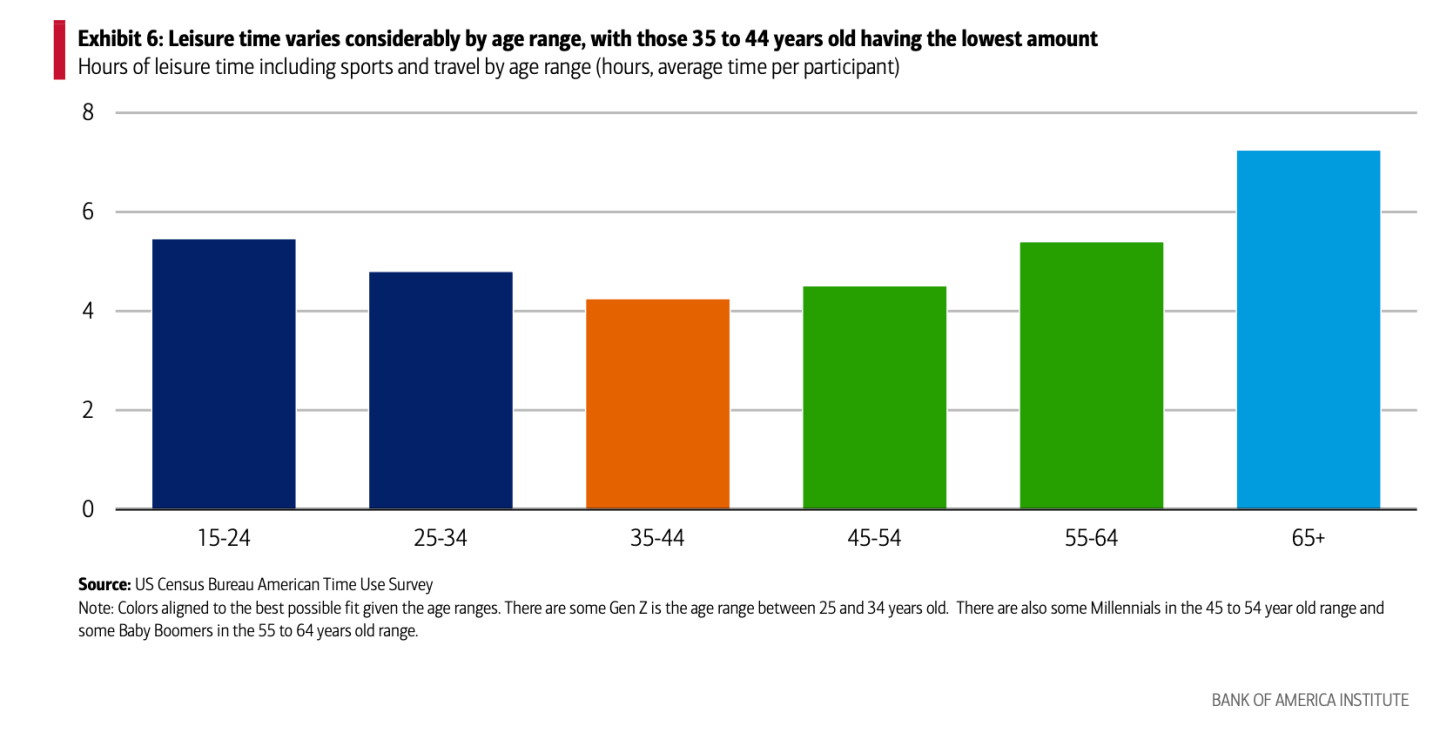
Older millennials—defined by BofA as people born between 1978 and 1988—led spending in the hobby category, followed closely by baby boomers and Gen X. It’s a notable finding because the group has relatively little free time. Adults ages 35 to 44 average about four hours and 15 minutes of leisure a day, the lowest figure across Census Bureau age groups cited in the report, yet their spending suggests that leisure is increasingly part of a household budget rather than simply an individual pursuit. Naturally, they may be spending on their children’s activities as well as their own interests. Wadford said the idea “makes sense” that Millennials would be spending on themselves and others, possibly their kids or even young relatives.
Lautz said the need for more space does not necessarily reflect family size alone. “For some, that means additional space for a growing family,” she said. “For others, it could mean a craft room, home office, or gaming room.”
Later childbearing and lower birth rates than in previous generations may also leave some millennial households with more discretionary money for their own interests rather than children’s activities, she said.
Homeownership’s spending advantage
The BofA figures do not show whether a customer owns a home, rents, has children, or uses home equity to finance hobbies. They cannot prove that homeownership is the reason older millennials lead hobby spending. But Lautz said they may have a financial advantage that affects the capacity for discretionary purchases.
“Millennial homeowners have had the opportunity to build housing wealth, and those who locked in lower mortgage rates may have more stability in their monthly housing costs,” she said. “That can provide greater flexibility for discretionary spending, whether on travel, hobbies, or other interests.”
The broader data supports the idea that housing status increasingly separates consumers’ financial options. Renters devoted 39% of their total expenditures to rent in 2023, compared with 31% of total spending on housing among homeowners, according to a Freddie Mac analysis of Bureau of Labor Statistics data. It added that renters’ growing housing costs were associated with lower spending in other areas, including apparel, services and food away from home.
The Federal Reserve has likewise found a steep income divide in homeownership: among adults under 60, people earning at least $100,000 were more than three times as likely to own a home as those earning below $50,000. Lautz stressed that millennials’ financial circumstances vary widely. “No single trend will be universal across such a large and diverse generation,” she said, warning against assuming that homeownership alone dictates how financially secure someone is or how they spend.
‘Funflation’ comes for hobbies
The rise of the older-millennial hobby spender also coincides with what Bank of America calls “funflation.”
Spending on hobbies increased 7.9% year over year in August, while the number of transactions grew 3.4%. That means spending is rising more than twice as fast as the number of purchases — customers are spending more per hobby transaction.
Bank of America says consumers may have recently rotated away from pricier travel toward hobbies as rising fuel costs lifted the cost of airfare. That frames hobbies as a potentially less expensive alternative to travel—especially for households that can afford gear, activities and family recreation but are looking to contain costs elsewhere.
A divided consumer economy
By contrast, Gen Z hobby-transaction growth was roughly flat in August, down sharply from nearly 16% growth a year earlier. The decline reflected substantially lower outdoor-recreation spending, although purchases at arts-and-crafts retailers and hobby shops rose.
At the same time, Gen Z has continued to spend heavily on games. Nearly 28% of Gen Z customers had online- or video-game spending in the three months through August—more than twice the Gen X rate and more than four times the baby boomer rate. Gen Z spending on video games rose about 20% year over year in August.
That suggests different kinds of leisure economies. Older millennials are leading spending in physical, family- and space-intensive hobby categories. Younger adults are allocating more leisure time and money to digital entertainment and gaming communities, which can be home-based, repeatable and social even if they are not always cheap. The dividing line, in housing and hobbies, suggests that 35 is the real time when adulthood truly begins in 2026.
Wadford noted that Bureau of Labor Statistics data shows that older Millennials have the highest annual average spending of any age group besides Boomers. “It’s safe to say they are not only a distinct consumer segment, but one with significant purchasing and economic power,” he said. “And while Gen X likely earns more on average, older Millennials may be spending more as they are aging into increasing family demands and financial responsibilities.”
For this story, Fortune journalists used generative AI as a research tool. An editor verified the accuracy of the information before publishing.