
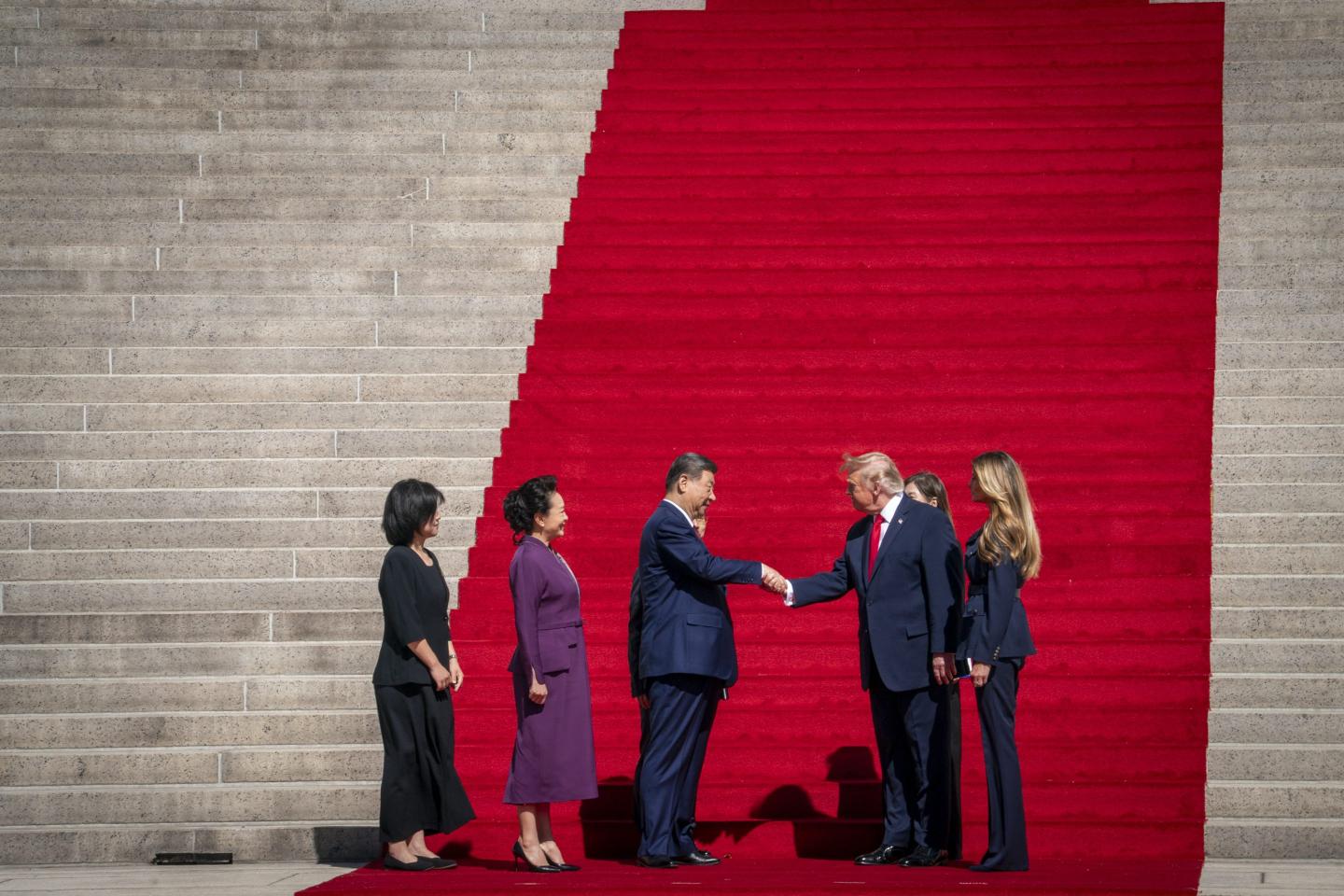
Chinese President Xi Jinping is now back in Beijing, following his three-day state visit to the U.S. During his time in Washington, Xi got a state dinner and a tour of the National Archives, where his host, U.S. President Donald Trump, showed him the U.S. Constitution and the first treaty between the U.S. and Qing-dynasty China.
The record of actual achievements from the summit was small. Both sides said that Xi and Trump agreed to build a “constructive relationship of strategic stability on the basis of respect, fairness, and reciprocity,” and there were some small agreements involving trade and AI.
Markets had diverging reactions to the summit on Monday. Hong Kong’s Hang Seng Index rose 0.7%, while Mainland China’s CSI 300 dropped 2.2%.
Yet given how far apart the U.S. and China are on a range of important issues—trade, export controls, the status of Taiwan, and today’s conflicts in Ukraine and Iran—it’s not surprising that few outside observers expected much to emerge from Xi’s trip to Washington.
“Expectations were low for this meeting and those expectations were met,” says Lindsay Newman, a visiting research fellow at King’s College London.
Eswar Prasad, a professor of trade policy at Cornell University, agrees that the Trump-Xi summit “fizzled out on substance, confirming the vast gulf between the two countries’ objectives and the lack of enthusiasm on either side to craft a grand bargain.”
But a summit short on substance may be precisely what’s needed. With neither side willing to make major concessions, Washington and Beijing appear to have settled for a more managed relationship, even as both countries rapidly try to decouple from the other.
“The bilateral relationship is on tactical autopilot and will likely remain so as long as Trump and Xi maintain a cordial working rapport,” says Ali Wyne, a senior research adviser on U.S.-China issues for the International Crisis Group.
So what got agreed?
The key agreement from the flurry of meetings between U.S. and Chinese officials was an extension of the tariff truce, first agreed last year in South Korea, for another two months. Both sides agreed to pursue lower tariffs on $30 billion worth of “non-sensitive goods” from each country. They also agreed to set up new crisis communication channels between their militaries.
The U.S. also announced that China agreed to import 10 million tons of coal annually over the next two years, though the Chinese readout didn’t mention this deal.
“Although China wanted a longer-term extension, for Trump the brief pause gives him some breathing room through November’s midterm elections,” Newman says.
On Monday, both sides unveiled a list of goods that may see tariff reductions. The U.S. plans to cut tariffs on 77 different goods like fireworks, household equipment, and toys. China, in turn, plans to reduce tariffs on 1,619 product categories, including agricultural products, timber, seafood, dairy products, and medical equipment.
Both sides also agreed to set up a dialogue mechanism over artificial intelligence, including a bilateral channel to discuss AI incidents. (Despite Trump’s claim that Xi agreed to use the U.S. president’s preferred term “super intelligence,” Chinese officials said Saturday that the country “respects the U.S. side’s wording”).
Hopes for more significant changes—a further relaxation of export controls on U.S. semiconductors and Chinese rare earths; Chinese investment into the U.S.; or movement on the U.S. position on Taiwan—weren’t born out.
“Almost everything else remains unresolved between the sides,” Newman says.
Perhaps the most significant agreement was the announcement that Trump will return to China in November to attend the Asia-Pacific Economic Cooperation summit in Shenzhen. That visit will be followed by a second Xi trip to the U.S. in December, this time to attend the G20 meeting in Miami, Fla.
“U.S.-China relations will have better stability, although without strategic concessions from either side,” says Dan Wang, China director for the Eurasia Group. “The two leaders have set a positive tone … details will be left to other top officials, likely around the time of APEC.”
Wang expects the trade truce to get extended again next year, noting China has a strong preference for external stability before the Communist Party’s 21st Congress next autumn.
She’s less optimistic about the prospects for cooperation on AI. The U.S. continues to impose tough controls on the sale of powerful AI processors to China; Chinese officials are also wary of recent calls to slow down AI development. “Beijing still sees the U.S. approach as trying to constrain China’s development,” Wang explains.
Trump, the least hawkish member of his administration?
In the months leading up to Xi’s visit to the U.S., Washington imposed several new barriers targeting China. In August, the FCC banned new foreign-made humanoid robots and power inverters from being sold in the U.S. Officials have also placed several top Chinese universities on a research blacklist and imposed sanctions on several Chinese shipping companies and refiners as part of a broader pressure campaign on Iran.
“The most important aspect of the summit is that it took place at all,” Macquarie China economist Larry Hu wrote in a research note late Sunday night. “It is meant to be more about optics than concrete deliverables. In that sense, the summit achieved its objective.”
Trump has intervened to stop more aggressive policies to preserve the relationship. He’s held back on approving a $14 billion arms package to Taiwan. Officially, the Trump administration claims the pause is to ensure there are enough munitions for the U.S.’s war in Iran, yet Trump has also talked about the arms package being a useful “negotiating chip” for his China negotiations.
Trump has also expressed openness to Chinese car companies manufacturing in the U.S., a prospect which has alarmed others in Washington. (Congress is currently considering a ban on all Chinese cars in the U.S.; the bill has near-unanimous support among U.S. Senators).
David Perdue, the U.S. Ambassador to China, revealed Sunday that Trump offered to sell U.S. arms to China during Xi’s visit, though the White House later said there was “no plan or offer to sell arms to China.”
“The president is likely to continue constraining advisors who favor a more confrontational approach,” Wyne suggests.
Still, China may be wary of how volatile the U.S. president’s tone could be. “Given the nature of the U.S. administration, everything could change next month,” says Chandran Nair, co-author of Understanding China and CEO of the Global Institute for Tomorrow, a Hong Kong-based think tank. “China’s main objective is to ‘give face’ and do what is possible without compromising itself, and thus maintain a certain steady state globally so things don’t get worse.”
‘Slow and progressive deterioration’
Stabilization may be the best anyone can hope for, given the continued decoupling between the U.S. and Chinese systems. “The summit does not alter our baseline view that the U.S. and China remain in a phase of détente,” Hu wrote in his research note.
China is building trade links throughout Europe, Southeast Asia and Latin America to replace the U.S.; Washington, in turn, is trying to secure rare earth minerals and semiconductor production in allies like the Philippines, Japan and South Korea.
When it comes to AI, China is building an entirely separate sector built on locally made chips and open-source models. U.S. developers like OpenAI and Anthropic are, in turn, trying to block Chinese access to their own powerful models.
“The baseline for the bilateral relationship is a slow and progressive deterioration of the trade, financial, and technological linkages between the two countries,” Prasad says.
What the Xi-Trump summit might imply is that both sides are now trying for a managed decline of the relationship, rather than a clean break. Last year’s trade standoff made both the U.S. and China “more aware that aggressively attempting to unwind their relationship carries dangers of its own,” Wyne suggests. “The two countries may try to harness mutual vulnerabilities in the service of mutual restraint.”
But as the two systems pull apart, China is growing more confident in its model of development and diplomacy, while Washington’s preferred tools of sanctions and pressure are losing their force.
“The U.S. has failed to force China into its agenda,” Wang adds. “That’s given rise to China’s more determined stance.”