
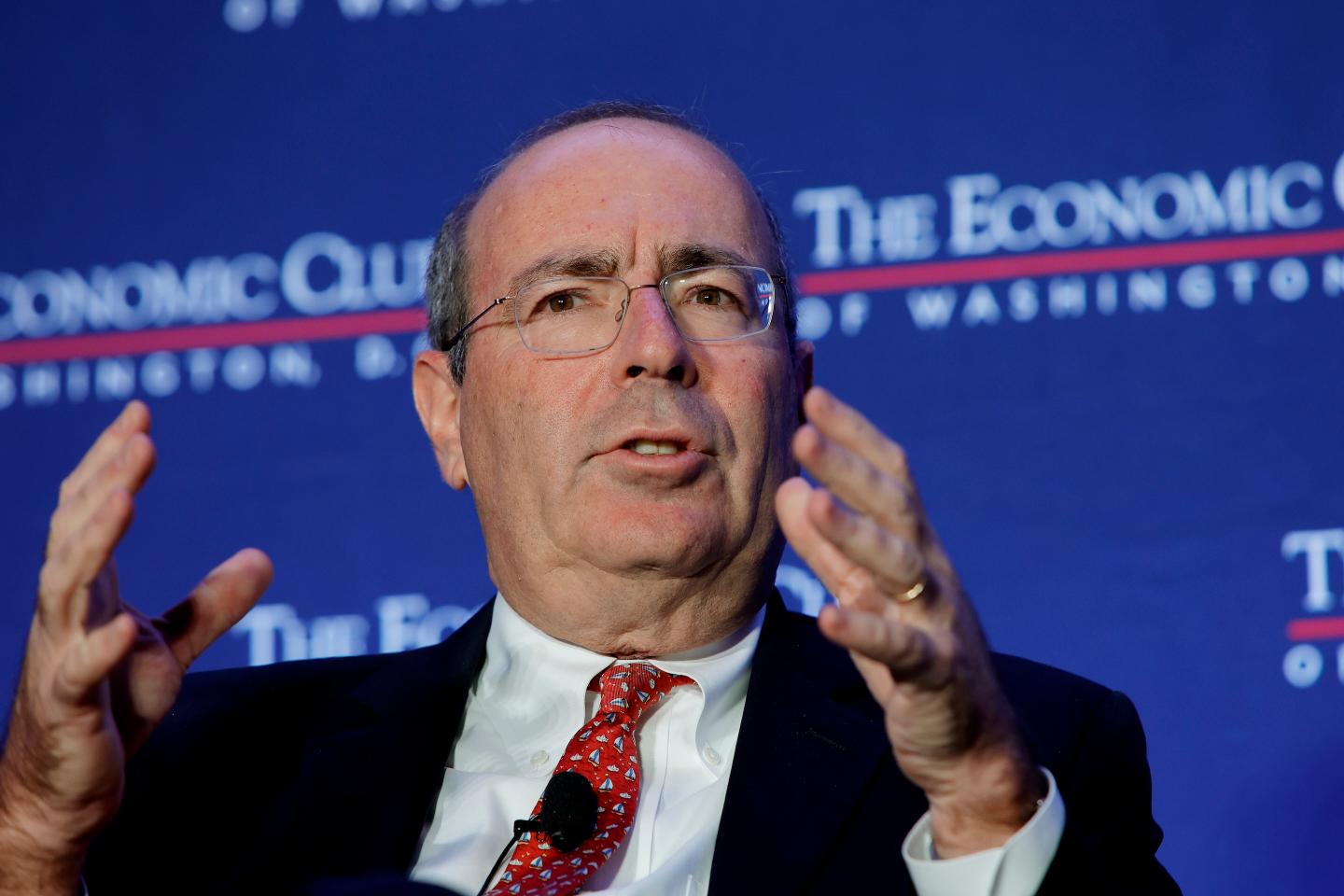
Good morning. The Federal Reserve raised interest rates for the first time since mid-2023 last week as some of the forces pushing up inflation prove harder to shake, Richmond Fed President and CEO Tom Barkin said Thursday.
Barkin pointed to persistent tariff costs, higher gasoline prices and a huge wave of AI investment that is pushing up prices for some technology equipment during a conversation with Barbara Humpton, CEO of USA Rare Earth, at an Economic Club of Washington, D.C., event.
Six months ago, he said, it was easier to argue that inflation’s persistence was temporary, and that oil prices, tariffs and the AI buildout would eventually “morph” away.
“If inflation’s not going to come down relatively quickly,” Barkin said, “then you have to look in the mirror and say inflation looks like it’s been here for a while.”
Barkin has a metaphor for the job Warsh has inherited: a log flume.
“You go slowly up the hill of the last ramp, and then you go full speed down into a pool of water, and the pool of water comes and soaks the guy in front,” he said. “That’s Kevin Warsh or Jay Powell. The rest of us are in back. Our hands are in the air.”
The metaphor captures the bind facing Warsh: The Fed has moved back toward higher rates as inflation has proved more persistent than policymakers expected, while an enormous wave of AI investment is reshaping prices and the labor market.
Barkin said he had “the deepest respect for anyone who would be foolhardy enough to take on the leadership of the Federal Reserve System,” adding that Warsh “made a number of, I think, very profound calls.”
Then there is AI.
Barkin said the economy is in an enormous AI investment cycle: Companies are spending aggressively because they expect AI to lift productivity, even as that expectation makes them more cautious about hiring.
The technology is already being used for coding, call centers, compliance paperwork and engineering, Barkin said. But strong corporate earnings are working against layoffs. Companies with deep backlogs of technology projects would rather redeploy freed-up capacity than cut headcount, said Barkin, a former McKinsey CFO.
The harder problem is organizational. “The unit of an AI-enabled task is not precisely the same as a mid-level manager and what they do,” he said.
Companies can see how AI might make individual tasks more efficient without knowing what that means for the people who perform them. Many firms haven’t yet figured out how to translate task-level efficiency into a redesigned staffing model.
Barkin also offered a less obvious possibility: AI could make it easier to bring inexperienced workers into skilled trades. He cited auto mechanics, where an AI assistant could give a less-experienced worker a real-time checklist to compensate for missing expertise.
“I think there’s a lot of talk about the AI apocalypse,” Barkin said. “We’re clearly not yet there.” He said he’s hearing “a lot less fervency in the conviction that we’re going to be there” than there was six months ago.
Humpton, whose company is focusing on rebuilding a domestic rare-earth workforce, offered a real-world example of the other side of the AI transition: retraining workers for jobs that increasingly require new combinations of technical and practical skills. She called the effort “truly transformative.”
Have a good weekend.
Sheryl Estrada
Sheryl.Estrada@fortune.com
Leaderboard
Notable moves this week:
Joanne Wilson was appointed CFO of Diageo plc (NYSE: DEO), a beverage alcohol company whose brands include Johnnie Walker, Guinness, Smirnoff, and Baileys. Wilson will join the company sometime in 2027, succeeding Nik Jhangiani, who will remain in the role for a transition period. Wilson is currently CFO of WPP plc. She previously held senior financial and commercial roles at Britvic, Tesco, and KPMG.
Todd Cello is stepping down as EVP and CFO of TransUnion (NYSE: TRU), a global information and insights company, effective Dec. 31, after 29 years with the company, including nine as CFO. Cello will then serve as a full-time advisor through March 1, 2027. TransUnion has launched a search for his successor.
Mike Hickman was appointed CFO of Boomi, a data activation company for AI. Hickman joins from Proofpoint, where he spent seven and a half years, most recently as senior vice president of finance, helping steer the company through its $12.3 billion take-private and $1.8 billion acquisition of Hornetsecurity. Hickman previously held finance roles at Adobe and Marin Software, and began his career at eBay and Vitria Technology.
Timothy Regan was appointed CFO of Delinea, an AI-based identity security platform. Regan joins Delinea from Dropbox, where he served as CFO from 2020 to 2025, helping steer the company through its 2018 IPO after joining as chief accounting officer in 2016. He stayed on as an advisor into early 2026. Regan earlier held senior finance roles at Pandora Media, Dolby Laboratories, and Ernst & Young.
John Landry was appointed CFO of CVRx, Inc. (Nasdaq: CVRX), a commercial-stage medical device company. Landry succeeds Jared Oasheim, whose resignation was previously announced. Landry will join the company on Oct. 12, and assume the CFO role on the day after the company files its Form 10-Q for the quarter ending Sept. 30. Oasheim will remain with the company for a transition period. Landry currently serves as CFO of Nyxoah SA. Before that, he spent 12 years at Vapotherm, Inc., most recently as SVP and CFO, where he led the company's IPO.
Bob Hau was named EVP and CFO of Pentair plc (NYSE: PNR), a water treatment and solutions company, effective Nov. 1. He succeeds Bob Fishman, who has served as interim CFO and will remain with the company through the transition. Hau brings more than 16 years of experience as a public-company CFO, most recently at Fiserv from 2016 to 2025, and previously held the same role at TE Connectivity and Lennox International. He spent 22 years at Honeywell International earlier in his career.
Aaron Huber was named CFO of Varda Space Industries, a privately held life sciences company. Huber brings nearly two decades of experience at the intersection of tech and capital markets, spanning automotive technology, synthetic biology and healthcare AI, including work on a $1.6 billion NYSE listing, multiple acquisitions, and non-dilutive financing structures.
Big Deal
CFOs are still largely optimistic about the economy heading into 2026 and 2027, but that confidence is splitting sharply among company sizes, according to the Richmond Fed, Atlanta Fed, and Duke University's Q3 2026 CFO Survey.
Large firms are ramping up expectations for revenue and hiring growth, while small and financially constrained companies are pulling back, with 20% of them saying they can't cover costs or chase new business, more than double the rate at large firms. Fewer companies overall plan to invest in equipment or facilities over the next six months, and one in five finance chiefs now names interest rates and the risk of further hikes as a top concern, alongside inflation, tariffs, and labor quality.
Going deeper
Here are four Fortune weekend reads:
"How Meta took the lead in the race for the post-smartphone world" —Sebastian Herrera
"Temu axed its $1 billion network of fake influencer accounts on Meta" —Jim Edwards
"U.S.-Iran conflict is causing unexpected problems for Americans: 65% of employees want jobs that help them avoid paying higher gas prices" —Eleanor Pringle
"Alice Walton got $33 billion richer last year without running a company. She’s building a tuition-free medical school instead" —Sydney Lake
Overheard
"For the past two years, business conversations about artificial intelligence have revolved around what AI can do. That question is becoming less interesting. The more urgent one is: what should we let it do on its own?"
—Tae E. Bolling, founder and CEO of Bridge IR Co., an investor-relations technology company, writes in a Fortune opinion piece. Bolling argues that enterprise AI is entering a new phase. "Companies are moving from AI as an assistant—answering questions, summarizing documents, drafting emails—to AI agents that access tools, complete multistep tasks, and act with increasing autonomy," he writes.