
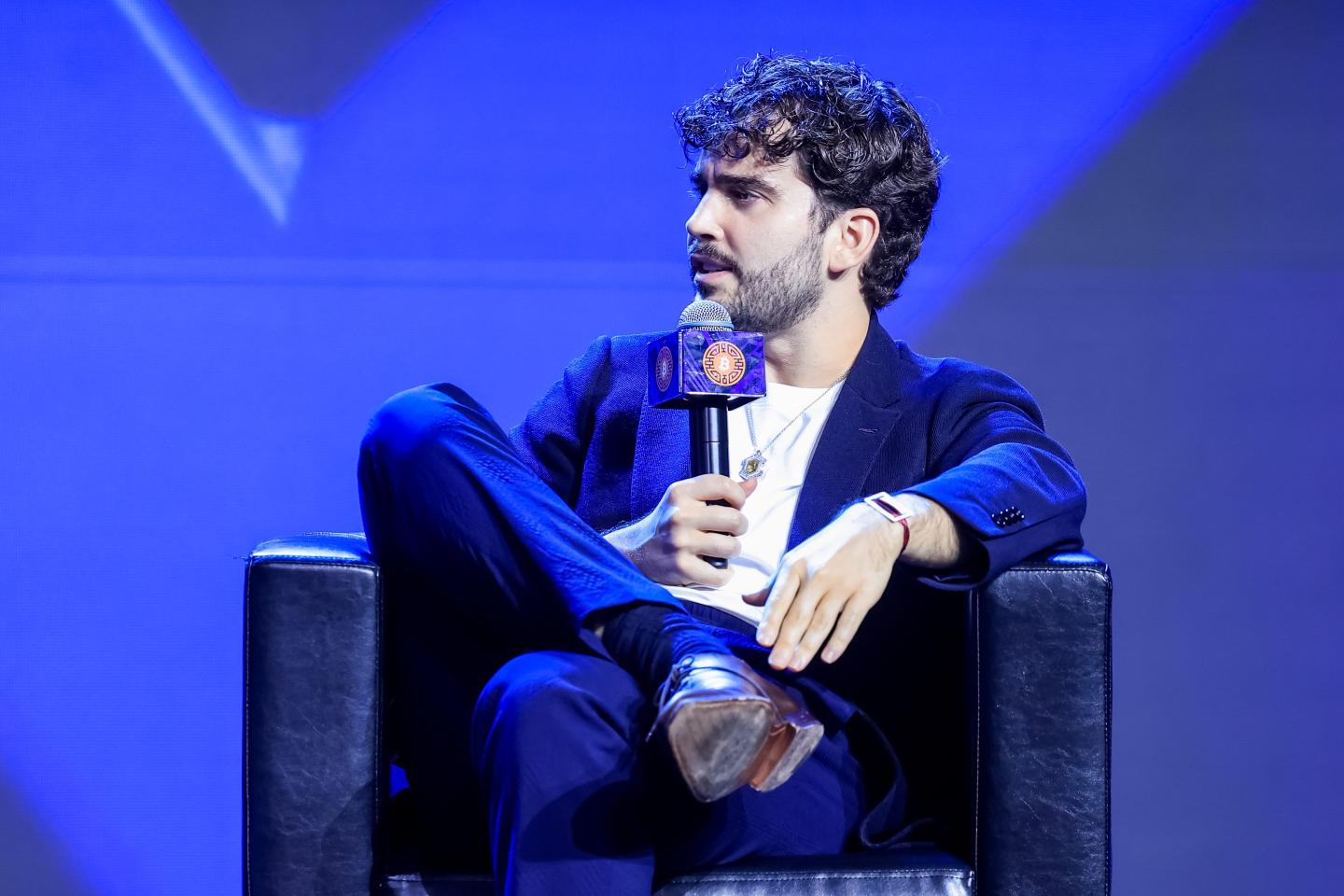
For most of the last decade, AJ Scaramucci has built companies nobody outside his network was watching. He backed a bitcoin miner years before it became a Trump family venture. He wrote the first check into a satellite ground-station startup when its founder and her husband were the entire company. He quietly amassed a collection of comics, trading cards, and even dinosaur bones that he now argues belong in asset classes comparable to gold and bitcoin. And he assembled it all under one investment thesis he has been developing since college.
Solari Capital, the venture firm he is taking out of stealth today, has deployed roughly $350 million across early-stage investing, late-stage growth checks, and in-house incubations since its founding.
The astronomer-turned-venture capitalist
Scaramucci’s route began in science, far from finance. Describing an interest in “amateur astronomy” as a kid, Scaramucci said he worked in a bioelectronics lab, studying implantable therapeutics and the cholinergic anti-inflammatory pathway, before moving to the Bay Area and taking a job at Tesla in 2013, then a rotation through Google, where he briefly worked alongside Eric Schmidt.
Scaramucci traces his current thesis to April 2012, when he sat in his dorm room at Stanford reading Peter Diamandis’ Abundance: The Future Is Better Than You Think. He described it as something of a spiritual successor to Ray Kurzweil’s 2005 book “The Singularity Is Near, calling the pair “the Old and New Testament,” as both predicted the shape of the current AI boom years before the underlying technology existed.
He immediately started working to get to know Diamandis via methods Scaramucci describes as “brute force”: emailing XPRIZE’s general inbox “dozens of times,” failing, and eventually finding his way in through Chris Lewicki, then-CEO of the asteroid-mining startup Planetary Resources. By 2015, he was an entrepreneur-in-residence under Diamandis, building the CAR-T cell therapy startup Cellularity and the education venture Abundance Group. He later worked at Kai-Fu Lee’s Sinovation Ventures, splitting time between San Francisco and Beijing.
Scaramucci traces the same “brute force” instinct to his upbringing. The oldest of five children in what he called “a big, loud Italian family,” he watched his parents go from a one-bedroom apartment above a fire station in Tarrytown, N.Y. — “negative money in debt,” in his description — to a house in posh Manhasset, Long Island, by the time he reached high school. His mother, a chemical engineer, and his father, serial entrepreneur Anthony Scaramucci, gave him “a front row seat to [the] American dream.” That upbringing, he said, shaped his sales-first, ask-forgiveness-not-permission approach to sourcing deals and mentors alike.
Andrea Pasinetti, founder of the AI education startup Kira Learning, a Solari portfolio company, met Scaramucci at Stanford roughly 10 years ago, when Scaramucci was an MBA student. “He basically shared his worldview with me when we first had lunch. He started talking to me about programmable reality,” Pasinetti said. “There’s a remarkable consistency at a macro level with AJ that also permeates the micro.”
The Programmable Reality thesis
But what is Programmable Reality, really? As Scaramucci describes it, it’s the idea that as computational power keeps compounding, biology, intelligence, physical matter and money all become substrates that can be engineered with software-like precision, rather than domains governed by trial and error, intuition or manual labor.
“The ramifications of the programmable reality thesis are that every bit in the universe becomes programmable,” he said. “It’s kind of like the sequel to software eats the world,” he added, citing Marc Andreessen’s famous 2011 essay, “reality becomes programmable.”
The thesis splits into four verticals, each with its own roster of bets:
Programmable Intelligence covers AI, compute and foundation models. Solari’s positions include xAI, the lab behind Grok, now folded into Space Exploration Technologies Corp. (Nasdaq: SPCX) following SpaceX’s all-stock merger with xAI; Suno, the generative-music startup; Physical Superintelligence, an AI-native physics lab; and Kira Learning, Pasinetti’s AI-native K-12 education platform.
Scaramucci has backed Kira “from day zero,” according to Pasinetti. Kira’s technology is now used as part of a broader AI-in-education push in El Salvador, where a pilot cohort of 171 public schools recently posted PISA-for-Schools results that officials and the OECD described as comparable to Germany and Sweden’s 2022 averages. El Salvador’s national PISA scores outside that pilot remain well below OECD averages, and Pasinetti cautioned that AI in education “has to be done right.”
Programmable Biology spans computational drug discovery, gene therapy, immunotherapy and longevity. The portfolio includes Tessera Therapeutics, which is developing all-RNA “Gene Writing” therapies; Gameto, which engineers stem-cell-derived ovarian cells for IVF; Orionis Biosciences, which uses AI to discover molecular glues for hard-to-drug cancers; Prolific Machines, which applies optogenetics to biomanufacturing; Cambrian Bio, a clinical-stage longevity company; and General Medicine, a chat-first healthcare marketplace co-founded by Elliot Cohen and TJ Parker, the PillPack co-founders, alongside former Amazon Health executive Ashwin Muralidharan, who serves as CEO.
Our understanding of the immune system and the genome is still nascent but accelerating, Scaramucci said, “particularly because you can design drugs increasingly in silico. I can run simulations as opposed to doing wet lab experiments.”
Programmable Matter covers aerospace, defense, energy, materials science, semiconductors and robotics. Holdings include Varda Space, which manufactures pharmaceuticals and materials in orbit; Apex Space, which builds satellite buses at production-line speed; Giga Energy, which builds modular AI data centers; Base Power, which makes home batteries that function as a distributed grid resource; General Biological, focused on critical-industry supply chains; and Northwood Space, a phased-array ground-station startup founded by Bridgit Mendler.
Solari wrote the first check into Northwood “when it was a baby company,” Scaramucci said. The startup now has over 100 employees and has raised over $100 million. He cited recent progress in humanoid robotics — “we’ve seen robots beat Usain Bolt in a 100-meter dash. That literally happened a few weeks ago” — as evidence that embodied AI is catching up to language models quickly. “We passed the Turing test effectively four years ago,” he said. “When that has a body and it has senses” is, in his view, the next unlock.
Programmable Finance covers monetary-debasement hedges, fintech, blockchain infrastructure and decentralized finance, including Genius Terminal, a non-custodial multi-chain trading terminal; Fission Labs, which tokenizes venture-backed private companies for liquid secondary trading; and Architect Financial, which Solari describes as the first U.S. derivatives exchange built specifically for the AI economy.
Betting on friends, and against the grid
Solari’s investing style, Scaramucci said, leans heavily on long relationships rather than cold outreach to founders it doesn’t know. One clear example: American Bitcoin, the Bitcoin miner co-founded by Eric Trump that went public this year via a reverse merger. Scaramucci backed a $220 million financing round in the company last July, Fortune exclusively revealed at the time, with Solari alone contributing more than $100 million.
The bet traces to U.S. Bitcoin Corporation, where Scaramucci backed Asher Genoot, Mike Ho, and his Stanford Business School roommate, Matt Prusak. That company merged into Hut8, now a $10 billion publicly traded company, which later spun out American Bitcoin. “That story is one of really like an 11-year friendship with Mike and Asher,” he said.
That trade sits inside a broader, deliberately contrarian view of where value is being created. Noting that gold and bitcoin together have created more market capitalization since 2008 than the entire “Magnificent Seven” group of tech stocks, he argued that “currency debasement” is a defining reality of 21st-century finance, with the “average life expectancy of a given currency” running around 26 years. That view extends into Treasure Trove, the collectibles holding company he launched earlier this year and has since used to buy a first-appearance Iron Man comic for $2 million and, separately, a record-setting Pokémon card.
“I think of collectibles as the cultural store of value in the same way gold might be the physical store of value or Bitcoin might be the digital store of value,” Scaramucci explained. “I’ve been in the market buying a lot of one-of-one Grail assets because these Grail assets have unbelievable, uncorrelated returns. … I view them as a debasement trade.”
Pasinetti pointed to Scaramucci’s interest in dinosaur fossils as an example of his timing. “This was probably a year and a half ago, two years ago, he was talking about … the short supply of T-Rex fossils,” Pasinetti said. “Just a few months ago, Sotheby’s transacted the most expensive T-Rex fossil, and AJ was talking about that very one a long time ago.”
Scaramucci called the collectibles market a “sleeping giant” that institutional capital has largely ignored, and pitched Treasure Trove as a way to open it up to ordinary investors, not just the ultrawealthy. “It’s a $25 trillion asset class that has not been properly institutionalized,” he claimed. It’s the flipside of programmable reality, he explained: one trade is “the AI trade or the singularity trade where computational power continues to double … But there’s also this other trade happening, which is the scarcity trade or the cultural trade.”
Building from zero
Solari also builds companies in-house, and Scaramucci said that incubation arm is central to the firm’s identity. Radial Health, an interventional psychiatry chain treating treatment-resistant depression, bulimia, anorexia, addiction and PTSD with transcranial magnetic stimulation and ketamine, is the flagship example. He built it alongside Cohen and Radial CEO John Capecelatro; public filings list Alex Klokus as a third co-founder, along with Anthony Scaramucci. The company has since raised follow-on funding from General Catalyst, the Box Group, the Emerson Collective and SV Angel, and now appears on the Nasdaq Private Market as a pre-IPO name.
Pasinetti recalled hearing the idea early. “He talked about his view on programmable biology and started talking about psychedelics as interventions for PTSD and other mental health disorders. This was before the conversation was mainstream,” he said. “Then you start reading headlines … that play back elements of the vision he had described a year before.”
Solari’s incubation model runs alongside SALT, the investor conference and media business Scaramucci co-chairs, which he described as an informal investor-relations function for the portfolio; its five to seven events a year draw roughly 10,000 attendees combined.
A network built over a decade
The firm’s approved list of backers includes SV Angel founder Ron Conway, Breyer Capital’s Jim Breyer, Bain Capital co-chairman Stephen Pagliuca, former Alphabet chief executive Eric Schmidt and Diamandis, who has founded more than 25 companies in longevity, space, venture capital and education — several of them mentors Scaramucci has known since his 20s.
“AJ is an exceptional investor and operator — a rare combination in venture,” Conway told Fortune. “He has the instincts to identify great founders early, tenacity and the ability to recruit world-class teams.”
Pasinetti compared Scaramucci to a sort of reverse Cassandra, the prophet from Greek mythology cursed to see the future accurately but never be believed. “AJ has a perpetual fear of Cassandra prophecy,” Pasinetti said. “He is able to see things that seem outlandish at first, but become kind of consensus after a year or a year-and-a-half of his working on them.”
Betting that exponentials are deceptive
Asked how quickly these technologies will reshape the economy, Scaramucci pushed back gently on the premise that AI adoption has stalled, arguing that any lag in real-world deployment is structural rather than a sign the thesis is wrong.
“I actually think that things in the digital domain are moving even faster than expectations,” he said. “The notion of having fundamental mathematics or physics or chemistry or biology breakthroughs — we’re starting to have that now.”
“In that reality, well, you have radical abundance,” he said of the world Programmable Reality points toward. “Ideally the optimistic take is that food, water, shelter and basic needs are covered … I’m less of a doomsday-er than I am an optimist.”
“You can expect from us to continue to double down on this nature of programmable reality,” he said. “It’s a thesis that I think has a lot of multi-decade staying power.”
For this story, Fortune journalists used generative AI as a research tool. An editor verified the accuracy of the information before publishing.