
China keeps growing its share of global cargo sales, indicating the Trump administration’s tariffs meant to punish the country are instead an obstacle that China has successfully navigated.
China now accounts for 40% of the world’s container exports on a rolling three-month basis, a 2.5% increase from nine months ago and its highest-ever levels, Jens Eskelund, president of the European Union Chamber of Commerce in China, told the Financial Times on Tuesday.
For Europe, China’s swelling share of global shipments represents a growing trade imbalance between the continents, Eskelund warned. As more cheaper goods from China flood European markets, European manufacturers are squeezed out, and the continent loses out on global market share for exports and China sells its goods for cheap elsewhere.
The U.S. is facing a similar fate, harkening back to the “China Shock” of the early 2000s, representing a surge of Chinese products on American shelves following its entry into the World Trade Organization, throttling U.S. manufacturing and leaving pockets of America with massive job losses and stagnant wages. Economists predict the impending “China Shock 2.0” will extend beyond retail shelves to technology like AI infrastructure and electric vehicles.
“China really is becoming the workshop of the world,” Jeremi Suri, a public affairs and history professor at the University of Texas at Austin, told Fortune. “And what that means is that almost every global economy is one way or another dependent on China.”
What’s troubling to economists and policy experts is how the U.S. got here. While China’s path to becoming a global export behemoth has been decades in the making, President Donald Trump’s trade philosophy of inundating China with import taxes may be, in large part, to blame for this more recent shift.
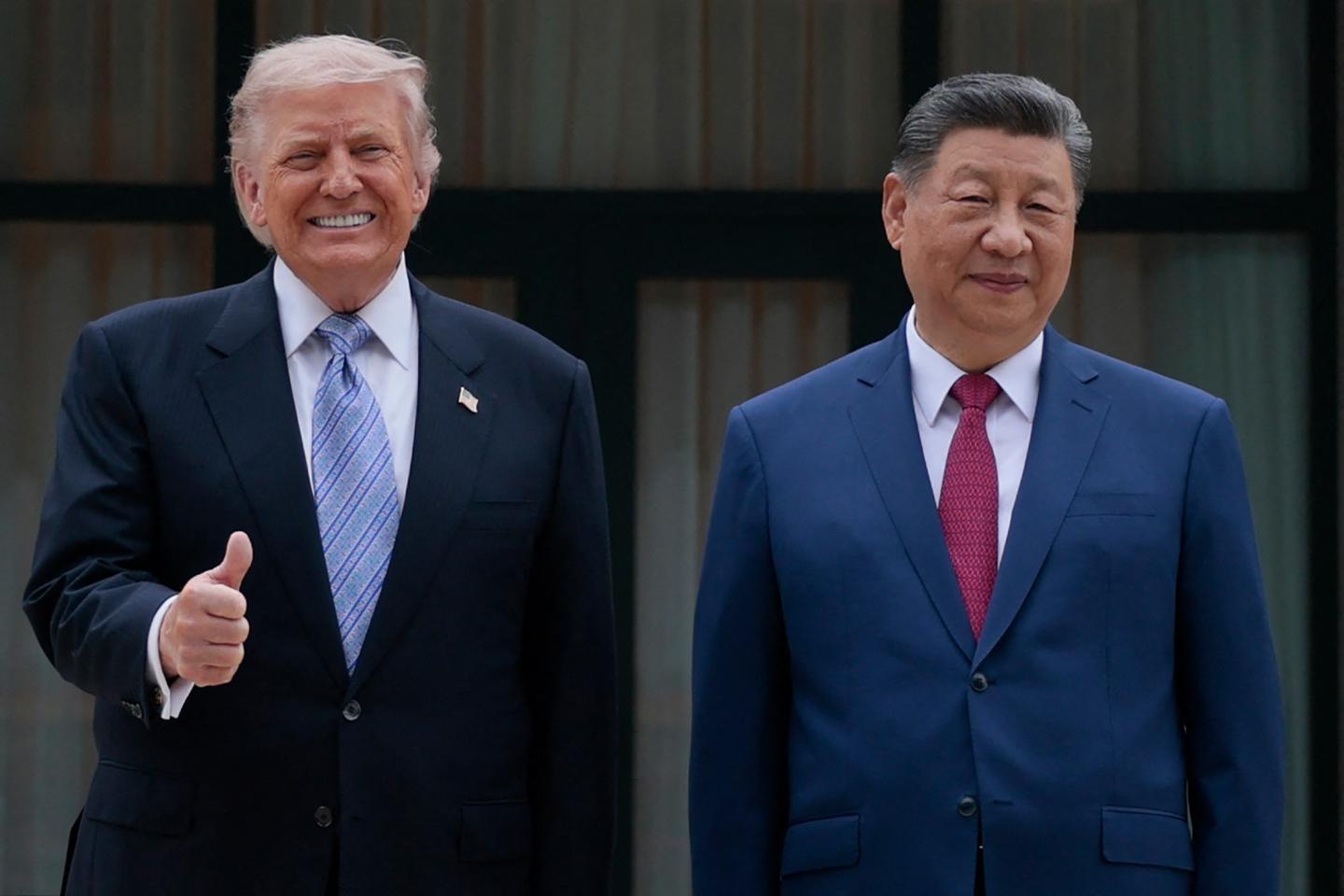
Trump and Chinese President Xi Jinping will meet for a two-day summit beginning on Wednesday.
“The tariff policies of the last two years have been an unmitigated disaster,” Suri said. “They have made exactly what we’re talking about worse for the United States.”
How did tariffs pave the way for China’s growing container export share?
Part of China’s rise to power in trades comes from a natural cycle. The U.S. began transitioning from a manufacturing economy to a service economy in the 1950s—and by the 1970s, China had meanwhile ended its isolationist policies like high tariffs and cemented its role in global trade when it joined the WTO 25 years ago. Buoyed by an undervalued currency, Chinese firms can charge up to 30% less than other countries to export goods, leading to a glut of production to be sold overseas.
But tariffs may have exacerbated China’s motivations to increase exports, as the import taxes have shut China out of parts of the U.S. market, forcing Chinese exporters to find markets elsewhere. The levies have also encouraged China to partake in the practice of transshipments, a form of tariff dodging in which the country exports intermediate parts to countries with lower tariffs rates to be assembled and sold to the U.S. with fewer import taxes. Last month, the White House released a report claiming the U.S. lost between $19 billion to $26 billion in tax revenue from transshipments, with China being the primary culprit. The Trump administration has broadened the definition of transshipments, however, including goods linked to China, or where China plays a role in a product’s supply chain.
Suri expects this trend of China branching out to other countries for trade to continue, not just as a means of evading the worst of the tariffs, but because U.S. trade policy has ruined America’s credibility as a reliable trade partner.
“We use trade for power, but we can’t presume that those levers will be as meaningful going forward,” Suri said. “With tariffs, we’re pushing countries further away more quickly.”
Is China the winner of Trump’s tariffs?
China’s growing share of worldwide cargo shipments may not be a clearcut victory for the country against Trump’s tariffs, however. That sum isn’t necessarily an indicator China is becoming a larger power in global trade. Transshipments and diversions are a response to changes in trade landscapes and not necessarily a net increase in the share of global trade, according to Andrew Greenland, a professor of economics at North Carolina State University specializing in U.S. tariff policy.
“I’m not saying that China isn’t growing in prominence,” Greenland told Fortune. “But the fact that they’re showing up as having more shipments, for example, could be consistent with any of those mechanisms.”
To Greenland, the increased shipments are more a sign China has found ways to adapt to U.S. tariffs, though it isn’t necessarily benefitting from the levies yet. There was nothing prohibiting China from diversifying trading partners or engaging in transshipments before the tariffs were imposed, leading Greenland to believe these changes in shipping behaviors have “got to be an adjustment that’s not necessarily making things better” for China.
But should tariffs continue to erode trade relationships between the U.S. and the rest of the world, China’s inroads in diversifying its own trade partners could position it as an even greater trade power in the future. Is it good for China to figure out its export markets, conditional on the U.S. becoming a less stable business partner?
“Yeah,” he said. “It’s good that they’ve been able to find places to send things that have not just meant sitting on excess supply.”