
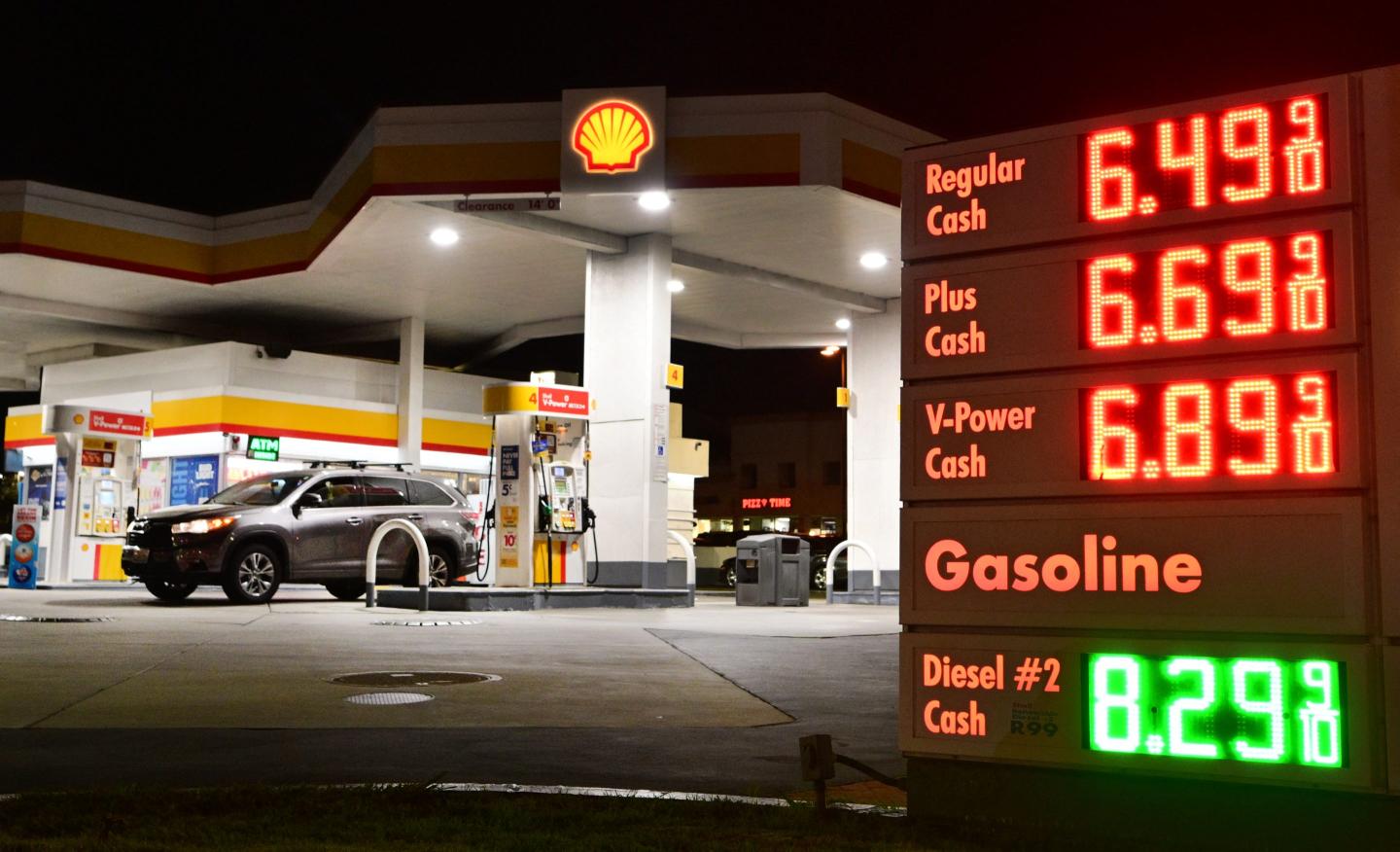
With U.S. diesel prices rising to an all-time high this week, President Donald Trump added support to the calls from farm-state Republicans to implement a temporary ban on diesel exports.
“I’ve said let’s not send out the diesel. We make a lot of diesel. I’ve called for it,” Trump said late Tuesday at the U.N. General Assembly in New York.
On the surface, it makes sense. Keep the diesel at home and prices will fall, sparing farmers, truckers, and inflationary pressures on all Americans. But that’s not quite right. Prices may go down some for about a month—timed with the midterm elections—but then the unintended consequences would quickly kick in.
What it would instead do is unwind much of the U.S. oil and refining industry, cause sky-high gasoline prices to soar further, and deplete the rest of the world of the U.S. diesel supplies they depend upon—a dependence that has only increased since the U.S. initiated the war in Iran and triggered the global energy crisis. Banning exports might force diesel costs to go down a bit, but only in geographic pockets, such as the U.S. Gulf Coast where most of the fuel is produced, analysts said.
Here’s how analysts say it would play out: If the U.S. energy sector is forced to keep its diesel at home, a domestic glut would quickly build, and storage would fill to the brim. Refineries would then reduce their operations, not only cutting diesel output, but gasoline and jet fuel supplies as well because there aren’t individual switches for each fuel type. Then, oil producers would limit their activity as well to prevent a domestic crude glut if refineries aren’t taking their products.
All these ripple effects would push oil prices and gasoline and jet fuel costs even higher, while further exacerbating diesel costs globally—keeping in mind that fuel costs are even higher in the rest of the world than in the U.S.
“If diesel exports get banned, [gasoline] prices could rise toward record levels,” said Patrick De Haan, head of petroleum analysis at GasBuddy. “The U.S. is not short of diesel. The world is. A potential export ban treats the global price problem as if it was a U.S.-only problem, and the cure would be far worse than the disease.”
U.S. Energy Secretary Chris Wright risked bucking Trump on Wednesday, agreeing that a ban would hurt U.S. refining and push up most fuel prices. He offered potential support for voluntary restrictions or some kind of export cap instead. Just a week prior at a G20 meeting in Houston, U.S. Interior Secretary Doug Burgum quickly pooh-poohed the idea of a diesel export ban, arguing it wouldn’t help lower prices.
The average U.S. diesel price of $6.52 per gallon as of Sept. 23 is an all-time high, still spiking after recently hitting the $6 threshold for the first time. The California average is up all the way to $8.43 per gallon with some stations reportedly maxing out the retail displays at $9.999. For gasoline, the U.S. average of $4.47 per gallon is a post-July record high.
What’s happening
So, why are fuel costs so high while the global oil benchmark remains relatively muted (though still high by historical standards) at just over $100 per barrel? The Iran war is disrupting Middle Eastern refineries from shipping out their products, while Ukrainian drone strikes have knocked out roughly 40% of Russia’s refining capacity. Altogether, at least 10% of the world’s global refining capacity is offline, making the energy crisis more of a fuel problem than an oil one—and making the world even more dependent on U.S. fuel supplies than ever.
And there’s that bigger global picture that must be considered, De Haan said. “The U.S. spent years becoming the world’s backstop for diesel supply. Telling every buyer from South America to Europe that American supply is politically conditional pushes them to diversify away from U.S. refineries and U.S. supplies, softening long-term demand for U.S. product and foregoing political leverage.”
Indeed, the U.S. currently supplies about 20% of the world’s global diesel exports, according to the American Petroleum Institute (API) lobbying and research group, which is sharply against an export ban.
“Restricting U.S. exports would hit an already-tight market with another supply shock,” said API CEO Mike Sommers. “The priority should be keeping fuel moving and refineries running, not adding new barriers.”
Sommers pointed to a further API statement that the “consequences would be catastrophic”: “Removing that much fuel from the global market would exacerbate the very global refining crisis that is increasing prices here in the U.S. And the impacts could extend far beyond pain at the pump, to dire consequences for international supply chains, agriculture, shipping, manufacturing and the entire global economy.”
Donald Trump is very focused on so-called U.S. energy dominance, and an export ban flies in the face of that, said oil forecaster Dan Pickering, founder of the Pickering Energy Partners consulting and research firm.
“Why would you want to undermine that?” Pickering said. “What’s bad for the world isn’t good for the U.S.”
Politics at play
Talks of banning fuel exports have floated in the air for months amid the Iran war, but they’ve never picked up any momentum until now despite sharp opposition from the U.S. energy sector.
The last time the U.S. did briefly ban exports was during the 1970s Arab oil embargo when the U.S. was much less of an energy exporter.
But now, farming harvest season has picked up in full swing in September and the agricultural sector is suffering from the weight of record diesel costs. And the midterm elections are rapidly approaching.
U.S. Sen. Chuck Grassley, R-Iowa, and other farm-state Republicans are pushing for export bans. “High diesel prices are killing farmers’ incomes,” Grassley said. Senate Majority Leader John Thune, R-S.D., also expressed his openness to the idea. Oil-state Republicans have pushed back, causing a party split, and leaving the matter up to the White House.
“It’s maybe another thing that Trump talks about and doesn’t do,” Pickering said. “It’s a growing probability, but still less than 50%.”
If a ban did go into effect though, Pickering suggested Trump would even consider taking it further and ban gasoline exports as well, causing even more issues globally.
Throughout the Iran war, the U.S. has depleted its Strategic Petroleum Reserve of crude oil down to 44-year lows and still falling. But the U.S. doesn’t have strategic reserves of gasoline and diesel.
In Europe, however, most of the strategic reserves are kept in refined fuel form—and not crude oil—although their reserves are not nearly as large. Still, French President Emmanuel Macron is pressing EU nations to coordinate inventory levels and consider the release of more reserves. Trump’s threats to withhold diesel could further pressure them into action.
Another lever to pull domestically is to continue extending the Jones Act waiver. The 106-year-old Jones Act, which requires cargo ships moving between U.S. ports to be U.S. built, flagged, and manned, reduces the number of vessels available to move crude oil and refined products between domestic ports. Waiving the Jones Act during the Iran war has allowed more ships, for instance, to move fuel from the U.S. Gulf Coast through the Panama Canal and up to California, which has dealt with newly shuttered refineries in recent months, to help alleviate shortfalls.
De Haan encouraged the White House to instead just extend the Jones Act waiver beyond its Nov. 15 expiration. “The Jones Act waiver is already doing a lot of work here, moving the surplus to where it’s needed,” he said. An export ban creates far too many problems, he said.
“Export bans are usually quick to go into place and slow to unwind, bringing lasting damage,” De Haan added.