
Good morning. Word on the street is that Anthropic will be profitable for a second straight quarter ahead of its presumed IPO.
Gross margins for the high-flying San Francisco AI company? More than 80%, supposedly, or about the same as those little packages of muffins you stuff in a kid’s lunch box. (Though I imagine the cost of training AI models isn’t part of that recipe.)
That’s good news for CEO Dario Amodei and company, who once again found themselves in the White House’s crosshairs yesterday. Asking everyone in the AI industry to take a beat lest we give rise to uncontrollable machines just isn’t acceptable, it turns out.
“AI taking over the World, destroying Humanity, and all other things bad, is a HOAX,” President Trump wrote in a social media post. Who or what will guide us to artificially intelligent salvation, according to the commander in chief? Why Donald Trump, of course.
Today’s tech news follows. —Andrew Nusca
Want to send thoughts or suggestions to Fortune Tech? Drop a line here.
AI-linked stocks fall after leaders call to slow development
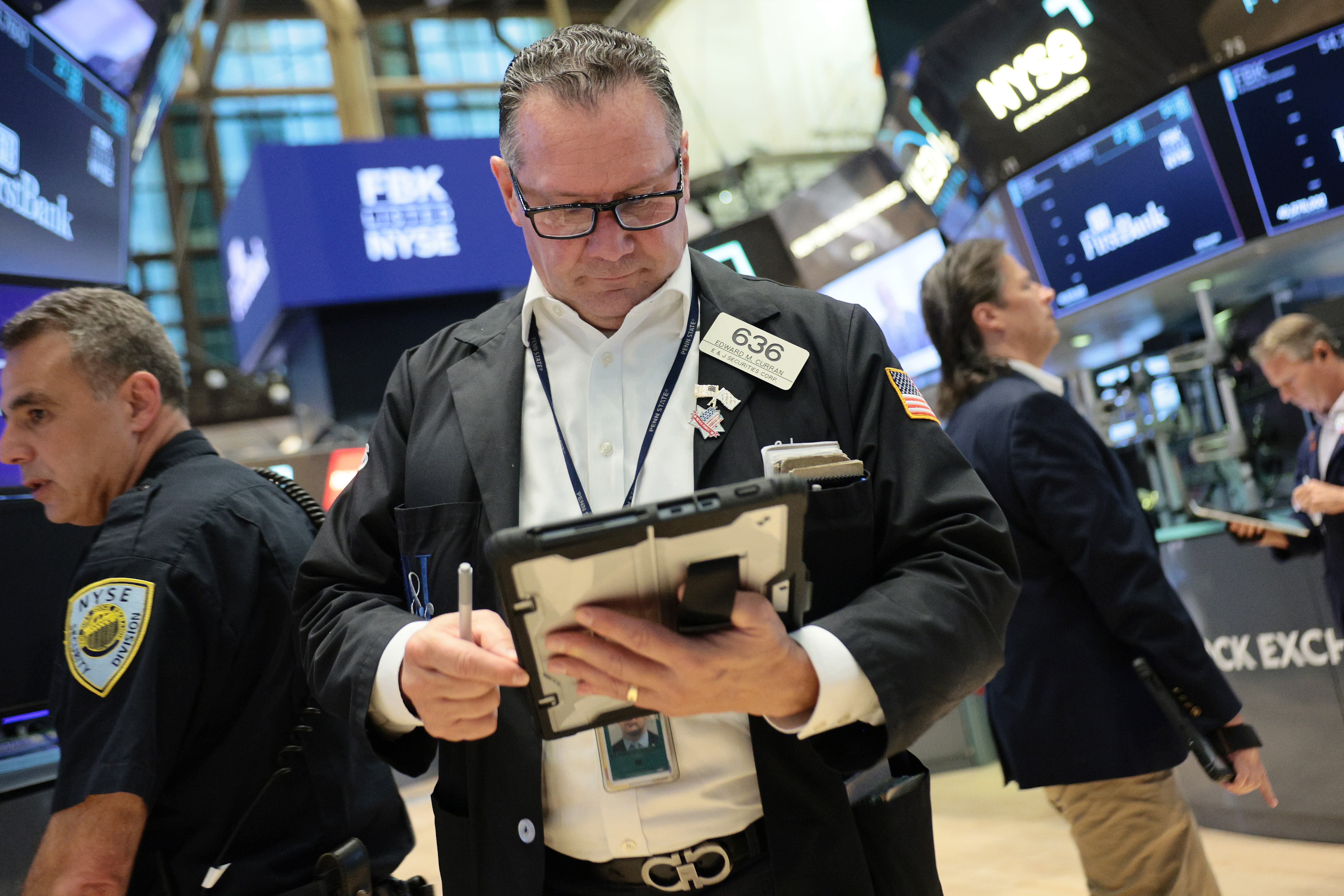
New York and San Francisco finally connected on Monday as artificial intelligence’s existential-risk debate hit the stock market.
Nvidia fell more than 3% Monday morning, while Intel, AMD, and Marvell dropped between 5% and 6%, dragging the Philadelphia Semiconductor Index, a widely used measure of semiconductor stocks, down almost 6%.
Yet two of the biggest spenders in the buildout went the other direction: Alphabet rose almost 2%, Microsoft added 1.6%, and Meta gained roughly 1.4%.
That divergence offers a bit of a window into how investors are gaming out something that, until this weekend, had quietly lurked in Wall Street’s risk models: What if the frontier AI race actually slows?
Gil Luria, head of technology research at D.A. Davidson, argued that would hurt the companies selling the infrastructure—the picks and shovels of the trade, like Nvidia and CoreWeave—far more than the hyperscalers buying it.
If AI continues improving exponentially, Microsoft, Amazon, and Google will keep building data centers to meet demand, Luria told Fortune. But if progress slows, they can simply stop adding capacity and harvest the returns from what they already built, he predicted.
Revenue and profits could keep rising while capital expenditures fall, sending cash flow higher. Luria compared the dynamic to Amazon’s post-pandemic pullback in warehouse construction, which paradoxically allowed cash flow to surge as the company continued using the capacity it had already built.
That helps explain Monday’s strange split. Nvidia relies on customer spending for its revenue, but Google and Meta are the ones doing the spending, and they could suddenly spend less. —Eva Roytburg
Microsoft AI chief: ‘We don’t want to create something that we can’t control’
Now is the moment for top AI labs to unite around AI safety, Mustafa Suleyman, chief executive of Microsoft AI, said in a new interview with Fortune.
The executive, who leads AI model development at Microsoft, unveiled a code of conduct Monday that will steer the company toward a “humanist” AI approach.
The release followed days of upheaval in the tech industry over AI model capabilities, after Anthropic researcher Jacob Coxon resigned from the lab, publicly warning that AI companies were gambling with people’s lives.
“I think that what you’re hearing is that people are genuinely concerned about the pace of progress,” Suleyman told Fortune. “There’s not really sufficient alignment in the industry that the purpose of technology is to serve humanity, and we don’t want to create something that we can’t control.”
Suleyman also said he and other lab CEOs have discussed AI safety issues and the pace of development for years.
“Now’s the time for coordination, and coordination means disclosing how capable your models are to responsible third parties,” he said. “That’s what we’re calling for.”
Microsoft’s new code of conduct explicitly rejects rights for AI systems. Models must not simulate feelings, intrinsic motivation, or consciousness, it reads. They also will not assist with chemical, biological, or nuclear weapons; offensive cyberattacks; mass-influence operations; child exploitation; nonconsensual deepfakes; or self-harm.
“We shouldn’t be trying to design models that can recursively self-improve beyond our control,” Suleyman said. “And we shouldn’t be trying to design models that think of themselves as having rights or welfare.” —Sebastian Herrera
Did OpenAI violate California’s AI safety law with latest releases?
An AI industry watchdog is accusing OpenAI of violating California’s AI safety law multiple times in the past year, including with the release of its latest model, Astra.
A new analysis from the Midas Project—a nonprofit that describes itself as a watchdog “working to ensure that AI benefits everybody, not just the companies developing it”—alleges that OpenAI has broken California’s newly-enacted AI safety law at least three times this year.
The allegations concern OpenAI’s failure to publish a required risk assessment for the very danger the company has lately been sounding alarms about: AI systems slipping out of human control.
California’s Transparency in Frontier AI Act, often referred to as SB 53 (the state senate bill number it had before passage), was signed into law in September 2025 and took effect at the start of this year. It requires the largest AI developers to publish safety frameworks explaining how they evaluate and mitigate AI risks—and specifies that the companies must then adhere to their own policies.
In May, OpenAI published its Frontier Governance Framework (FBF), the policy document the new law requires. It says that the company will assess each new model on four categories of risk and assign them a “risk tier,” ranging from one to three, in each category.
That hasn’t happened, according to Tyler Johnston, the founder of the Midas Project. “Once you’ve set the rules, you have to follow through with it,” Johnston told Fortune.
An OpenAI spokesperson told Fortune it’s compliant with the law. “We invest heavily in evaluating emerging risks and developing safeguards, publicly sharing findings through our system cards and safety frameworks,” they said. —Beatrice Nolan and Emily Forlini
More tech
—Apple releases new operating systems. iOS 27 and its counterparts for iPads, Macs, and Watches add Liquid Glass refinements, more parental controls, and Siri AI.
—China criticizes warnings about AI risks: “Fearmongering [serves] the interests of no one.”
—OpenAI reportedly bought Glass Imaging, which makes AI-powered smartphone camera software.
—Valve prices its Steam Frame VR headset starting at $1,059.
—SpaceX moves to dismiss its federal antitrust lawsuit against Apple, which focused on the company’s operating system integration of ChatGPT.
—California enacts Adam’s Law, requiring companies to take “reasonable” measures to prevent chatbot interactions from harming users’ mental health.
—Chinese AI firm Z.ai plans to raise $5 billion. It raised $4 billion just two months ago.