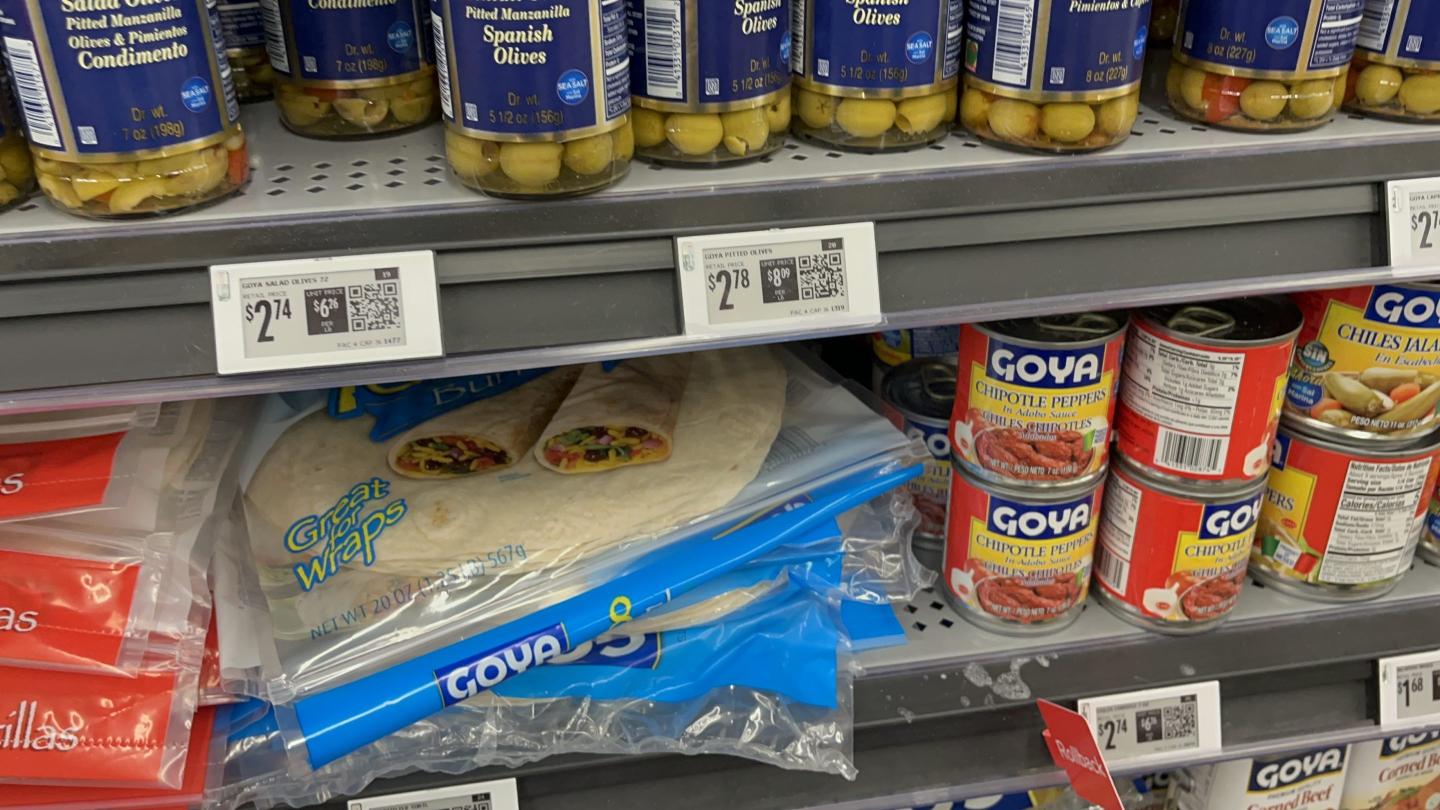
At a Walmart Supercenter in North Bergen, New Jersey, just across the Hudson River from Manhattan, Victor Lopez, 21, tapped the screen of his work-issued smartphone. Under a field labeled “Enter new price,” he punched in $10 for a bottle of barbeque sauce.
If it had worked, Lopez, a team leader, would have almost tripled the price of the item with a click of a button. But it didn’t, and that’s not due to some human or technical error. It was the whole point of the demonstration: to show that store associates are not able to use electronic shelf labels (ESLs) to raise prices arbitrarily.
“We cannot take prices up in the store,” Kyle Boyd, store manager of the supercenter, where about 90% of tags have been replaced with ESLs, told Retail Brew during a tour of the facility last month. “We can only take prices down in the store.”
The willingness to promote some pricing practices—as well as touting what it is characterizing as a technical stopgap in place to prevent price hikes at the store level—comes as Walmart faces political pushback that could determine the future of electronic shelf labels.
With lawmakers increasingly tying the technology to controversial pricing practices, the retail giant is making the case that ESLs won’t fundamentally change how prices are set.
Using or abusing: In July, New Jersey Governor Mikie Sherrill signed the Fair Price Protection Act into law to protect consumers from “discriminatory surveillance pricing”—which it defines as using personal data to set prices t —and placing a one-year moratorium on new ESLs while the state studies the effects of the tech.
Critics of the legislation argue that digital price tags are simply a tool for saving time and cutting costs, while supporters of the law argue they make it easier for retailers to manipulate and raise prices.
This debate is now playing out on a national level. Maryland passed a similar law earlier this year, and legislation is pending in several other states. A recent report from the Groundwork Collaborative, Consumer Reports, and More Perfect Union also claimed that Instacart’s AI pricing tool offers individualized prices on the same items.
In response, companies and industry groups are eager to distance ESLs from unpopular pricing practices like surveillance pricing, dynamic pricing, and other labels such as surge pricing, which conjure images of skyrocketing airline or concert tickets.
“Electronic shelf labels are not tools for surge pricing, but rather tools for efficiency and affordability,” Macy Lemon, vice president of state government affairs at the National Grocers Association, said in a statement urging Governor Sherrill to make changes to the New Jersey law before it was signed due to concerns it would make it harder for stores to offer affordable groceries to consumers.
On the opposite end of the spectrum, Ademola Oyefeso, international vice president of the United Food and Commercial Workers (UFCW) International Union, told Retail Brew it’s not a matter of if, but when, companies start using the technology to engage in dynamic pricing.
“A retailer may not be doing it right now, but they are laying the groundwork for it,” he said.
Now the union wants a full ban on ESLs, which it sees as a “tool for price-gouging and job loss,” Oyefeso said. He pointed to the recent example of Norway, where a number of grocery chains engaged in rapid repricing on a daily basis after installing digital tags.
For an industry that seemed ready for widespread adoption, the legislative pushback could have serious implications for the future of the technology. Walmart committed to rolling out ESLs across its entire US footprint of 2,300 locations by the end of the year. Kroger added the tech to a number of stores across the country, and Whole Foods is testing out digital tags at nearly 50 stores.
The struggle for retailers now is convincing consumers and lawmakers that digital labels won’t open the door to problematic pricing practices.
Will they or won’t they? “DSLs operate on a closed system and do not interact with shoppers or collect any information about them,” Robyn Babbitt, director of corporate communications at Walmart, said in an email to Retail Brew. “There is nothing like a camera or microphone in them; they just display prices”
The legislation is an “overreaction,” she added.
When there is an increase to the base price of a product, as opposed to a rollback or promotion, it’s happening at the corporate level and usually outside of regular shopping hours—not spontaneously while customers are walking around the store, Babbitt said.
“They’re centrally controlled through our pricing team,” she said during the tour of the supercenter in North Bergen, adding that human beings remain in control of all pricing actions.
While working closely with retailers on their merchandising and promotional strategies, Asa Farquhar, strategic principal of price and promotion at RELEX, a retail planning platform, said he is not see this technology being used for dynamic pricing among his retail clients.
Instead, he sees them being used to reduce errors and optimize price adjustments that were happening anyway. “I have never seen them talking about how we can use these tools to get a leg up on customers,” he said.
Theoretically, however, the technology could make it easier for retailers to price more dynamically, Farquhar explained, and for that to result in “any number of negative pricing scenarios.”
For Farquhar, though, this is not a guarantee of bad practices.
“If a price can be changed faster, easier, and with less expense, I think it’s fair to say that could lead to retailers being willing to change prices more often,” he said. “But I think it’s a stretch to say just because a price could change more often or is executed more operationally efficiently that we would see any kind of nefarious strategies around that.”
This report was originally published by Retail Brew.