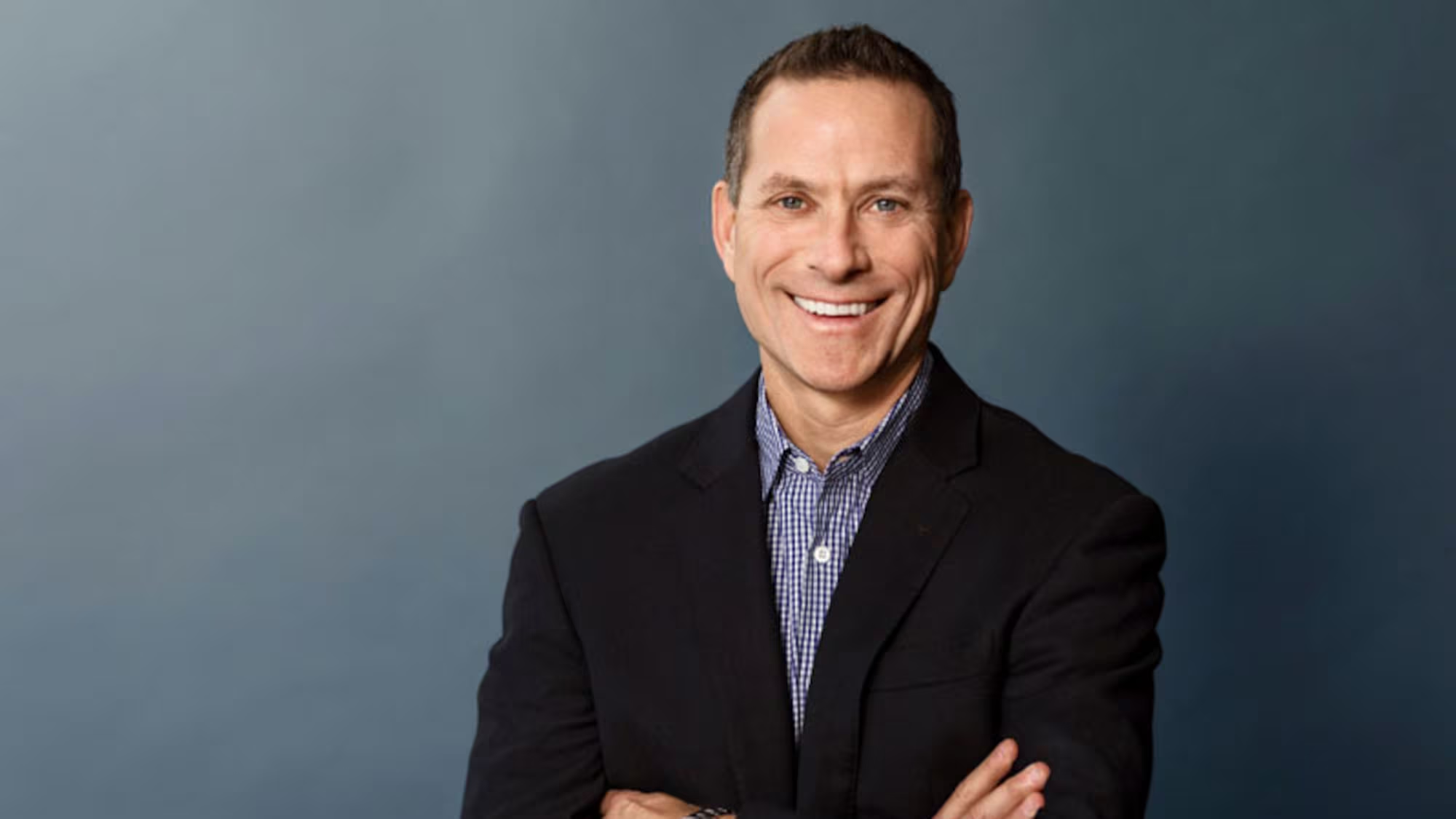
I did not set out to write a book. For most of my life, I was too busy building things to pause long enough to name what I was doing. I worked inside fast‑moving environments—markets, businesses, teams—where decisions had to be made before the data was complete and before the consequences were clear. Over time, some of those decisions worked out. Others didn’t. What mattered most wasn’t intelligence, or even experience, but something harder to define: the ability to adapt—to reframe a problem, update one’s thinking, and act decisively under uncertainty.
Only later did I realize that this pattern repeated across very different domains. I’d helped build investment businesses. Supported entrepreneurial spin‑offs. Created a nonprofit focused on financial literacy. Opened a neighborhood restaurant. Helped turn around and sell a software company. The contexts were different, but the underlying mode of thinking was strikingly similar. What separated progress from paralysis wasn’t foresight. It was adaptability.
In retrospect, some of this way of thinking began much earlier. I grew up as the son of not one but two psychoanalysts, with a mother who also held a PhD in linguistics. Questioning assumptions was not an activity in our household—it was the atmosphere. I learned early that the surface of one’s thoughts—and even the language used to express them—were only the outermost layer of something deeper. Ideas could be unpeeled. Meanings reframed. Causes traced beyond appearances.
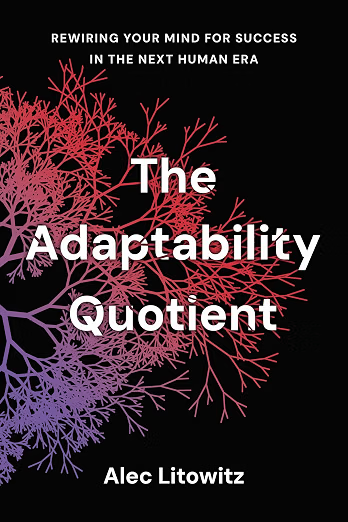
I was taught, implicitly, that understanding required movement: telescoping up and down between levels of abstraction, not just zooming in for detail but zooming out to see structure and context. That habit of shifting perspective, testing interpretations, and resisting the comfort of first explanations shaped how I came to see the world. It made pattern recognition feel less like intuition and more like disciplined curiosity. Over time, in my professional life, I noticed that the people who navigated uncertainty best weren’t the ones with the most impressive credentials or the most refined models. They were those who could hold uncertainty without freezing, learn without overfitting, and act without waiting for perfect information. What’s often described as intuition or vision was, more precisely, an adaptability of mind. I began calling this capacity the Adaptability Quotient, or AQ.
Long before I had that language, I had to build my way toward it—deal by deal, trade by trade, business by business. The markets were my laboratory.
Our story begins in the frigid Chicago February of 1994. When I walked into Wellington Financial Group that winter—just a few months before it changed its name to Citadel Investment Group—it was still a small firm. I believe there were seven other employees there on my first day. Citadel’s founder, the inimitable Ken Griffin, liked that I had a JD‑MBA. But what he found in me most of all—and, over time, what I found in him—was someone whose mind worked in similar ways. We were both relentlessly analytical thinkers who loved to probe, deconstruct, and question, at times to the consternation of those around us.
With my fresh JD‑MBA and a scant six months of mergers‑and‑acquisitions experience at JPMorgan, I was first set by Ken to work on learning the business of risk arbitrage, also known as merger arbitrage or risk arb—which, at the time, was an esoteric, poorly understood, mostly clandestine, and ad‑hoc subarea of finance. I’d never been aware of, let alone studied, hedge fund strategies; if you’d asked me what risk arb was during grad school, I wouldn’t have had the faintest idea. What I soon learned is that risk arbitrage, in basic terms, means following announced mergers and acquisitions—agreed deals, letters of intent, rumored deals, hostile deals—and betting on whether they’ll fall apart or close successfully.
To explain it to investors, I developed a simple analogy. Risk arb is like having a friend introduce you to a recently engaged couple, and then inviting you to bet on whether they will, in fact, get married. You wager ten dollars and lose it all if the couple calls off the engagement, but win eleven dollars if they wind up tying the knot. Short of peering into their souls or eavesdropping on their private conversations, you focus on observable steps. They need to set a date, reserve a venue, get sized for wedding bands, hire florists and caterers, send invitations, perhaps take a blood test, file paperwork for a marriage license, and more. Most of this unfolds along a more or less predictable timeline. If three weeks remain until the supposed wedding day and no invitations have gone out—or some other big piece is missing or wobbly—that’s information that needs to be accounted for and might shift your thinking.
That is analogous to risk arb. You break mergers into their constituent steps, figure out how to assess—based on publicly available information—whether those steps are proceeding as expected, and then watch those and any other indicators like a hawk to anticipate or monitor each party’s commitment as evidenced by progress.
The trouble was that, when Ken decided I should learn how to build a risk‑arb business, there was virtually nothing—and virtually no one—to learn from. There were no textbooks, no how‑to guides. Just a twenty‑page pamphlet by Guy Wyser‑Pratte, one of the earliest practitioners, which mostly gestured at concepts rather than showing how to apply them. So I started the only way I knew how: break the problem down, then build it back up again. No one asked me to do so, but no one told me not to.
I wasn’t sure which factors mattered, so I began with what I much later understood as maximum entropy—a starting point that assumes all outcomes are equally likely because you have no basis yet for favoring one over another. It’s the cleanest possible mental reset: maximum uncertainty, zero assumptions, full openness to signal. That meant beginning with the basics: building the tools I’d need to track various aspects of each deal, which would also form the foundations of a database, along with spreadsheets to take in live quotes and calculate key metrics. I called friends at Bear Stearns, trying to glean something from their expertise, but quickly found that wasn’t good enough. I didn’t just want to know, based on the considered opinion of some expert advisor, whether a given deal was likely to be approved or rejected. I wanted to understand why, and be able to perform that analysis for myself, so I could operationalize it and make it repeatable.
So even as I was constructing my tools and corralling a rogues’ gallery of experts, I was reading as widely and deeply as I could: merger agreements cover to cover, Delaware corporate law, the inner workings of regulatory bodies from the Fed to health‑care and state insurance regulators. That gave me the ability to go back and interrogate the data for myself, starting from a blank‑slate posture known as beginner’s mind. Sometimes I thought I spotted a pattern and the data confirmed it. Other times, my intuition turned out to be wrong, and there was no real arbitrage opportunity after all. Not everything panned out. But the process sharpened my judgment and deepened my understanding.
In early 1995, we put together 1 million to form Titan Partners—the first fund I ever managed. I’ll never forget my first trade, which I made the day after we started the fund. A company was doing a spin‑off, so I called two brokers. One said the market was a four‑dollar bid with a five‑dollar ask per share. Another said it was a six‑dollar bid with seven dollars offered. Both were ten thousand shares up. I put one phone to my left ear and another to my right, buying ten thousand shares at five dollars per share from one broker and selling, to the other, ten thousand shares at six dollars per share. Boom—just like that, in practically an instant, I’d made 10,000. It wasn’t an astronomical sum, but it was a 1 percent return on our 1 million raise—on day one, in fewer than twenty‑four hours.
That was when it began to dawn on me—not in a thunderclap, but as a slow‑rolling realization. No matter what the textbooks might say, markets are not efficient. Rigor and process can yield an edge in many places, in so many unknown, unheralded, or underappreciated ways. I became determined to find more of those places, to map the changing territory around me, to find the best spots others missed on their own maps, and then to rationalize and systematize what others approached as random bets.
In risk arbitrage, speed and accuracy are everything. The ability to evaluate a deal faster and more precisely than your competitors—without cutting corners—creates a compounding advantage. From the start, I saw that the traditional process was riddled with inefficiencies. Every time a merger was announced, you had to start from scratch: diving deep on the industry and regulatory environment, parsing press releases, dissecting the merger agreement, evaluating regulatory risk, scrubbing the financials. That blank‑slate approach created drag—an information bottleneck that slowed everything down and left too much room for noise and error. So I began to wonder: what if we could industrialize this? What if, instead of reinventing the wheel on every deal, we built a framework that could systematically reduce uncertainty—something closer to a Henry Ford–style assembly line than an artisanal garage?
During a wave of commercial bank mergers in the 1990s, for example, conventional wisdom held that the Fed cared about two things: strong Community Reinvestment Act ratings and avoiding dominant local market share. If there was too much overlap, the banks would divest deposits and move on. I wanted to go deeper. I bought books detailing every bank deposit in the United States and ran my own calculations to estimate market concentration. I realized state banking authorities, not just federal regulators, played a crucial role. That led me to a consultant in Florida with deep connections in the state banking world. Hiring her turned out to be a game changer. By calling around, speaking with competitors, and piecing together open‑source intelligence, she helped us forecast approval timing with far more precision than anyone else.
That was one data point, but the pattern extended far beyond it. Over time, we built a web of hundreds of consultants across industries and geographies to triangulate regulatory intent, decode bureaucratic momentum, and anticipate expectations through legal, public means. If I needed to understand a market or approval process, I had a person for that. My working assumption was never that all was going smoothly. I assumed it wouldn’t be—and that any deal could fall apart at any moment.
The results were stark. In my first 1,100 trades, I lost money on just four. Over nine years, our strategy produced high‑teen annualized returns after fees, with only five down months—including through the 1994 rate spike, the Russian default, and the dot‑com crash. This was not because we had a crystal ball, but because we built a decision‑making machine that got better with every trade.
This is where a distinction that runs through my work comes into focus: the difference between making the right decision and making decisions right. Success doesn’t come from one‑time brilliance, but from repeatable processes. Elite military teams understand this. A raid that succeeds despite a sloppy plan is not treated as a success; it’s a warning and a learning opportunity. The true measure of a good decision‑making process is not that it guarantees victory, but that it gives you the highest odds, over time, of surviving uncertainty.
The same is true in markets and in business. A CEO who makes bold, high‑stakes calls without a structured process might get lucky once in a while. Eventually, luck runs out. A leader who builds a sound framework and culture for gathering information, testing assumptions, and learning from feedback will sometimes still be wrong—but will make better decisions overall.
Looking back, what I built in those early years at Citadel and Titan was less a clever hedge‑fund strategy than an operating system for decisions under uncertainty. I didn’t have a name for it yet, but I was already living the Adaptability Quotient.
This is excerpted from The Adaptability Quotient by Alec Litowitz. Reprinted with permission of the publisher, Disruption Books. Copyright 2026.