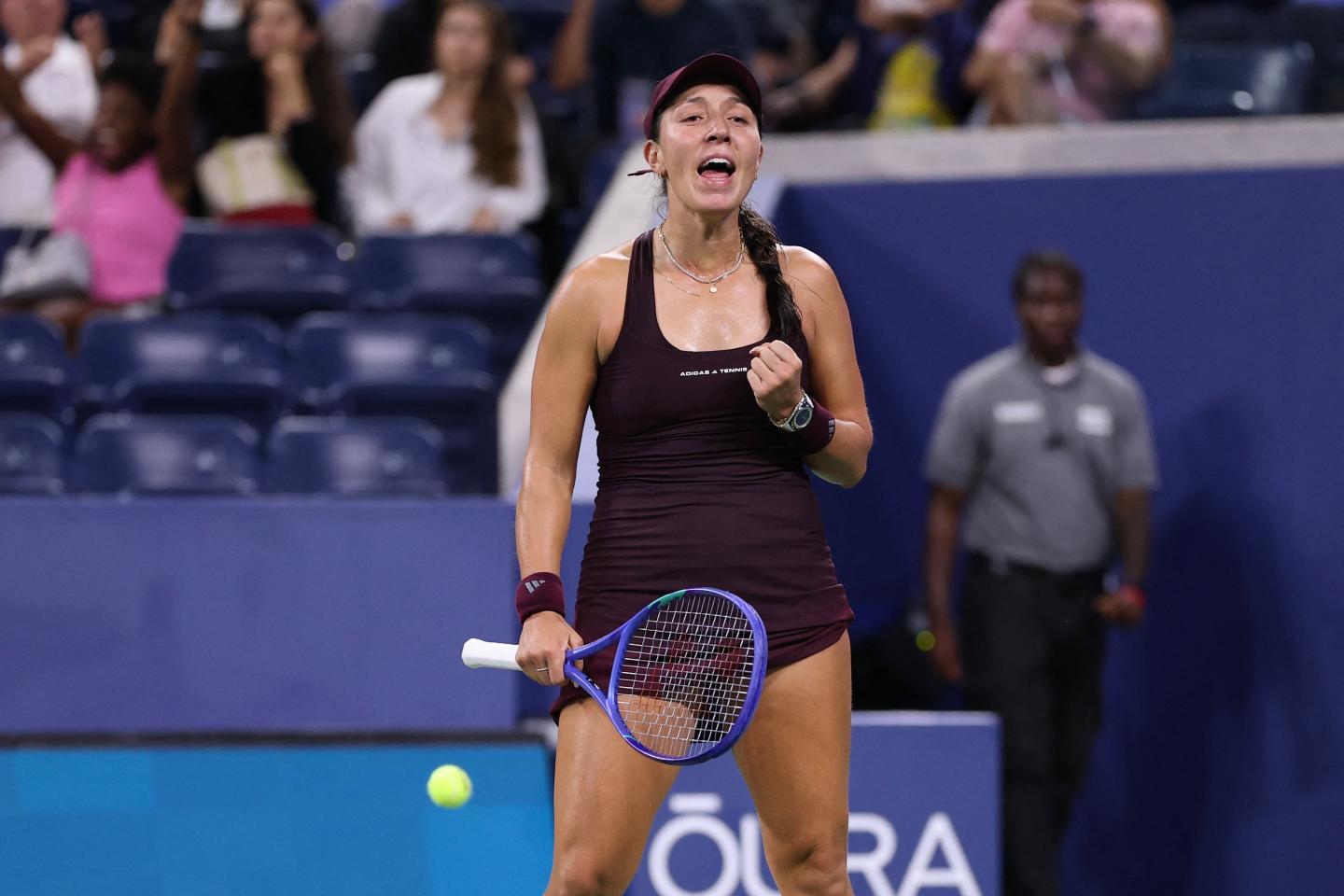
When world number three and top-ranked American tennis player Jessica Pegula stepped up to the baseline to serve against Belarus’ Aryna Sabalenka in the semifinals at the U.S. Open on Thursday night, it wasn’t only cameras from fans, broadcasters, or journalists capturing her every move.
That’s because at the start of this year’s tournament, IBM launched a new feature in the U.S. Open’s app with the United States Tennis Association (USTA) as part of their ongoing partnership. Called “serve quality,” it tracks over 20 points on Pegula’s body (and every other singles athlete competing at the tournament on both the men’s and women’s side) using technology powered by cameras.
Serve quality is measured out of 100 and considers knee, wrist, and elbow movements, among other factors. IBM’s WatsonX then processes the data to put together the score shown in the app.
Although limb tracking, or skeletal tracking, has been used in pro sports events like soccer, this marks the first time a Grand Slam tennis tournament has offered a feature for fans. And, unsurprisingly, AI is powering it.
This launch came as part of a suite of other app additions for the 2026 event, including an AI chat feature and highlighting “key moments” during a match.
According to IBM, the recently unveiled feature began private testing over the last couple of years and estimates 1.2 billion joints will be analyzed by the end of this year’s tournament. Additionally, the company anticipates that the app will generate 7 million serve quality insights.
Here’s how the serve quality score works: People can find the match listed on the tournament’s app, click on “match recap,” and use IBM’s “match chat feature” to find a readily available suggestion: “How did serve quality affect the match?”
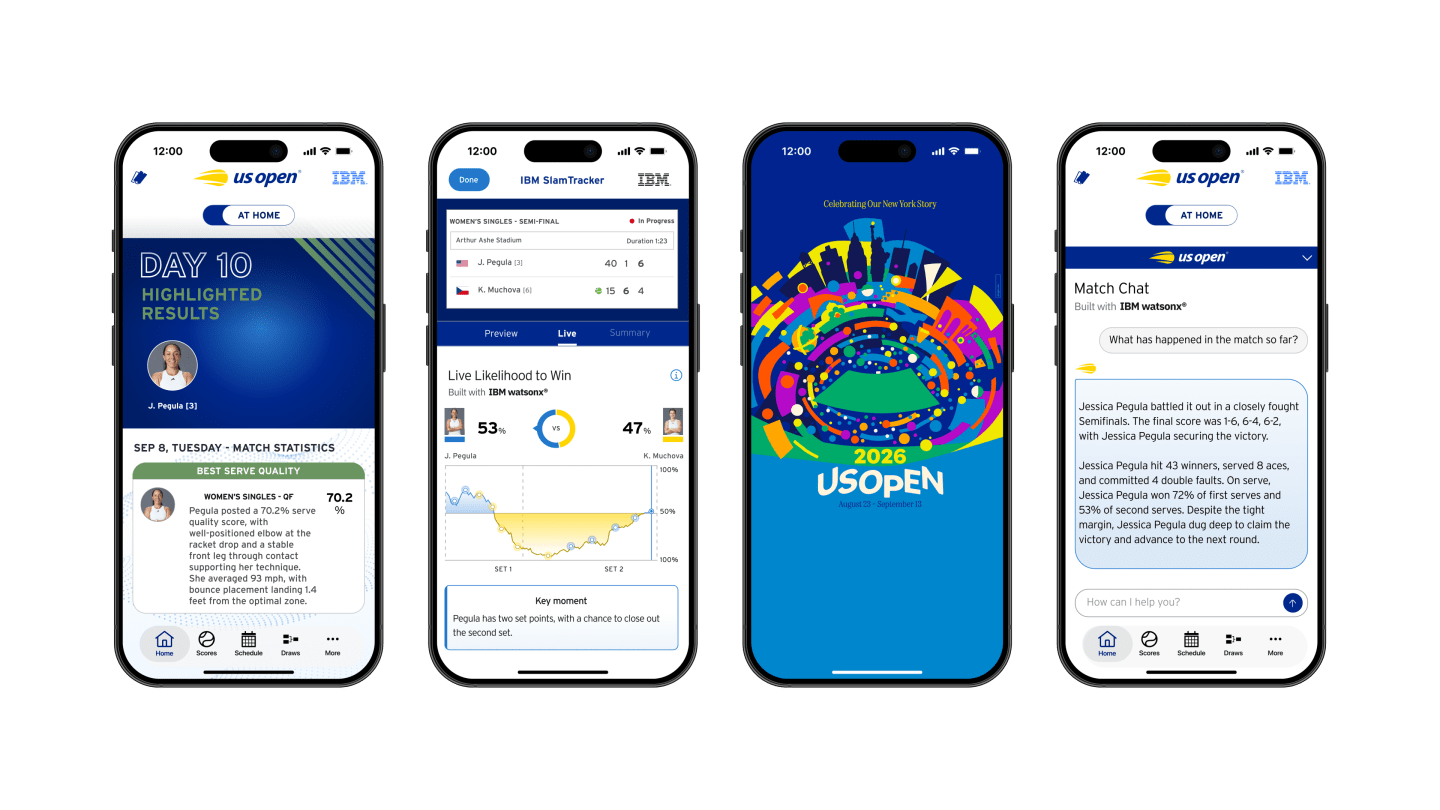
From there, the AI response noted: “Jessica Pegula outperformed Aryna Sabalenka on serve quality, posting a 72.32% serve quality score compared to Aryna Sabalenka’s 71.95%.” Even though Pegula lost the match, her serve quality score was higher, according to IBM’s logic, which includes ball, racquet, and player-movement tracking data.
“Jessica Pegula was sharp with their placement, landing 75.95% of 79 total serves in the box, with an average placement of 1.555 feet away from the optimal serve zone,” it continued.
Serve scores like this are available for every singles match in the tournament – only after completion.
This video from IBM illustrates how the serve quality feature works:
And here’s more on how data is collected and calculated to create each score: “It all starts with the camera,” said Tyler Sidell, the Technology Program Director of Sports & Entertainment Partnerships at IBM, in an interview with Fortune. He explained that 12 cameras are positioned around Arthur Ashe Stadium for the sport’s automatic line-calling system using Hawk-Eye technology. Limb tracking at a tennis tournament started when Hawk-Eye introduced its “SkeleTRACK” product at the 2024 Laver Cup tennis event, though not as an app for fans to see a serve score.
The Hawk-Eye cameras began “to capture the limbs, and so we’re analyzing 21 limbs and joints from every single singles player,” he added, “and then we’re feeding that into our platform that we built. That really helped speed up innovation.”
“We started to train the models on 2025 data to come up with the right algorithm for this. 2026 is the first year that we’re pushing it out into production for fans,” he said.
“There is so much data that now comes out of a tennis match, right?” said Brian Ryerson, the Senior Director for Digital Strategy at the USTA, in an interview with Fortune. “Obviously, skeletal data is fairly new to us at the U.S. Open,” he said. “We’ve had it the last few years, and it’s also a very rich and heavy data set.”
The team challenged themselves to provide a “unique angle” to fans in a digestible format. IBM and the USTA started with the serve because of the shot’s significance. “The serve is the most important stroke of a tennis match,” said Sidell. “So it was already trained on a lot of that data, but our developer actually fed academic papers into it to help … weight the system.
Going forward, Ryerson said success for the serve quality score is determined by two factors: “One is really ensuring that it was understood by fans because it is a pretty technical data set, and we’re trying to distill that down,” he said. “We just wanted to make sure it resonated, and we’re feeling like we hit the mark there pretty well.”
“And then I think what we were really looking for,” he added, “is how it can help enhance our day-over-day storytelling, and really making sure we’re as accurate as possible.”
This may be only the start of limb-tracking tech at major tennis tournaments. Both IBM and USTA executives said other shots, such as forehands and backhands, could eventually be tracked and shared with app users in the coming years.
“There is potential for the future,” said Sidell. “Maybe there’s racket insights that we provide. This is the first year that we’re launching serve quality, but next year when we have serve quality as well, we can start making some comparisons and correlations.”
Ryerson from the USTA agreed. “As more and more of this skeletal data comes in,” he said, “I think it’s going to open up a lot more of these kinds of key insights and things that we haven’t had access to in the past.”
IBM said more tennis tournaments and sports could feature skeletal tracking data shared with app users. “It’s the first foray into it [for IBM], but there’s no reason that we can’t bring it to other sports or even bring it to our other Grand Slams,” said Sidell. “You might see that as production-ready for Wimbledon.”
There’s a future where limb-tracking features are available not only at tennis’ biggest events, but also at golf’s premier tournaments. For example, IBM has a longstanding partnership with The Masters. “If there’s hardware capturing the same limbs and joints of golfers,” he said, “there’s no reason that we can’t bring that to another sport and do stroke quality.”