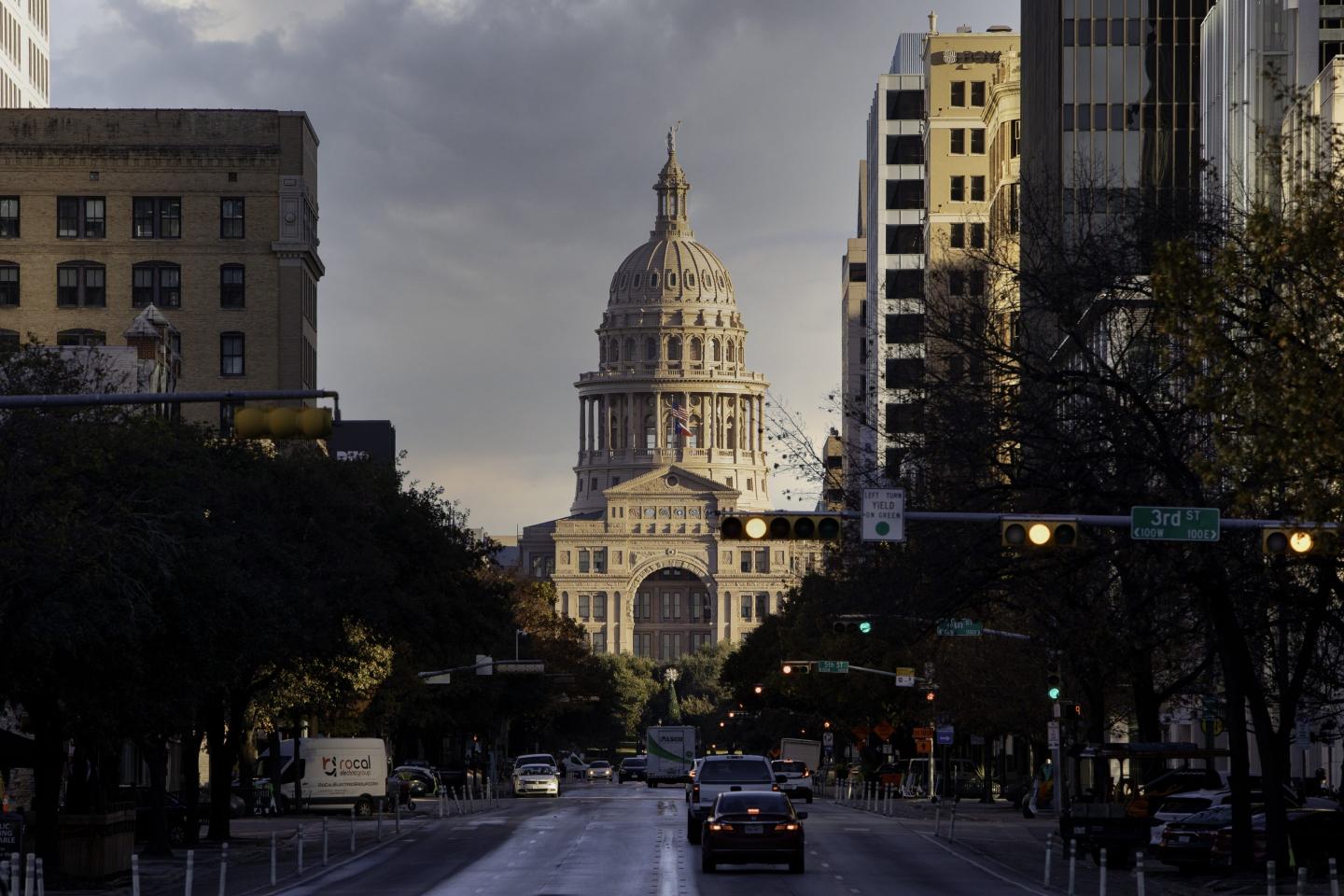
Mathew Davis, who lives in a homeless shelter in Austin, Texas, would love an apartment of his own. But with the little money he makes donating blood plasma, even a $450-a-month tiny home with no running water and a communal bathroom would be a stretch.
Meanwhile, over 4,500 units the city classifies as affordable — nearly 16% — sit empty.
“I don’t make enough money really to afford anything,” Davis, 49, said of the few hundred dollars he earns a month. “I just keep trying to swim uphill.”
The poorest people in the U.S. face the most acute shortages of affordable homes. But the majority of low-income housing financed in recent years is for those earning 50% of an area’s median income or above, according to a survey of state housing agencies.
Some cities are now seeing an uptick in vacancies as rents for these units approach market rates. The result: Apartments designated as affordable sit empty because the poorest of the poor cannot afford them.
Meanwhile, some people are forced into homelessness and others into desperate circumstances to pay for housing they can’t afford.
The poorest have few housing options
There are only about 4 million affordable rental units available for the country’s 11 million extremely low-income renter households, according to the National Low Income Housing Coalition’s most recent annual report.
These are people with annual incomes either below the federal poverty guidelines — just under $16,000 for a single-person household — or 30% of the median income in their area, whichever is higher. They comprise about a quarter of U.S. renter households, and include many people working low-wage jobs, seniors and those with disabilities living on fixed incomes.
About three-quarters of extremely low-income renter households pay over half their income on rent and utilities, the report said, leaving little leftover for other necessities.
Yet homes set aside for these renters were only about 12% of the affordable housing units financed in 2024 by the Low-Income Housing Tax Credit — a federal program providing tax credits to developers in exchange for keeping rents low for at least 30 years, according to figures from the National Council of State Housing Agencies.
The majority are for those earning at least 50% of an area’s median income, or AMI. In Austin, that’s a single person earning roughly $47,000 a year, as compared with an extremely low-income person earning under $28,000.
The program has financed nearly 4 million affordable units nationwide since its creation 40 years ago. But some experts say it’s inefficient — and more costly than housing vouchers.
“It’s enormously complex and bureaucratic, and it raises the cost of construction enormously because the rules are so complicated,” said Chris Edwards, an economist at the Cato Institute, a libertarian think tank, who told Congress the program’s complexity “spawned” an industry of law and accounting firms just to administer it.
“If you’re going to subsidize affordable housing, you should give the money directly to tenants,” he said, referring to housing vouchers.
Other experts say the two programs work together well because properties built with the tax credit are required to accept vouchers — while landlords of market-rate apartments in many states are not.
Still, there’s a major federal funding shortfall: Experts estimate only one-in-four eligible families ever receive vouchers. Vouchers can help the poorest pay for housing that’s targeted to higher income groups, but the waitlist can be yearslong.
Some affordable housing developers say that without vouchers, it’s not economically feasible to provide units for extremely low-income people.
True Ground Housing Partners, an affordable housing developer in the Washington, D.C., area, gives an example: A unit for those earning 60% of the area’s median income — nearly $70,000 a year — brings in $1,715 per month in rent. But after $1,575 in mortgage and operating expenses, only $140 is left.
“The math does not lie,” said president and CEO Carmen Romero, noting that an extremely low-income person would pay only half that rent.
“Our expenses don’t make it really possible to create a 30% AMI unit, unless there was this extraordinary amount of subsidy that just doesn’t exist.”
Affordable housing competes with market-rate rents
Meanwhile, affordable housing rents for 60% AMI units are approaching those of market-rate apartments in U.S. cities like Austin, Denver and Portland, Oregon.
As a result, some people are opting to pay a bit more for market-rate apartments with less income-verification and faster approval — leaving growing numbers of affordable units vacant.
In Austin, the vacancy rate for all affordable housing is nearly 16% with over 4,500 vacant units, according to real estate data and analytics firm CoStar. A healthy vacancy rate is around 5%.
LDG Development, an affordable housing developer, cited a 12% vacancy rate for its 60% AMI units in Austin. Chief portfolio officer Rebekah Fischer said LDG is “in direct competition” with the thousands of new market-rate apartments recently built in Austin.
“I have to have every bank statement, every pay check, every bill, every Venmo transaction that you had with your friends,” Fischer said of affordable housing applicants.
“When we’re almost going after the same renter, you can be approved within two minutes at a market-rate deal, where unfortunately in affordable housing … it takes time.”
In Denver, there’s a 13% vacancy rate among 60% AMI units financed by the federal tax credit program — and a 21% vacancy rate for 80% AMI units, according to the Colorado Housing and Finance Authority. Meanwhile, there is far too little housing for the city’s poorest.
In Portland, where there is also a housing shortage for the lowest income groups, there are over 1,700 vacant affordable units for an overall vacancy rate of 7.5%, according to the Portland Housing Bureau. Most are for those earning 60% AMI, or about $54,000 for a single-person household, with rent capped at $1,444 per month.
That’s close to the average rent of $1,581 for a one-bedroom market-rate apartment, according to CoStar figures shared by the bureau.
Portland resident Jaiden Barbee earns around 55% of the area median income and is on waitlists for affordable housing. But, he says, he’d pay more for a market-rate apartment to avoid the lengthy application process.
“I’d rather spend the $200 extra just to get into a place easier that’s wherever I want” and doesn’t have “all these hoops,” he said.
‘I want to shut the door at night and sleep’
Austin officials set a goal of building 20,000 units between 2018 and 2027 for extremely low-income people — 17% of the city’s households.
Just 543 were built as of 2024, city documents show.
Meanwhile, all 15,000 units planned for those earning between 60% and 80% of area median income were built.
In response to questions from The Associated Press, the Austin housing department said it recognized the need to do more to produce housing for the poorest people and was taking steps to do that, including giving preference to funding proposals that include 30% AMI units.
For Davis, who lived in his car for a year before getting a bed in the Austin shelter, the housing shortage for people like him is frustrating.
“I want to shut the door at night and be able to sleep,” he said. “I really just want to find the right place.”
__
Former AP writer Charlotte Kramon contributed.