
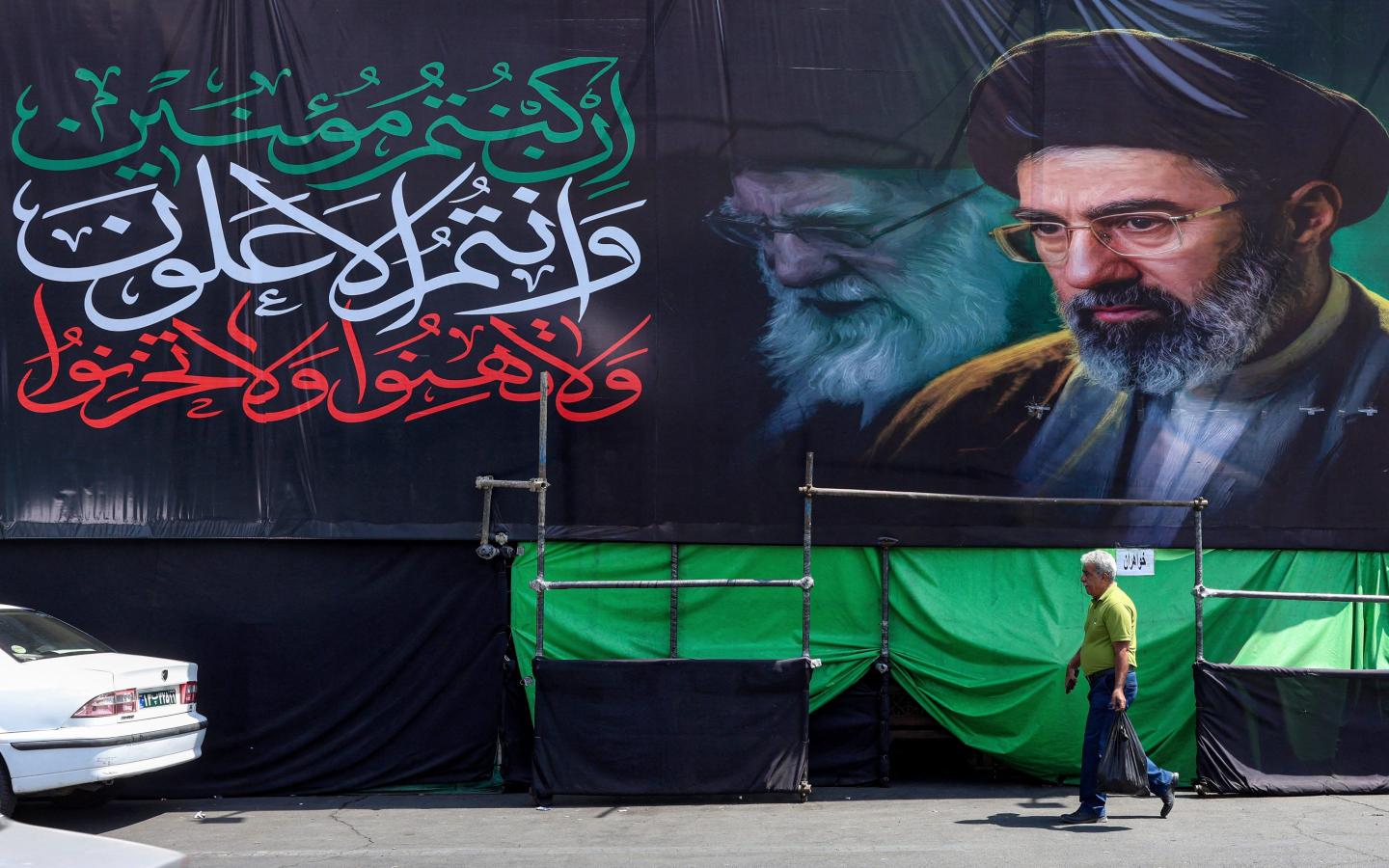
Iran’s regime maintains an iron grip on power but still can’t ignore the impact of U.S. economic warfare, which is getting even tougher.
That extends even to Supreme Leader Ayatollah Mojtaba Khamenei, who hasn’t been seen in public since the U.S.-Israeli strike on Feb. 28 that killed his father.
In a written statement issued late last month, he banned Iranian officials from “committing anything that harms social cohesion” and urged them to avoid any “discouraging statements that weaken national and public motivation,” according to Reuters.
That’s as economic hardship and long lines at gas stations have already stirred some fresh protests, though not at the massive scale that was seen in January.
Still, a currency collapse last year and high inflation triggered widespread unrest, and the regime slaughtered thousands in a brutal crackdown. Since then, the rial has plunged to new lows and economic conditions have worsened due to the U.S. war and naval blockade.
In his statement, Khamenei expressed concern about the economy and called on the government to take action.
“There is the need to seriously address the chain of economic and livelihood challenges, such as inflation, unemployment, management of prices and the market for goods and services,” he said.
Around the same time as the statement, Iranian President Masoud Pezeshkian similarly acknowledged his country’s economic woes.
In an interview with state media, he signaled defiance in the face of all the pressure and credited Iran’s resilience to its unity, but admitted “we have many problems.”
Pezeshkian also estimated that Iranian trade has plunged 25% to 35%, with imports down significantly more than exports, and voiced frustration with attempts to deny the economic impact.
“Some people say that sanctions have no effect at all,” he added. “I really don’t know what to tell these people. I just want to say this: Saying that sanctions have no effect is not consistent with these facts.”
And the U.S. is tightening the screws. Treasury Secretary Scott Bessent announced an “economic D-Day” to shut down avenues that help Iran dodge sanctions, further degrading the regime’s ability to earn money from oil exports and to obtain vital imports.
Senior Iranian sources told Reuters that the U.S. blockade and its crackdown on sanctions evasion are growing increasingly difficult to withstand.
The effort to block Iran from international financing networks in other countries represents an especially urgent threat, the report said.
One senior source added that Iran only has two months’ worth of gasoline supplies, which must be imported due to limited domestic refining capacity.
Meanwhile, Iran’s currency has crashed to 2.2 million rials per U.S. dollar, down from about 1 million a year ago. Inflation has also soared above 80%, with prices for certain food staples up 100%.
To be sure, experts have cautioned that Iran’s repressive regime is unlikely to be swayed by the suffering of ordinary citizens and is prepared to wait out economic hardship longer than the U.S. public can endure high gas prices.
U.S. economic pressure also relies on the Navy’s continued presence to maintain the blockade on Iran and to shepherd oil tankers from Gulf Arab producers through the Strait of Hormuz.
Such an indefinite, expansive mission could strain U.S. military resources and readiness, while Iran only needs to sustain limited strikes on commercial shipping to keep traffic below prewar levels.
In an interview on Fox News Sunday, Energy Secretary Chris Wright said the Navy is getting better at defending against Iranian attacks and has heard from other countries that want to help out.
“But there’s simply no other country on earth that has nearly the military capacity of the United States,” he added. “So in this conflict where it’s still a little bit hot, it’s dominated by the United States right now. The other military assets involved are our friends and allies in the region. But to get those from outside of the region, I hope that’s soon.”