
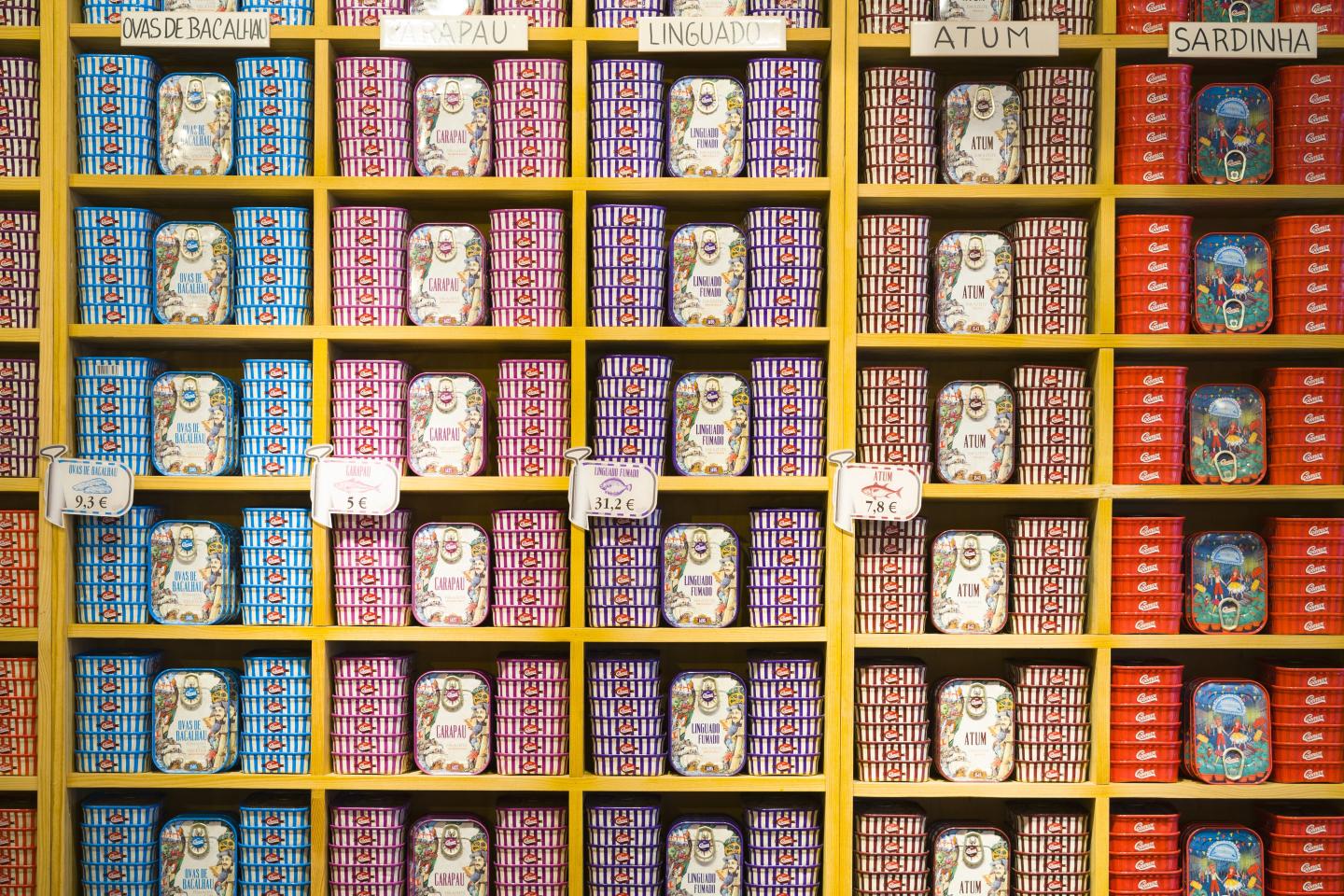
Tinned fish is having a real global moment. The pandemic-era pantry habit has since turned into restaurants nationwide serving tinned fish straight out of the can. Domestically, sales climbed from $2.3 billion in 2018 to more than $2.7 billion in 2024, and Americans’ obsession with sardines specifically is only accelerating: Americans bought $3.52 billion worth of shelf-stable seafood over the past year, and sardines have overtaken salmon as the second-most popular tinned fish behind tuna, as Grubhub reported orders of tinned fish tripled in 2025. The global tinned fish market was worth roughly $10.24 billion in 2024, and is projected to reach $17.97 billion by 2034. Canned sardines are a meaningful part of that worldwide push.
But the supply behind that growing appetite is shrinking fast. Morocco, the world’s top sardine supplier, saw its fish landings fall nearly 46% between 2022 and 2024, and the reasons are feeding into each other. Because sardines are unusually sensitive to temperature, warming water as a result of climate change is pushing the fish into new territories further away from fishermen.
The war in Iran, coupled with the effective shutdown of the Strait of Hormuz (through which one-fifth of the world’s global oil supply normally passes) is driving up fuel costs. Fishermen now need to go further to catch the fish, just as it’s costing them that much more to travel longer distances, and they’re bringing back almost half the quantity as before.
Rashid Sumaila, a professor and Canada Research Chair in interdisciplinary ocean and fisheries economics at the University of British Columbia, has spent his career studying fisheries, and how they navigate geopolitical forces. He said the combination is something he hadn’t seen affect the fishing industry in quite this way before.
“Sardines are very sensitive to climate change, and we know it here on the Pacific coast,” Sumaila told Fortune. “When it’s warm, sardines move from Mexico through the U.S., and Canadians see more sardines. They follow the temperature.”
He said Morocco’s sardines are shifting, too, and he saw the same thing while on a trip to Portugal this summer, when he left his hotel at 2 a.m. for an early flight and the temperature was still 34 degrees Celsius.
“Some of that 45% drop is partly climate change, and partly overfishing, and other things happening to the ocean,” he said. “There’s just so much. You have pollution, plastic. Stresses upon stresses.”
The Iran war adds a second layer. While Iran’s own waters are not a major sardine source, Sumaila said the war still reaches Moroccan boats through the price of fuel.
“The Iran war doesn’t quite impact this directly,” he said, “but indirectly it does, because prices are going up. The price of fishing, the vessels, the energy. It’s crazy.”
Since the conflict began, Brent crude surged 10% to 13% after the Strait of Hormuz effectively closed to shipping this spring, an event the International Energy Agency called the largest oil-supply disruption in the market’s history. Sumaila said he heard the same complaint from fishermen thousands of miles from the Persian Gulf.
“Thai fishers are feeling it,” he said. “You can imagine Moroccan fishers, or fishers in Africa or the Pacific Islands, feeling it too.”
A global supply food chain risk
Warmer water and higher fuel costs interact in a specific way for Moroccan boats, Sumaila said, because the two pressures compound each other. As sardines shift toward cooler water further from shore, fishermen who once worked familiar nearby routes now have to travel farther to find them, exactly as fuel becomes more expensive and the yield becomes less guaranteed.
“It’s more risky,” he said. “Insurance payments, security for people. The combination is really quite scary.”
“It’s the whole region. If the fish are moving up, that’s what we face,” he continued. “It’s like we’re facing a double whammy.”
The same pressures are also reshaping how Morocco sells what it does catch. Frozen sardine exports have fallen from about 70% of the country’s small open-sea fish exports in 2020 to roughly 23% in 2025, even before the war began.
“Climate change is a factor,” he said. “The war is going to affect it too, because all the freezing is energy, and energy prices are going up while the sources are being reduced.”
This all means we’ll be paying more to eat less, he said of his research of Canadian consumers’ grocery spending on seafood.
“This isn’t only the fish we catch in Canada,” he added. “It’s fish coming from all over the world. All of it gets affected. The price dynamics show up in people’s household budgets.”
He said affordability pressure isn’t limited to lower-income countries, even if it hits hardest there: “It’s not only in the developing world. We all feel it. I don’t go to any meeting these days where somebody isn’t talking about the cost of groceries.”
A fish called subsidies
Government fuel subsidies make the underlying problem worse, even if not all subsidies are bad. Public spending on fish stock research and fisheries management is useful, but paying for fuel is a different story.
“If you pay for fuel, that just makes people fish more than they would,” he said. His team’s most recently published estimate puts global fisheries subsidies at $35.4 billion in 2018, with $22.2 billion of that classified as capacity-enhancing subsidies that fuel overfishing, which shrinks fish populations further and forces boats to travel even farther for a shrinking catch.
Sumaila has a running joke about it, borrowed from an old British comedy about a heist gone wrong. “A fish called subsidies,” he said, referencing “A Fish Called Wanda.” “A third of your fish is actually subsidized and illegally caught.”
Outside of Morocco, both Portugal and Spain are trying to mitigate this as well. Portugal’s 2026 sardine season reopened in May with a national catch limit of 33,446 tonnes, nearly 1,000 tonnes fewer than the year before. Portugal closed its purse-seine sardine fishery for the final weeks of 2025 after its fleet worked through roughly two-thirds of the combined Portugal-Spain quota. Spain’s own 2026 quota came in nearly 3% lower than the prior year, yet the fishery still fetched stronger prices, with sardines selling for an average of 1.50 euros a kilogram, 50 cents above 2024 levels.
To combat the less fish but sold for more money scenario playing out in Spain, Morocco put an export ban on frozen sardines, meant to protect domestic supply and stabilize prices at home. Sumailia had little hope in this working, basing his prediction on the ongoing trade fights between the U.S. and Canada.
“When you ban fish, maybe in the short term you have some relief,” he said. “But that triggers a lot of other things you might not even perceive when you do it. You get a counter reaction, and a counter reaction to that.”
Most of all, he said, sardines are one of the primary food sources for lower-income individuals.
“When you shut off these consequences, you’re affecting small-scale people,” he said, referencing the emigration of fishermen from Morocco to Portugal. “People move. And then you have immigration. Where is this coming from? It’s coming from things like the war in Iran, too.”