
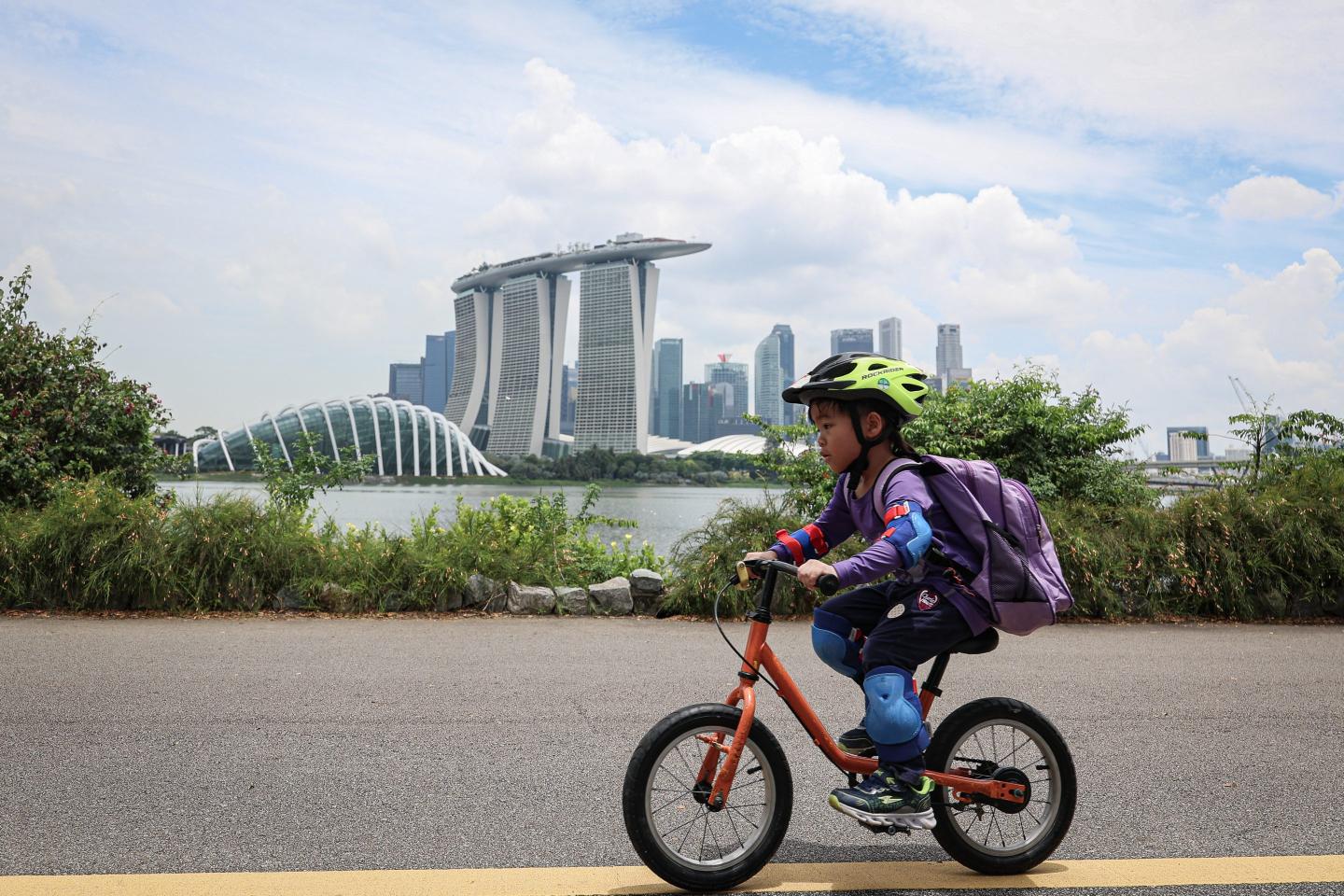
Singapore is overhauling its landmark baby bonus scheme, first introduced in 2001, as the city’s fertility rate and number of births fall to record lows.
In 2025, births in the Southeast Asian country fell below 30,000 for the first time in its post-independence history, while the fertility rate dropped to just 0.87 per woman, a record low. That’s a dangerous prospect for any country, but especially for Singapore, crammed into a space smaller than New York City.
“The country does not have the natural resources to finance the costs of supporting an aged society, including both care and medical expenditures,” Tan Poh Lin, a senior research fellow at the National University of Singapore (NUS)’s Institute for Policy Studies explains. Immigration, in his view, won’t be enough to solve the problem: “Boosting the fertility rate is crucial to slow down the rate of change and allow society to adjust economically as well as institutionally.”
At the country’s National Day Rally on Aug. 23, Prime Minister Lawrence Wong unveiled the “SG Child Support Package,” boasting measures like expanded childcare leave, strong financial support for parents, more affordable caregiving options, and extra chances to get subsidized housing. In total, the support is equal to almost 70,000 Singapore dollars ($55,000) by the time a child is 17.
Demographic experts are cautiously optimistic about the new scheme, which appears to offer more sustained and holistic support for families.
“Singapore’s family policies had become increasingly complicated, with benefits varying by birth order and across different schemes,” says Bussarawan Teerawichitchainan, a social demographer and sociologist from NUS. With the new package, “support is attached more clearly to each child and is provided over a longer period of childhood rather than being concentrated primarily around birth.”
But previous policies to give parents more money, both in Singapore and elsewhere in Asia, haven’t been able to reverse falling birth rates.
“Singapore has progressively expanded financial support for marriage and parenthood over many years, yet fertility has continued to decline,” Teerawichitchainan admits. “Concerns voiced by parents increasingly involve not just money but time, work-family pressures, childcare, housing and other demands associated with raising children.”
Economic impact of low birth rates
Persistently low birth rates could threaten a country’s ability to sustain its economy. “Smaller younger cohorts enter the workforce while the older population continues to grow…over time, that places greater pressure on labor supply and the tax base,” says Chua Yeow Hwee, an economist at Singapore’s Nanyang Technological University (NTU). “For businesses, an aging and shrinking workforce also makes labor constraints more acute.”
Singapore has long turned to foreign workers to make up for a dwindling domestic workforce. As of 2025, Singapore is home to nearly 1.6 million foreign workers, making up 40% of the country’s total labor force, the highest in Asia outside of countries in the Middle East, according to the Migration Policy Institute, a U.S. think tank.
The country is also placing its hopes on automation, with the government committing 1 billion Singapore dollars ($787 million) to public AI research from 2026 to 2030.
“The relationship between demography and economic growth is complicated,” Teerawichitchainan explains. “Economies can adapt through productivity growth, technology, longer and healthier working lives, higher labor force participation and immigration.”
The role of companies
Singapore’s new scheme shifts from merely encouraging births to focus on family well-being over the long term, which might help change how potential parents think about children.
“Cash gifts have a positive impact on births, but the effect tends to be short-lived as many beneficiaries do not increase their final family size,” Tan of NUS explains. “Tangible change can only be achieved by adjusting parenting expectations, including the notion that parenthood involves sacrificing personal wellbeing.”
Some of the responsibility for changing these expectations lies with companies. “There is a limit to what government policy can do directly, and employers have an important role,” Chua says. “A generous leave entitlement has less value if employees believe that using it will make them appear less committed or affect their advancement.” (Singaporeans get 16 weeks of paid maternity leave and four weeks of paternity leave, as well as 10 weeks of parental leave, shared between both parents, that must be used within a year of birth).
But there may be little anyone–government or corporate–can do to persuade people to have children amid greater economic uncertainty.
“These days, folks will have children only if they are confident that they could ease their children’s journey ahead and help them access a good life in the future,” says Tan Ern Ser, an adjunct principal research fellow at Singapore’s Lee Kuan Yew School of Public Policy. “Unfortunately, the world we live in today does not leave much room for optimism, notwithstanding the government’s relentless efforts.”
Singapore’s government, too, acknowledges that there are limits to its ability to influence its populace to have kids. “The decision to have children is a deeply personal one. Policies alone cannot make this happen,” Wong, Singapore’s Prime Minister, said during his speech. “But what we can do is make it easier for Singaporeans who want children to start and raise a family.”
Ultimately, Singapore may just need to accept that it’ll have to live with fewer people.
“The economic challenge is not simply to restore some particular fertility level,” Teerawichitchainan concludes. “It is also to build institutions, labor markets, and technologies that allow Singapore to prosper under a demographic reality that may remain one of low fertility and population aging.”