
As the U.S. paves the way for a nuclear renaissance to power the AI data center boom, the next frontier is building small nuclear reactors offshore to power coastal facilities and merchant ships.
Strangely, the momentum could begin in California, a state that banned building new nuclear plants 50 years ago. This summer, the Port of Long Beach signed an agreement with the Trump administration to develop next-generation small modular reactors (SMRs) that could power ports, data centers, and vessels with emission-free energy.
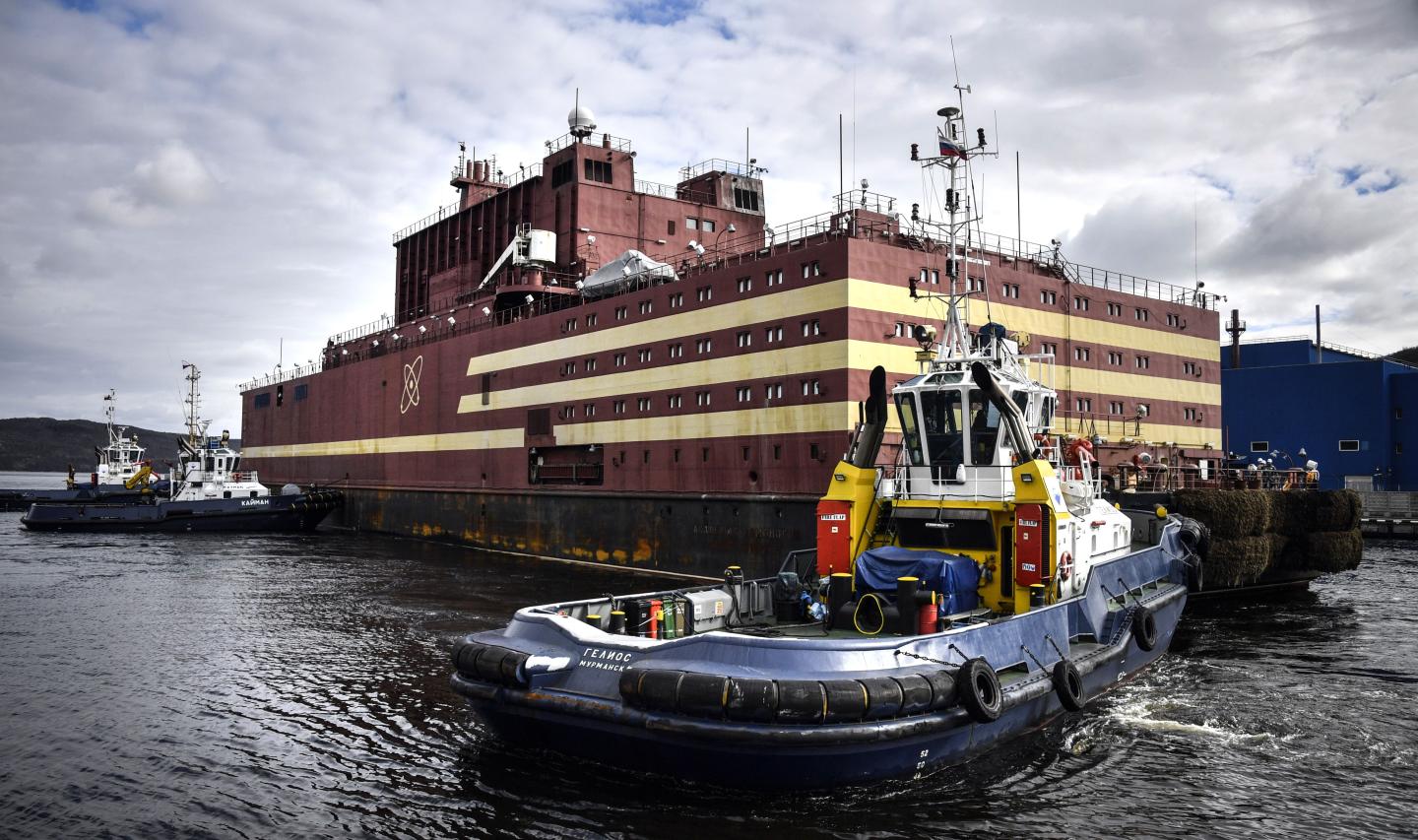
Offshore nuclear power sounds unusual, but naval submarines and aircraft carriers have run on small nuclear reactors for decades. In 2020, Russia put the world’s first floating nuclear power station on a barge into service, powering the remote Arctic town of Pevek—population 4,000—and its harbor.
Long Beach and Los Angeles are a different scale entirely. The two ports adjoin one another and together form the largest container port complex in the Western Hemisphere. The Port of Long Beach is now working with local startup Bluecore Energy to build SMRs on floating barges—though the project remains at least a few years from reality.
“I think it’s very viable. It’s just a question of when, not if,” said Max Hopkins, a nuclear power analyst at CITIC CLSA, speaking about the growth of offshore nuclear power broadly—not California specifically—across military, maritime shipping, and AI data center applications.
“To put something into place fast, with production means, and then you can just float it somewhere—it seems like offshore barges are going to be almost ideal,” Hopkins told Fortune. “I think it’s going to become pretty accepted, much more so than people realize.”
Still, Hopkins emphasized the technology is years from commercial deployment. Regulatory frameworks need to be built, and so do the supply chains and manufacturing systems.
The progress isn’t confined to Long Beach. Denmark-based Saltfoss Energy is developing similar nuclear reactor barges in Europe.
Nuclear’s maritime moment
The future of powering military warfare and maritime merchant shipping could be nuclear, Hopkins said. Maritime vessels account for about 3% of global greenhouse gas (GHG) emissions, which may not sound like much, but it’s roughly equivalent to the total GHG emissions of all of Africa.
The federal push is accelerating on multiple fronts. This week, the U.S. Department of Transportation’s Maritime Administration (MARAD) announced a partnership with London-based Core Power to develop the regulatory frameworks and technology for a future fleet of nuclear-powered merchant cargo vessels.
A day later, the U.S. and the International Atomic Energy Agency (IAEA) launched the Atomic Technologies Licensed for Applications at Sea (ATLAS) initiative. The effort is designed to advance SMR and micro-reactor technologies for merchant shipping “underpinned by the highest levels of nuclear safety, security, and nonproliferation,” the IAEA said.
The appeal is speed and endurance: Nuclear-powered ships need to refuel only every two or three years instead of every voyage, cutting fossil fuel use and enabling faster transit. “At the same time, innovations such as floating nuclear power plants provide versatile energy sources that could deliver reliable electricity to coastal or remote communities and industry,” the IAEA said in a statement.
A nuclear California?
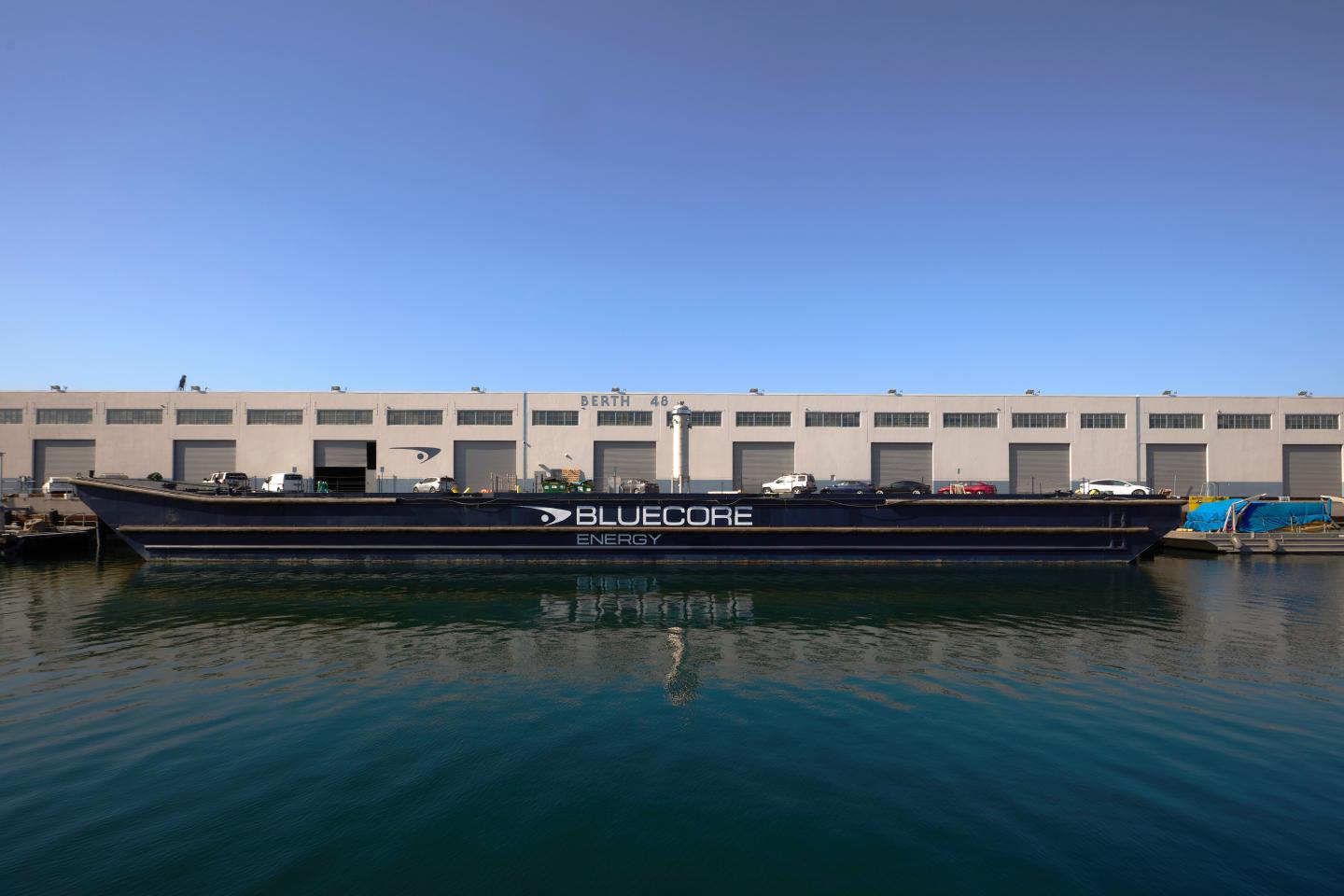
Long Beach–based Bluecore was founded only in January. It raised $10 million in a pre-seed round and quickly became the first nuclear company to partner with MARAD on offshore reactors.
Founder and CEO Kofi Asante, 31, is a Ghanaian-American from Austin who quickly became a Silicon Valley veteran before relocating to Southern California. He built his logistics and maritime-shipping expertise at Uber Freight, heavy-cargo drone company Elroy Air, and electric barge startup Arc—before starting Bluecore.
His goal: use the maritime industry to provide clean, consistent power for ports and AI data centers.
“The philosophy was really process of elimination: If you need that much energy, then you arrive at a nuclear reactor,” Asante told Fortune. “And if you need real estate, two-thirds of the world is water, so you can use barges for extra real estate.
“We can go miles away and connect via subsea cable—so we don’t have to be near neighborhoods, and we don’t have to be co-located at the port,” he added.
All of this requires technology that’s already largely developed, Asante argued, including smaller versions of traditional light-water nuclear reactors. Each 10-megawatt reactor on a barge can power the equivalent of about 10,000 homes, can be moved via tugboats, and can be stacked alongside each other for extra power generation.
Asante recognizes he’s pursuing this technology in a state that banned the development of new nuclear reactors in 1976, citing environmental and safety concerns, including still-unsolved issues with radioactive waste.
The Port of Long Beach knows this is a lengthy process. Port CEO Noel Hacegaba noted that state lawmakers are already debating legislation to study lifting the ban.
“Nuclear is having a moment at the Port of Long Beach, and we are engaged with the private sector, along with state and federal legislators on this issue,” Hacegaba said in an emailed statement to Fortune.
“This innovation is years away from becoming a reality due to the technological advancements and regulatory hurdles that still need to be cleared, and it cannot advance without state and federal approvals,” he added. “In the meantime, our new partners at Bluecore Energy are following state and federal laws as they provide the private-sector experience to research and develop SMR technology.”
Can it be safe—and affordable?
Two big questions loom over offshore nuclear: safety, and whether it can compete economically with natural gas and solar power.
Asante draws a manufacturing analogy—with some exaggeration—arguing that previous nuclear power plants were built bespoke, akin to constructing an entire factory to produce a single car.
“Small modular reactors like ours, you build multiple of them, so it starts to look like a factory,” he said. “Some of our team came from Rivian and Toyota, and we’re looking at it like a production facility.”
The analyst Hopkins backs up the point from a different angle: “A jet engine is actually much more complicated to build than a nuclear reactor from a materials science perspective.”
But what happens in the event of a tsunami or a major weather event? Hopkins said modern safety design wraps uranium fuel pellets in multiple layers of heavy-duty ceramics and graphite casing, and they’re rendered inert when separated.
Asante offers his own case: “Our floating nuclear power plants are mobile. In the event of severe weather, they can quickly be repositioned. They are also shielded so that they can withstand extreme weather and be underwater. And we have multiple control mechanisms that will automatically turn the reactor off if needed.”
Being on the water is an advantage, he argued. “Water is the cooling mechanism and safest place for our systems, and we have an unlimited amount of access.”