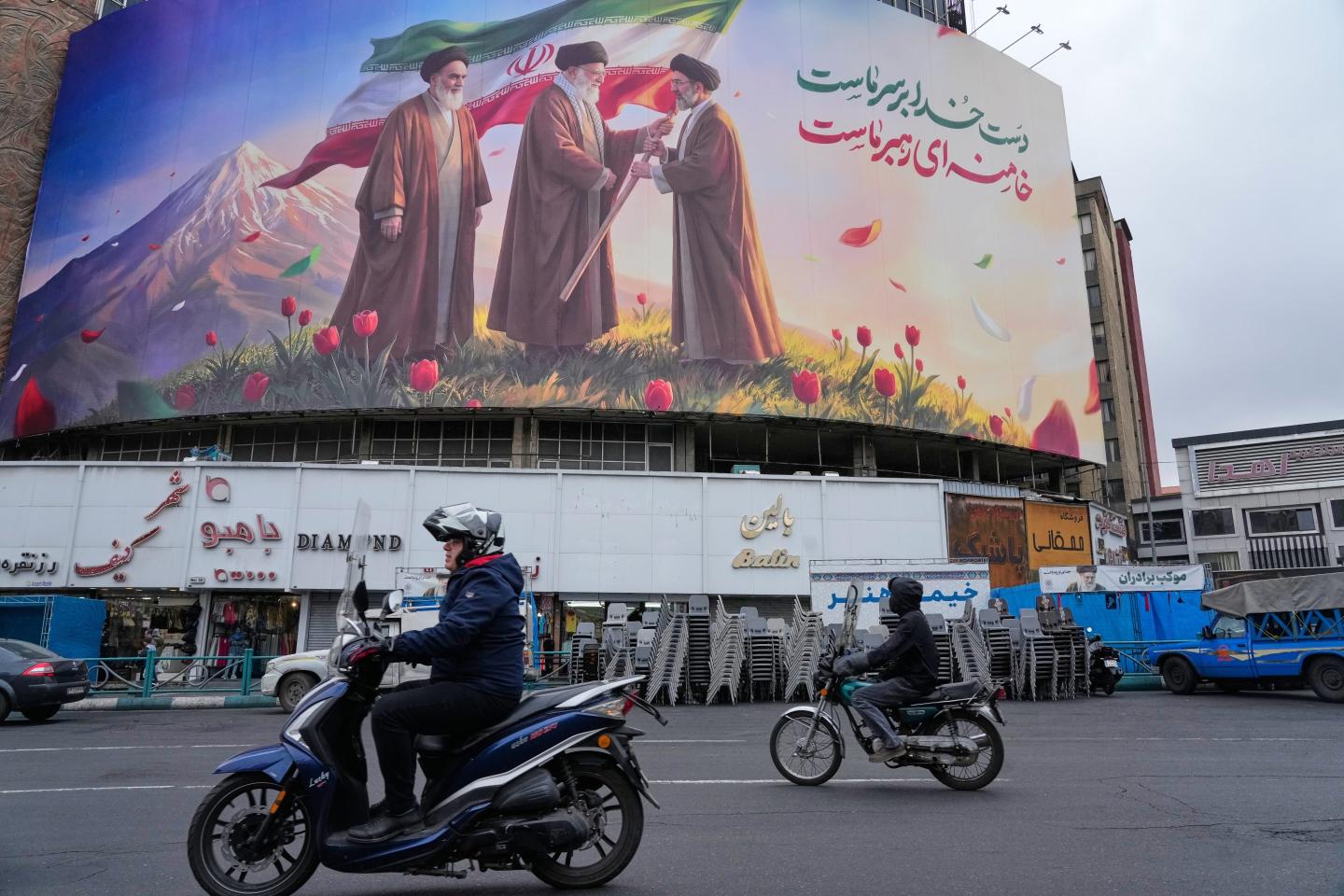
After six months of war, Iran’s leadership has coalesced around a hard core of military generals and clerics long entrenched in the ruling theocracy. They are ready for a potentially long confrontation with the U.S. and determined to prevent any unrest at home.
It’s a far cry from U.S. President Donald Trump’s initial hopes of toppling the Islamic Republic and his subsequent claims that “regime change” had brought more compromising officials to the fore.
Iran’s new leaders evince little faith in any agreement with Trump — after coming under attack twice while holding talks — and they may be bracing for another assault once the U.S. replenishes its supplies of interceptors. They have also threatened to escalate the war as a continuing American blockade and Trump’s plans for new sanctions threaten to suffocate Iran’s already worsening economy.
“If (Trump) wants to do something, we will retaliate in a seismic manner,” the new secretary of Iran’s Supreme National Security Council, Mohsen Rezaei, said last weekend. In a post on X, he said that “if the economic war continues, not a single drop of oil will be exported” from the Persian Gulf.
Iran is determined to smother any internal unrest
Rezaei’s appointment came in a recent set of decrees by the supreme leader, Ayatollah Mojtaba Khamenei, that formally set Iran’s new senior leadership, including top military posts. Khamenei’s father and much of the highest echelons were killed in the bombing campaign launched by the U.S. and Israel on Feb. 28.
Perhaps most telling was the newly named head of the Basij, the Revolutionary Guard’s volunteer street force, which played a major role in crushing January’s nationwide protests, when thousands were killed. That post went to Hossein Taeb, a hard-line cleric and longtime intelligence chief who led one of the first major crackdowns on protests, in 2009.
His appointment is seen as a sign that the leadership is intent on preventing any new unrest as discontent over the economy spreads.
The 56-year-old Khamenei has not been seen in public, or even appeared in video or audio, since Israeli strikes killed his father, Ayatollah Ali Khamenei, who had been Iran’s supreme leader for some 37 years. The younger Khamenei is believed to have been wounded in the strikes. His public absence could reflect the depth of security surrounding him, since he is likely in Israel’s sights, or the extent of his wounds.
The supreme leader surrounds himself with hard-line allies
With the appointments announced Aug. 11 and 12, he has surrounded himself with longtime personal allies, like Rezaei and Taeb.
They are “a clique of older senior officers who’ve served together over the last decades,” said Sascha Bruchmann, an analyst with the International Institute for Strategic Studies’ Middle East office in Bahrain.
Rezaei, 71, led the paramilitary Revolutionary Guard during its formative years, through the entire 1980-1988 war with Iraq and until 1997. He has run for president as a hard-line candidate multiple times since 2009.
Brig. Gen. Ahmad Vahidi, 68, was confirmed as head of the Guard, where he has been acting commander since his predecessor was killed along with the elder Khamenei. Also confirmed in their posts were the acting commander of the Guard’s naval forces, Gen. Ali Ozmaei, and the military chief of staff, Gen. Ali Abdollahi.
Bruchmann, who pointed out that Rezaei was Vahidi’s commander for many years, said the emphasis appears to be on ensuring unity. “It looks like internal cohesion, as in hard core people are being pulled into the inner circle,” he said.
Moderates urge restraint over economic concerns
Homayoun Falakshahi, the top oil analyst for the global commerce information firm Kpler, wrote that the appointments of Rezaei and Vahidi show “greater influence for officials associated with a tougher stance.”
Still, escalation is not inevitable, and Iran could find it difficult to “escalate enough to restore deterrence without triggering retaliation that leaves it worse off,” he said.
A ceasefire deal reached in June quickly fell apart amid exchanges of strikes. Iran has demanded the release of billions in frozen assets as called for under the deal — as well as formal authority over the Strait of Hormuz.
President Masoud Pezeshkian is one of the most prominent voices still calling for a negotiated solution. His allies argue Iran risks overplaying its hand by continuing the war as its economy suffers.
“It would be better to bring the war to an end, since today we enjoy power and dignity and the entire world approved our victory, and the U.S. is hated,” Pezeshkian said last week. He has also defended the June ceasefire deal against hard-liners’ accusations that it conceded too much.
In contrast to ultra-hard-liners who reject any talks, Rezaei has held out the possibility of a deal — if the U.S. backs down. On Monday, he told Pakistani mediator Gen. Asim Munir that the U.S. should “change its attitude and take practical action about implementing the conditions” of the ceasefire deal.
Tehran-based political analyst Ahmad Zeidabadi said there are “serious differences over the future path of the country.”
Hard-liners oppose normalization with the U.S. because “their survival depends on the existence of conflict and hostility,” he wrote in the newspaper Hammihan, which backs Pezeshkian.
Amid worries over unrest, a strong figure leads the Basij
So far there has been no sign of new protests even as Iranians find it harder to afford basic staples.
Taeb’s appointment as head of the Basij is a sign the leadership wants to preempt any potential unrest “before it even manifests,” Bruchmann said. “Putting someone from an intelligence background in charge of the people that would do the crackdown makes sense,” he said.
Taeb, a 63-year-old cleric, led the Basij when it played a key role in crushing mass protests that erupted against the 2009 reelection of hard-line President Mahmoud Ahmadinejad. Dozens were killed.
Soon after, Taeb was named chief of the Guard’s intelligence apparatus. He led the agency for nearly 13 years until he was removed in 2022, reportedly in a shake-up after Israeli espionage successes.
The Basij run a nationwide network of volunteers who maintain a presence in the streets, government offices and cultural centers, seeking to ensure loyalty and ideological purity for Iran’s theocracy.
In the decree appointing Taeb, Khamenei ordered him to deepen the Basij presence in Iranian social life, use new technologies and “promote the Basij across the world against Zionist-American arrogance” — suggesting the group may begin to form links with Iran’s proxies abroad.
The Basij boosted its presence during the war, and hard-liners have held nightly rallies in Tehran and other cities, drumming up support and intimidating any possible dissenters. It’s unclear specifically how Taeb will step up the force’s role, but in a recent speech he seemed to point to increasing control over society.
He warned that U.S. pressure on the economy aimed to create divisions within Iran. “If the mosque becomes the center of the neighborhood, the nation will protect its unity, which will be a greater deterrent than any missile.”